Archive for the ‘CDM’ Category

Expectations for COP 18 in Doha

This week sees the start of the 18th Conference of the Parties of the UNFCCC, or COP18 for short, in Doha, Qatar. This should be a busy transitional COP, with much on the agenda to resolve and important steps forward being taken toward a long term international agreement. But procedural issues, agenda disagreements and fundamental sticking points could still dominate, leading to a two week impasse. Let’s hope not.

At the core of the process lie three work streams which have evolved over many years.

The oldest of these is the discussion on the Kyoto Protocol (KP), which has now been running in one form or another for most of the twenty year history of the UNFCCC. Discussion on a second commitment period (KP2) over the past years have embodied the toughest issues in the climate negotiations, such as the role of developing countries in reducing emissions, engagement with North America (neither Canada or the United States will participate going forward) and the need to put a robust price on CO2 emissions. I am a big fan of KP, despite its shortcomings. It was designed with carbon pricing as its central theme, allowed countries to trade to find lowest cost abatement pathways and through its architecture encouraged signatories to implement cap-and-trade based policy frameworks within their respective economies. The simple but clever ideas within it have not been matched since in terms of effectiveness and efficiency despite years of negotiations. Given sufficient willingness, there are clearly routes forward by which KP could evolve to become the much sought after “21st Century global agreement”, but instead it is reaching the end of its shelf life. There seems to be no resolution with North America under this banner, developing countries appear reluctant to let it be the approach to govern their much needed actions and even the country of its namesake city is unwilling to sign again on the dotted line. Australia and the EU remain as the KP bedrock, if for no other reason than to rescue the CDM and consummate their carbon market linkage with a common approach to accounting, offsets and single market currency (AAUs and CERs). The parties do need to agree on KP2, despite the lack of critical mass, and then roll forward its inherent carbon market architecture into the new grand design.

Next comes the discussion on long term cooperative action, or LCA, a workstream which appeared in 2007 at the Bali COP and is home to a broad range of developments from the Green Climate Fund (GCF), the Nationally Appropriate Mitigation Action (NAMA), the much discussed New Market Mechanism (NMM) and more recently the Framework for Various Approaches (FVA). It was meant to deliver the grand deal at Copenhagen in 2009 but didn’t and now labours on with many loose ends and partially thought through ideas which have not been implemented or even fully negotiated. Nevertheless it has been a useful testing ground for new thinking, but has not yet delivered any real mitigation action. It needs to stop now, but difficult issues remain such as the funding of the Green Climate Fund and the modalities for actually spending any money that may arrive in its coffers. These spinoffs from the LCA will need to continue under one of the Subsidiary Bodies or within the ADP (see below) discussions, but the parent discussion should be put to rest in Doha.

Now comes “the new hope”, the Durban Platform for Enhanced Action. For some, the parties at COP17 simply kicked the can 9 years down the road knowing that little new progress would be made, but for many this represents a much needed and major reboot of the process after years of making almost no progress at all on the respective roles of developed, emerging and developing economies. As Harvard’s Rob Stavins noted in his blog of January 2012;

Now, the COP-17 decision for “Enhanced Action” completely eliminates the Annex I/non-Annex I (or industrialized/developing country) distinction.  It focuses instead on the (admittedly non-binding) pledge to create a system of greenhouse gas reductions including all Parties (that is, all key countries) by 2015 that will come into force (after ratification) by 2020.  Nowhere in the text of the decision will one find phrases such as “Annex I,” “common but differentiated responsibilities,” or “distributional equity,” which have – in recent years – become code words for targets for the richest countries and a blank check for all others.

We should not over-estimate the importance of a “non-binding agreement to reach a future agreement,” but this is a real departure from the past, and marks a significant advance along the treacherous, uphill path of climate negotiations.

Although there have been some opening salvos fired in the ADP (Ad-Hoc Working Group on the Durban Platform for Enhanced Action) in various inter-sessional meetings this year, the heavy lifting for this work stream needs to start at COP18. In recent months the IEA, the World Bank, PWC and others have all made it abundantly clear that unless some truly meaningful progress is made in the sort term, the 2 deg.C goal will pass us by (it may already have) and that before we know it we will be looking at a 4 deg.C outcome, along with all its consequences. Even the timetable for the ADP, which seeks to reach agreement by 2015 for implementation in 2020 is problematic in terms of the need for immediate action, but it is what it is.

The ADP needs to define a work programme that embraces the five primary strands of action coming out of the KP and LCA, namely;

  • National action defined through specific targets, goals and actions, but aligned with the overarching mitigation objective. This would also include REDD.
  • An underlying carbon market infrastructure as currently embodied by the KP but adapted to the applicable framework for mitigation action. Without an evolving price on carbon in the international energy markets, mitigation action will stall. This work stream should also pick up the NMM discussion.
  • A funding mechanism that can leverage private sector finance for kickstarting technologies and helping less developed economies invest in a low carbon pathway forward. This is the GCF.
  • A continuation of the work of the TEC and CTCN to share knowledge and best practice arising from technology implementation.
  • A robust approach to adaptation.

Recently the World Business Council for Sustainable Development resurfaced work that it undertook back at the start of the LCA, but which is highly relevant to the first of the two prospective work areas above. “Establishing a Global Carbon Market” looks at how the substance of the KP carbon market can be applied much more broadly to an evolving world of various approaches.

The above represents a tall order for two weeks work, but with some 10,000 people in tow there is certainly enough labour at hand to get this heavy lifting done. A refined single track approach will bring much needed focus back to the discussions which then paves the way for at least some hope that the 2015 goal for a new agreement can be met. In summary, the big asks for this COP are:

  1. Agreeing a continuation of the Kyoto Protocol through to 2020 and then politely ushering this Grand Dame of the UNFCCC off the stage with some reverence and applause.
  2. Bringing closure to the LCA work programme and shifting some key components (e.g. GCF, TEC) into the formulation of the ADP.
  3. Establishing a clear work programme for the ADP, which incorporates as a priority, the foundations for a continuing and evolving global carbon market.

Good luck and success to all the delegates.

In search of a new home for CERs

Two recent publications highlight the challenges ahead in the multilateral process that continues to seek an equitable global approach to the issue of growing CO2 emissions. But comparing and contrasting them illustrates the contradictions that exist as negotiators attempt to maintain existing structures and work within the spirit of the Durban agreements.

Two weeks ago, a major report issued by the High Level Panel on the CDM Policy Dialogue recommended a very broad range of actions for stabilizing and reversing the ongoing price collapse in the CER market (Certified Emission Reduction, the carbon unit within the CDM), with a view of re-establishing the CDM as the cornerstone of the global carbon market and thereby kicking off a further round of emissions mitigation action.

This week, the Harvard Project on Climate Agreements issued a policy brief  which outlines the shape of the new paradigm that the UNFCCC process has hopefully entered following the creation of the Durban Platform for Enhanced Action at COP 17 last December. Their ambitious interpretation of the agreement sees the Berlin Mandate effectively consigned to history (which enshrined the notion that emission reduction was effectively the responsibility of developed countries and which led to the 95-0 vote on the Byrd-Hagel Resolution in the United States Senate) and a new order emerging which results in all countries acting to manage emissions. There is no doubt that the latter interpretation is the only one that makes sense, but only time will tell if this represents the new reality. The Harvard think piece ends with the challenge;

Having broken the old mold, a new one must be formed. A mandate for change exists. Governments around the world now need fresh, outside-of-the-box ideas, and they need those ideas over the next two to three years. This is a time for fundamentally new proposals for future international climate-policy architecture, not for incremental adjustments to the old pathway.  We trust that this call will be heard by a diverse set of universities, think tanks, and advocacy and interest groups around the world.

Rescuing the CDM as recommended by the Policy Dialogue is a laudable ambition, but perhaps falls into the category of “incremental adjustments to the old pathway” rather than “outside of the box ideas”. Conversely, the Policy Dialogue proposal is attempting to stave off the collapse of the very idea of “carbon markets” by rescuing the one global example of their application. While “out of the box” thinking is certainly welcome, it is also hard to argue that we are done with carbon pricing/markets and now need something new. In fact, carbon pricing remains core to the solution.

As such, we end up with the dichotomy of needing new ideas but not wanting to see the structures of the past slip through our fingers; but should we mind that they institutionalize some of the ideas within the Berlin Mandate?

The CDM was a bold idea when conceptualized in the Kyoto Protocol, starting with the simple phrase;

A clean development mechanism is hereby defined.

But has it reached its use-by date and should it be consigned to the dustbin along with the Berlin Mandate? Unfortunately the answer is both “yes” and “no”. It does represent an era of action and financing being the responsibility of developed countries only, which is no longer a tenable paradigm within which to operate. It was designed to help developed countries meet their mitigation goals and to channel funding from developed to developing countries for the purpose of sustainable development. Yet it did demonstrate a mechanism which allowed a broader range of actors to get involved in the carbon market than those immediately impacted by the cap on allowances. This has become a design feature of more recent cap-and -trade systems, albeit with home grown offset systems.

The solution for the CDM, both to rescue the market today and to prepare it for the “out of the box” solution of tomorrow, must be to disentangle it from the Kyoto Protocol and make it available as a general offset resource under the UNFCCC, perhaps even one that any nation could use when it wants to involve part of its economy in the market without actually applying a cap to it (such as the farming sector in Australia).

Considerable resource is required to establish an offset mechanism, both in design and operation. Reinventing this multiple times around the world hardly seems like the best use of government resources, but that is what is happening. Unshackling the CDM wasn’t discussed in the Policy Dialogue report, perhaps because it then enters into the complex realm of Kyoto Protocol politics. The closest it got to this was a proposal to broaden the use of CERs.

To unlock the full potential of the CDM, all countries should be enabled to use CERs, not only those with mitigation targets under the Kyoto Protocol.

But the Kyoto Protocol represents the Berlin Mandate and, according to the Harvard Project, the new paradigm is a world without such a legacy. It also makes little sense under the accounting rules of the Kyoto Protocol to have other parties dipping into that market when their compliance obligation may be governed by another system. This leaves only the more radical approach of decoupling the CDM from the Kyoto Protocol, but then following the recommendations of the Policy Dialogue to broaden its scope and expand its use.

This also takes the CDM into the world of another discussion, that of the New Market Mechanism. Under such an approach, the CDM could migrate to become the NMM, but for all nations to use within the design of their emission trading systems.

Is the CDM now increasing emissions?

Late last week Point Carbon reported that the Executive Board of the UNFCCC’s Clean Development Mechanism has (re)agreed to allow energy efficient coal fired power plants to be included under the mechanism. Point Carbon said:

The governing body of the U.N’s Clean Development Mechanism (CDM) has agreed to allow the most energy efficient coal-fired power plants to earn carbon credits under the scheme, causing outcry from green groups who claim the carbon market could be overrun by millions of low-quality offsets. The CDM Executive Board’s decision to lift its ban that prevented coal plants from seeking credits could allow some 40 projects, mostly based in China and India, to earn Certified Emission Reductions (CERs).

The credits are awarded to projects that cut emissions of greenhouse gases and can be used by companies and governments to meet carbon reduction targets.

. . . . .

. . . . .

The Board approved six coal plants for CDM registration before agreeing in November 2011 to suspend and review the methodology that outlines how many credits the schemes could earn, effectively stopping new projects from earning credits.

While it is always good to use a resource more efficiently, this move has potentially negative consequences for the very issue it is setting out to address, a reduction in the total emissions of CO2 to the atmosphere.

In this instance the CDM is not acting as a carbon pricing mechanism, rather it is simply incentivizing energy efficiency. In a recent paper written by a colleague (featured in a July posting), the secondary impacts of energy efficiency policy as a climate change response are explored. This particular action by the CDM Executive Board falls right into one of the problem areas.

The paper presented the argument that energy efficiency action on its own could actually result in an increase in CO2 emissions. The diagram below explains this. On the vertical axis is the cost of providing an energy service, such as electricity. At the margin, this may be driven by non-fossil provision operating within the economy, such as a wind farm or the like. On the horizontal axis is a measure of the available carbon resource base. As the price of non-carbon alternative energy rises or falls, so too does the long term availability of the fossil alternative for a given technology set. At high alternative prices, more money is available to spend on expanding the fossil resource and vice versa. As the fossil resource expands, the cumulative number of tonnes of CO2 emitted will also grow, even if it takes longer for this to happen.
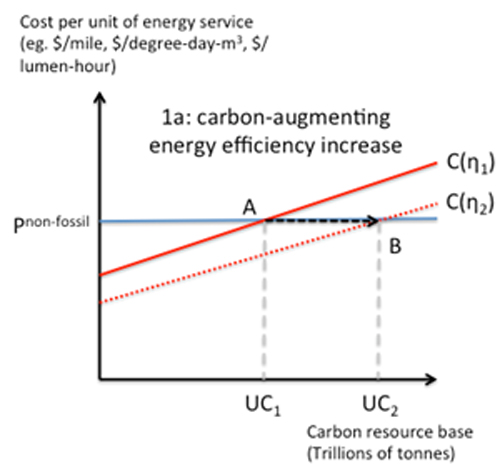
Assuming a given alternative cost of providing electricity (pnon-fossil), the more efficient the power stations that burn coal, the more the electricity provider can ultimately afford to pay for the coal that is used. As more coal is used and the price rises (all other things being equal), so the resource base expands (from UC1 to UC2 in the figure above) and so does cumulative CO2 in the atmosphere. Further, as the CO2 issue is basically an atmospheric stock problem, this then drives up long term warming, even if the rate at which CO2 is emitted happens to fall in the short term.

From a climate finance perspective the CDM has been a successful mechanism, albeit with some significant operational difficulties. It has paved the way for carbon pricing in many countries and has been an important catalyst for change in some areas (e.g. landfill methane). But subsidizing more energy efficient coal fired power plants, while well intentioned, may in fact have negative environmental consequences. The CDM needs to act in its purest sense, which is as a carbon price in the energy system of true developing economies.

N.B. Just prior to posting this, a colleague noted that the Executive Board may have only allowed the issuance of CERS against already approved projects to proceed, rather than allowing future projects to apply by releasing the current hold on the underlying methodology. Hopefully this is the case, but in any case the argument still stands.

As Australia struggled through the ill fated CPRS legislation and finally landed with its carbon pricing mechanism, I often thought that it would be much simpler if they just joined the EU ETS. Governments don’t tend to do simple practical things like that, perhaps it makes them feel they are giving away some portion of national sovereignty or that they aren’t doing the job they were elected for (i.e. “we must invent it here” syndrome). But despite all this and having gone the very long way around to get there, Australia has, in effect now joined the EU ETS (or perhaps the ETS has joined the Australian trading system).

Last week the Australian Government and the European Commission announced that their respective emission trading systems would link up progressively over Phase III of the EU system, but for Australian entities from the start of full carbon allowance trading in 2015. This is a bold move by both parties and quite possibly one that will make others with nascent trading systems sit up and think about where they want to go. For Australia, provided the changes can be implemented by a parliament that isn’t exactly friendly towards carbon pricing (but a wafer thin majority currently is), the move cements the system into place even further, in that undoing it would likely cause some embarrassment on the international stage. For the EU, it puts the ETS back in the frame and maybe introduces some additional demand at a time of allowance oversupply, depressed prices and a consequent lack of confidence in the system. Let’s hope this move helps both sides to deliver confidence and stability in their respective systems.

A full two-way link between the two cap and trade systems will start no later than 1 July 2018. Under this arrangement businesses will be able to use carbon units from the Australian emissions trading scheme or the EU Emissions Trading System (EU ETS) for compliance under either system. To facilitate linking, the Australian government will make two changes to the design of the Australian carbon price:

  • The price floor will not be implemented;
  • A new sub-limit will apply to the use of eligible Kyoto units. While liable entities in Australia will still be able to meet up to 50% of their liabilities through purchasing eligible international units, only 12.5% of their liabilities will be able to be met by Kyoto units.

In recognition of these changes and while formal negotiations proceed towards a full two-way link, an interim link will be established enabling Australian businesses to use EU allowances to help meet liabilities under the Australian emissions trading scheme from 1 July 2015 until the full link is established.

Various Australian, EU and other websites cover all the details, so I won’t repeat them here. Rather, let me spend some time on a key issue that this move raises, namely the future design of any international framework via the UNFCCC (or other process). Both Australia and the EU have stressed that this is a bilateral linkage, to the extent that the allowance transactions will not be processed through the International Transaction Log (ITL), but CER transactions will be. However, there will still be a Kyoto AAU balancing at various times to ensure compliance in that system (although there remains considerable uncertainty with regards the issuance of Kyoto Second Period AAUs as there has been no firm agreement on the full nature of that period).

Despite this apparent distancing from the Kyoto based ITL, it must still be the case that the overarching Kyoto framework has helped this linkage – I might even go a step further here and say “allowed this linkage to happen”. Thanks to the UNFCCC architecture, these two systems grew up with enough harmony to make a linkage possible.  They “count” the same way, “track” the same way and “comply” the same way.  Both the systems have common offset arrangements through CERs under the Kyoto Clean Development Mechanism and the units created under the Australian Carbon Farming Initiative are also Kyoto compliant. This means we have the makings of a linked system with global reach.

This could be the primary goal of a new international framework, i.e. to provide sufficient tools, rules and mechanisms which countries can use in developing their carbon trading systems, thus facilitating linkage at a convenient time for those interested in doing so. Such a linkage framework could deliver the global market that we need, as shown in my illustration below (which by the way has been around for about 5-6 years now, so for me it is great to see that one of my linkage lines has finally been filled in!!).

The opportunity to devise such a framework now exists under the Durban Platform for Enhanced Action, which aims to see a new international agreement in place by 2015, for commencement not later than 2020. The agreement between Australia and the EU should be seen as a catalyst for the thinking behind what is to come.

Finally, as something of an aside, one of the major complaints by Australian companies has been that the current $23 fixed price and the future market floor price put the Australian price of carbon “out of line with the international price”. I challenged this notion in a recent post, but irrespective those who called for such alignment have pretty much got what they wanted, although obviously not in the very short term. There may be eventual irony in this, should the EU system go through something of a recovery in its fortunes. While every indicator today points to a continued depressed price through to Phase IV, stranger things have happened in commodity markets.

P.S. I still think that the simplest approach for Canada, which has been putting off economy wide carbon pricing legislation for years, would be to join the EU ETS.

While much of the focus in the recent UNFCCC meeting in Bonn was on the protracted discussion around agenda and chair for the ADP (Ad-Hoc Working Group on the Durban Platform for Enhanced Action), some progress was made in other meeting rooms. On the middle Saturday a workshop was held for initial discussions around the call for a “New market Mechanism” (NMM). A report out from the workshop can be found here.

So far, the discussion on a NMM has tended to focus on the crediting of mitigation activities in developing countries, such as the role performed by the CDM. The talk is often about up-scaling rather than having an initial discussion about the market conditions necessary for crediting to be effective or alternatively to ask what a market mechanism actually is. For some, the CDM can be represented as shown below. 

This is a very supply biased conversation, when in fact the full description of the mechanism must include both the creation of supply and the likely demand. The mechanism is much broader than the CDM and involves the core design of the Kyoto Protocol and the various elements within it. 

There are many definitions of “market mechanism”, but all talk about the process of the whole market rather than just a sub-part within it. Here are three;

  1. Means by which the forces of demand and supply determine prices and quantities of goods and services offered for sale in a free market.
  2. The use of money exchanged by buyers and sellers with an open and understood system of value and time tradeoffs to produce the best distribution of goods and services.
  3. The process by which a market solves a problem of allocating resources, especially that of deciding how much of a good or service should be produced, but other such problems as well. The market mechanism is an alternative, for example, to having such decisions made by government.

As the NMM discussion matures and eventually becomes part of the ADP, a much broader discussion on the need for a viable carbon market will be necessary. This cannot be limited to a discussion on crediting mechanisms because these, if standing alone, are not market mechanisms. A working mechanism requires some means of establishing price and particularly demand, a feature not inherent to the CDM.

The assumption that demand for credits will somehow be created is arguably a flawed one. The Kyoto Protocol addressed this by assigning AAUs to certain countries and making the CER (from the CDM) a fungible instrument, thereby allowing interchange for compliance. The AAU approach created demand in countries that had compliance obligations which in turn completed the market mechanism. Nations that held AAUs tended to cascade the instrument directly into their economies or if not, a proxy (e.g. the EUA under the EU ETS). Either way, the compliance obligation remained and allowed private investors to participate in the market.

There was a certain elegance in the market mechanism design of the Kyoto Protocol, one that shouldn’t be lost in the transition to a new international agreement. While it may not be smart politics in some quarters to highlight the benefits within the KP, the NMM discussion will do well to learn from what was developed in years gone by and not throw the baby out with the bathwater.