Skip to content
  • Home
  • About David
  • Twitter
  • Facebook
  • LinkedIn

David Hone

Climate Change Advisor for Shell

Hello and welcome to my blog. There's lots said about why climate change now confronts us, and what it means, but the real issue is what to do about it. Plenty is said about that too, but there's not enough discussion on the practical aspects of implementation. Focusing on energy, that's what my blog sets out to achieve.

More about me

RSS Feeds

RSS feed RSS - Posts

  • How RSS feeds work
  • My blog rules

Follow

  • View Shell’s profile on Facebook
  • View davidshellblog’s profile on Twitter
  • View davidhone’s profile on LinkedIn

My new Amazon book

Putting the Genie Back


Recent Posts

  • Temperature implications for a troubled world
  • A landmark announcement from China
  • Can a 90% reduction in greenhouse gas emissions be achieved by 2040 in the EU?
  • Different planes or new fuels?
  • Like it or not, carbon management is the future
  • Five years on from COVID-19 – a scenario perspective

I am also interested in...

  • Global Climate Change
  • Putting the Genie Back
  • RealClimate
  • Shell

Archives

  • Emissions Trading
  • Carbon capture & storage
  • Carbon price
  • Climate Science
  • UNFCCC
  • Low carbon economy
  • Policy
  • Net zero emissions
  • Renewables
  • Twitter
  • Facebook
  • LinkedIn

Shell Climate Change

David Hone – Chief Climate Change Advisor for Shell

  • Home
  • About David
  • Low carbon economy

The last 20%

dchone July 10, 2009

In the last 24 hours we have heard much from the G8 meeting in Italy on climate change as world leaders debate reduction targets for developed countries. Whilst they seem unwilling or unable to agree on much of anything for the near term (although in fairness most of the G8 countries have or are about to have a near term target – they are just all different), they have managed to agree on an 80% reduction in emissions for their economies by 2050.

But it raises an interesting question – can we actually reduce emissions by 80%?

In 2007 the EIA reports that total US GHG emissions were 7419 million tonnes, including international marine and aviation bunkers. Without getting into the detail of a 1990 or 2007 baseline (but it is important), let’s assume that US emissions in 2050 must be 1484 million tonnes, or an 80% reduction from 2007. I will also assume that we have long passed the point of international offsets, given that the rest of the global economy will be under tight CO2 regulation as well.

So the scramble for the last 1.5 billion tonnes is on. To make it easy for everyone else I will assume two things – firstly that the power sector is at zero emissions and second that the commercial and residential sectors only use electricity. Neither of these will be easy to achieve in just 40 years, but you will see in a minute why it becomes essential.

There are many sources of GHG in the economy other than fossil fuels. There is methane from agriculture and human waste, various other gases leaking out of our cars and old appliances in the garage, landfill methane, N2O from agriculture – the list goes on and on.

Then there are the fossil fuels that we have all come to depend on. One of the great features of a gallon of gasoline, jet fuel or diesel is the huge amount of stored energy we can get from it. Whilst we may be able to get around this with advanced battery technology in cars, it is hard to imagine anything else powering an A380 twin deck airliner. We may of course be able to synthesize these fuels from bio-sources.

So, just to put some numbers out there and I will be the first to confess this is just “back of the envelope stuff”, we end up with a transition that looks something like this (the 2007 breakdown is approximate):

USA 80 percent reduction

What we see from all this is that some huge changes have to take place – apart from the power and buildings sector. Road transport (fossil derived)gasoline effectively vanishes but some diesel remains for large trucks and industrial equipment (e.g. diggers). Big industry has to reduce by about 70% which means finding new ways to heat things like blast furnaces. Sectors such as cement and lime are going to have to use technologies such as CCS, but with plants having very long lifetimes and the processes being relatively simple, how much uptake of advanced technology might we really see from such facilities? Some certainly, but an 80% reduction is unlikely.

It would be good to get some comments from the agricultural side – because in my numbers above I imagine that 80% reductions just won’t happen. Are we really going to be able to change methane releases from cattle and capture all the methane from rotting waste products?

I saw a presentation on aviation today and it looks very hard to make huge reductions. Whilst there are still big efficiency gains to be made as we replace fleets with 787 type planes and beyond, it looks like liquid fuels are here to stay. But bio may play a bigger role than the industry can forsee today.

So that is the picture looking out to 2050 – a completely different economy to the one we see today and a real scramble to claim space for those remaining emissions.

Of course, nobody is talking about 2060 when we might need a 90% reduction. Or 2070 . . . . . ! That is when we will really need technologies such as CCS in combination with bio-processing such that we end up with net sequestering (negative CO2) industrial processes.

  • Climate Science

Meeting James Lovelock

dchone July 2, 2009
James Lovelock's latest book

James Lovelock's latest book

Yesterday I travelled into rural Devon to meet with James Lovelock, the renowned author and scientist. James is the originator of the Gaia hypothesis, which proposes that the biosphere and the physical components of the Earth (atmosphere, cryosphere, hydrosphere and lithosphere) are closely integrated to form a complex interacting system that maintains the climatic and biogeochemical conditions on Earth in a preferred homeostasis.

James has written much about climate change and his latest book, “The Vanishing Face of Gaia“, puts forward a very different agenda for the world than that being discussed globally today. Whilst he recognises the importance of efforts to reduce emissions, his view is that the earth is about ready to jump to a new much hotter homeostatis with a transition that will be rapid and extraordinarily damaging to us.

I  must confess that whilst I had heard and read much about James in the press, I had never taken the time to read one of his books. I did so with “Vanishing” before visiting Devon and found it to be a fascinating insight into the possible reaction of the earth to our CO2 onslaught, although it does tend to leave the reader feeling a bit helpless and hopeless.

Whilst many may disagree with the views of Lovelock, they are not to be simply dismissed either. This is a man with an immense science background dotted with very significant contributions to fields such as atmospheric chemistry. But best you hear it from James himself in the short interview below. Finally, my sincere thanks to James and his wife Sandy for meeting with me and James Smith, Chairman of Shell UK.

  • Uncategorized

The cost of cap-and-trade: What MIT really thinks

dchone June 26, 2009

The MIT Joint Program on the Science & Policy of Global Change have long been advocates of cap-and-trade as an appropriate policy instrument to drive a reduction in national emissions. They also provide valuable insight into the economic impacts of such an instrument through the economic modelling tools they have at their disposal.

As Waxman-Markey races through Congress and might even become legislation this year, both sides of the debate are arming themselves with data to defend or attack the proposal. In recent weeks MIT have found themselves in the middle of this foray as their findings have been somewhat misquoted by those not in favour of a cap-and-trade approach in the USA.

In Rome this week the Joint Program is holding its 29th Forum and I am here for Shell as one of the program sponsors.  I have had the chance to interview the originator of the MIT study, Dr. John Reilly, Associate Director for Research.

  • Uncategorized

An accumulating problem

dchone June 19, 2009

The actual reason I went to Bonn last week was to participate in a side event run by The Oxford Institute for Energy Studies. They put forward the view that the real issue at hand is not the emissions in 2020 or 2050 or any other year, but the total additional GHG carrying capacity of the atmosphere in relation to a temperature objective. The full story on this appears in the 30th April edition of Nature.

To limit temperature rise to 2 deg.C, the number is about one trillion tonnes of Carbon, or 3.67 trilllion tonnes of CO2 (equivalent). That number is even smaller for a low risk (of exceeding 2 deg.C) scenario. The problem is, we have already used up about half this space, so we have 1.8 trillion tonnes of space left. Given our current usage patterns, 1.8 trillion tonnes doesn’t go far. I did some quick calculations and came up with the following;

  • Even without accounting for extra bio-CO2 being released into the atmosphere through landuse change or the impact of the non-CO2 gases, we have to be done with fossil fuels globally by about 2060. One interesting contributer to this which I assume for my calculation continues unabated through the whole century, is cement. The manufacturing process releases fossil carbon into the atmosphere as the calcium carbonate is processed. The cement industry is growing rapidly as developing country cities rise from the forests and plains. The result is that over the next hundred years that one industry uses up at least one hundred billion tonnes of the available space.
  • By contrast, if we can apply carbon capture and storage (CCS) to all our coal use by 2050, oil and gas can continue to support our energy needs until the end of century (albeit declining from 2020), which approximates to the complete use of current proven reserves (as per the BP Statistical Review of World Energy) – and of course there is still the cement.

The point here is that looking at the total space available is very instructive. It will help guide the policy process and clarify thinking on energy use and the application of technologies such as CCS. It also makes us aware of the cummulative impact of all the other things we do.

But again, there is no reference to anything like this in the negotiating text. The Oxford team have set themselves the task of making this happen, although given all the competing interests in the negotiating process, it represents a formidable challenge. I hope they succeed.

  • Copenhagen
  • Emissions Trading
  • Uncategorized

In search of missing text

dchone June 17, 2009

At the end of last week I was in Bonn, where another round of UNFCCC negotiations was taking place in the lead-up to Copenhagen. I happened to catch the Greenpeace show, which involved the sounding of an incredibly loud air-raid type siren from within a locked steel cage on the back of a truck. The German police didn’t take kindly to this and proceeded to cut them out.


But the point made by Greenpeace isn’t without merit. My own “alarm moment” comes from looking at the text which the negotiators are deliberating over. Although much was apparently added during the Bonn talks, the starting point (the AWG-LCA text) says little about how to actually address this problem, but rather presents fifty three pages of arcane language about process. It talks of “appropriate action”, but doesen’t define what this might actually entail, other than in the loosest terms. Take a technology such as carbon capture and geological storage – it doesn’t even get a mention. The word “renewable” appears once, “nuclear” doesn’t appear at all and “energy efficiency” twice. Even the notion of a carbon market to drive large scale deployment is barely touched upon.

Short of a document which clearly spells out a forward emissons profile for every country, perhaps it is time to replace abstraction with clarity and focus. There are five, and only five things we can do to address the mitigation side of climate change. We have to do all of them, we have to do them at huge scale and we have to do them very quickly. They are;

  • Using energy much more efficiently;
  • Increasing the use of renewable and nuclear sources of energy;
  • Rapidly commercialising and deploying carbon dioxide capture and geological storage in tandem with the use of fossil fuels [or with the chemical conversion of fossil derived materials for the provision of various manufactured products];
  • Containment, destruction and reduced usage of greenhouse gases other than carbon dioxide;
  • Reducing emissions through land use, land use change and forestry, including reducing emissions from deforestation and degradation.

At the very least, the text should be driving these specific solutions forward, for example through properly funded large scale demonstration programmes and targeted mechanisms to hasten deployment. Carbon capture and storage provides a good example. Three policy initiatives are required to support this technology;

  • An underlying price for CO2 must be in place;
  • A clear recognition of the demonstration nature of the technology, which means funding, objectives, timelines and focus on delivery of projects;
  • A robust approach to CO2 storage certification (and MRV) based on 2006 IPCC GHG Inventory Guidelines.

The EU has nearly reached this point, but it has taken eight years to do so. Whilst this represents a landmark in policy creation, the rate at which it has happened is hardly commensurate with the gravity of the issue that we are trying to address. We need to focus our efforts on bringing this technology to developing countries, particulalry those with large coal reserves. A policy framework similar to that in place now in the EU is needed, but on an international scale. First and foremost, this means recognising CCS within the an international project mechanism. We will also need to underpin this with an internationally recognised CO2 storage certification, again based on the 2006 IPCC GHG Inventory Guidelines. Finally, we need a mechanism within which large clusters of projects can be identified, funded and implemented against defined deadlines. Most importantly, we need all this now, in Copehagen, with a view to starting implementation in 2010.

  • Carbon capture & storage
  • Emissions Trading
  • Low carbon economy

The cost of cap and trade?

dchone June 10, 2009

As Waxman-Markey starts to bed into the consciousness of the US, there has been a rush to calculate the “cost” of climate legislation – some with the view of destroying the bill and others to reassure us that it won’t impact us at all.

So it seems that this might be a useful subject to do some basic thinking about. But beware, I am not an economist, so I will be probably get roundly dumped on by those that are – but I am an engineer and engineers are quite good with envelopes and the back of them – or in my case this evening a pad of Post-It notes.

There is no doubt that reducing emissions in the USA will cost some money. But there will be benefits as well. For starters, have a look at the McKinsey abatement curve for the USA.

An batement curve for the USA

An abatement curve for the USA

There are two parts to this curve, the left hand side where no carbon price is actually necessary to deliver the reductions, and the right hand side where a carbon price is needed.

On the left hand side there are actions such as improved lighting, better domestic appliances and building insulation. All these actions improve energy efficiency and lower our costs – so we should just do them. But we don’t as a matter of practice (bad housekeeping really), so improved standards and building codes should be employed to force these changes into the marketplace and as a result the economy benefits.

On the right hand side we are using technologies such as Carbon Capture and Storage which will cost money. If CO2 didn’t have the impact that it does in the atmosphere we would never do this. Equally, we wouldn’t force offshore wind, certain solar technologies and perhaps new nuclear into the market quite as quickly. Earlier take-up of these technologies could cost us money overall.

Simply eyeballing the abatement curve, shows that the two blue areas are about equal, which means through to 2030 this is a zero sum game. What we gain on efficiency in the economy we spend on early technologies and CCS. But that doesn’t mean that cap-and-trade doesn’t cost anything, because it does. Cap-and-trade is only needed on the right hand side of the abatement curve, so let’s just focus on that bit alone.

First of all it shows that the CO2 price needed for these technologies ranges from a few dollars to about $50 per tonne, so lets say the average is $40 per tonne in the big industry and power sectors which is where the CO2 price is really needed. We run with this from 2012-2030 during which time emissions in the power and industrial sectors of the US economy are reduced by about 35% or 1.2 billion tonnes per annum.  So the total emission reduction is 1.2*18/2 = 11 billion tonnes (rounded up). At $40 per tonne, the total cost of abatement is $440 billion. There are about 90 million families in the USA (340 million people by 2030), so this means a cost to each family for much of the right hand side of the abatement curve of under a dollar a day (actually 75 cents).

This isn’t nothing, but it is hardly going to break the economy either (between 1945 and 1996 the USA spent at about double this rate just manufacturing and deploying nuclear weapons). In addition, Waxman-Markey skews the distribution of allowance value to low income families, so compensation is there for those who rightly need it.

There are other reductions on the right hand side of the curve as well, but much is in the agricultural and forestry sector and seems to come in at around $15 per tonne. So overall, I will go with the $1 per day per family from 2012 to 2030 for the real “cap-and-trade” bit. Don’t forget though that these same families also get the benefit of the left hand side of the abatement curve as well, because of improved appliances, home insulation programmes, new lighting standards and so on.

But what is the benefit of doing all this? That’s easy – Nick Stern did the calculations for us and put the social cost of CO2 at about $80 per tonne – i.e. the cost we leave to future generations if we just keep on emitting.

  • Copenhagen
  • Emissions Trading
  • Low carbon economy

What next for Canada??

dchone June 4, 2009

This week I have been in Canada, talking with people in both Provincial and Federal government about Canada’s policy plans to reduce greenhouse gas emissions. There is a feeling of deja vu doing this, because it seems that Canada has been talking about such policy for years now – but almost nothing substantive has been implemented.

But now very substantive action is going to be needed – and needed fast. Its largest tading partner is on the move and will implement either an emissions trading system or succumb to the rigours of the Clean Air Act. As a developed country in a leadership position with G8 status, Canada will almost certainly have to sign up to something like a 20% reduction in emissions (or more) from 2005 to 2020 when it faces other nations across the negotiating table in Copenhagen.

But Canada has been here before, signing up to the Kyoto Protocol and agreeing to reduce emissions by 6% from their 1990 level of about 600 million tones. In 2006 GHG emissions were at 721 million tonnes, nearly 30% above the Kyoto target. However, emissions have fallen from a high of 743 million tonnes in 2004, perhaps driven by a variety of policy efforts at provincial level and some from the Feds.

Putting to one side the issue of how Canada will finesse complance with its Kyoto obligations (and these are real obligations irrespective of what happens to the Protocol), a formidable task remains to reduce emissions between now and 2020 (remember, that’s 4000 days). This is all the more challenging for Canada because the resources boom in Alberta is also putting upward pressure on emissions.

Getting back to my mission this week, it is clear that the political appetite for action has changed and that a cap-and-trade system is now the preferred way forward. But there are many hurdles to cross. Whatever is put in place has to be compatible with the expected US system. Waxman-Markey allows unrestricted flow of allowances from “equivalent systems”, but therein lies the first issue – what will be deemed equivalent. Whilst the idea of a trading approach is alive and well in Canada, so too is the idea of a buy-out option by putting money in the collection tin (the “Technology Fund”). Unfortunately this means it isn’t a cap-and-trade system any longer and it is hard to imagine any such construction being deemed equivalent.

Two other obstacles confront Canada in the design of a national trading system.

The first involves the concerns that wealth transfer may result between provinces arising from the flow of allowances between those needing to buy allowances due to substantial growth from those with a flatter emissions profile. This is a real issue, but it has been addressed in the EU and the approach adopted there may be applicable in Canada. In the EU a large New Entrant Reserve has been set aside from within the cap. Member states can draw on this as necessary, using the allowances for auction or grant to the new facilities in question. This helps countries like Poland experiencing rapid growth in that it limits the flow of funds leaving the country for compliance pruposes.

The second issue is also a wealth transfer one, but between Canada and the rest of the world. It is almost certain that Canada will have to buy international offsets or US / EU allowances to meet a potential 20% by 2020 reduction target. With the resources boom in Alberta, the best that Canada can probably achieve domestically is a 10% reduction by 2020. This means Canada / Canadian industry could need to purchase some 250 million tonnes of external compliance units between 2013 and 2020, perhaps costing as much as $10 billion. There really is no getting around this – it is the nature of an emissions trading approach built on environmental targets and strict compliance. It is also because there is no getting around the issue of climate change other than reducing emissions – the atmosphere doesn’t really have much use for our money, only our ability to manage what we emit to it.

So there is much to do to push Canada across the line and get cap-and-trade implemented. But there is also a great deal of willingness and drive to finally make something happen – hopefully enough to overcome some tricky obstacles along the way.

  • Carbon capture & storage
  • Copenhagen

A focus on CCS in Norway

dchone May 29, 2009

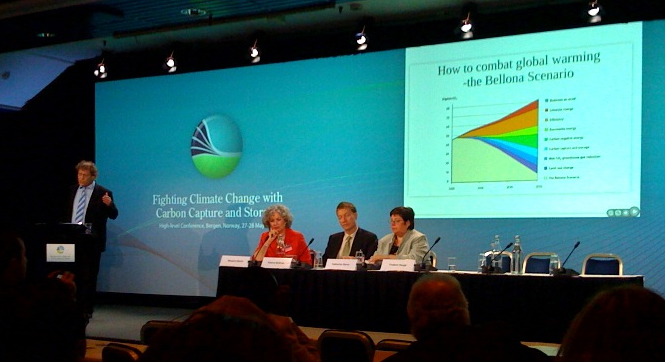
Norway has long been the Carbon Capture & Storage (CCS) capital of the world, with its Sleipner offshore storage project and strong support for this nascent technology. This week the Norwegian Government put on a High-level Conference in Bergen, “Fighting Climate Change with Carbon Capture and Storage”. It was attended at Ministerial level and featured the likes of Dr. Rajendra Pachauri, head of the Intergovernmental Panel on Climate Change.

Frederic Hauge, President of The Bellona Foundation on the podium

Frederic Hauge, President of The Bellona Foundation on the podium


Most of the plenary content was on Thursday, focussing on the potential of CCS, experience with the technology, balancing energy needs with CO2 management globally and the necessary incentives for CCS. I was on the “Incentives” panel and gave a short presentation on that subject (see below).

In his opening remarks, the Norwegian Minister for Petroleum and Energy noted that CCS faced three particular questions, those being:

  1. How do we know the CO2 stays there?
  2. Who will be liable for the storage site in the long term?
  3. How can we be sure that spending money on CCS doesn’t crowd out technologies such as renewables?

I wasn’t quite sure why he asked these as it’s not as if CCS doesn’t face enough challenges. But I think the answers are clear – although he didn’t give them;

  1. At 3 kms below the surface in formations that have long held oil or gas, it just does [stay there]. There isn’t anywhere for the CO2 to go. Norway’s own Sleipner project has been storing one million tonnes of CO2 annually for ten years and there is no sign of it coming back.
  2. At least under the EU CCS Directive, government holds the long term liability, having been handed a closed storage site by the operator which has met a series of checks for permanence.
  3. It won’t – just to meet global energy needs and contain CO2 we are going to need to put lots of effort into all potential energy technologies.

We then heard from John Ashton, the UK Special Representative on Climate Change from the Foreign and Commonwealth Office. John made one point abundantly clear – “A lot of coal is going to burned between now and the end of this century, which means there is no credible climate strategy that does not include CCS in the coal fired power sector.”

He went on to point out that CCS isn’t some distant dream and that the issue today was not a technological one, but a cost discovery problem. Nobody really wants to be the first to do this at scale. He noted that we have had years to do this, but have now left it to the last minute to act – which means the mobilisation effort required is now huge.

He also challenged the audience with the view that if the Copenhagen deal doesn’t include a sizable CCS focus, then it isn’t a deal worth having and negotiators should be sent back to the table. In his view, the current status of CCS in the UNFCCC deliberations, particularly the brick wall it has hit with regards inclusion in the CDM, is “a scandal”.

A lot more was said during the day about progress, the status of funding and potential deployment strategies. What was abundantly clear is that despite the robust call for action from the IPCC, the UK and The Bellona Foundation [a Norwegian NGO heavily behind CCS] things are just not moving fast enough. The showcase of global action (Sleipner, Weyburn in Canada and In-Salah in Algeria) looks no different to the showcase a few years ago. Another “scandal”, given the gravity of the situation.

But maybe things are looking up for CCS. There are some real support packages appearing in the EU, Canada, Australia and the USA and both China and South Africa have promising development programmes – although neither see the rapid roll-out that is actually necessary.

My own presentation focussed on the incentive structures that are needed. In my view we need to find ways of replicating what has happened in the EU where all the necessary pieces of the puzzle are now on the table, i.e.;

  • An underlying price for CO2 must be in place
  • Recognition of the demonstration nature of the technology
    • Clear demonstration objectives in place
    • A timeline for action
    • Funding commensurate with the task at hand
    • A focus on delivery of fewer complete projects, rather than limited funding for many.
  • A robust approach to CO2 storage certification (and MRV) based on 2006 IPCC GHG Inventory Guidelines.


Bergen CCS Conference Presentationhttp://static.slidesharecdn.com/swf/ssplayer2.swf?doc=bergenccsconference-hone-090528175154-phpapp01&stripped_title=bergen-ccs-conference-presentation

View more OpenOffice presentations from David Hone.


  • Emissions Trading
  • Policy

Going once, going twice . . . .

dchone May 24, 2009

As the American Clean Energy & Security Act (ACES) 2009 (i.e. Waxman-Markey) shows itself, it reveals some different thinking on emissions trading to that in Europe, notably in the area of allowance distribution.

An emissions trading system is designed to establish an alternative fiscal flow through the economy, favouring low carbon goods and services and directing investment towards low emission and emission reduction projects. It does this by establishing a price for emitting CO2 through the creation of emission allowances, with one allowance required for every tonne of CO2 emitted. A virtuous fiscal loop is created, which sees government auctioning a decreasing pool of allowances to emitters, the emitter pricing goods and services to reflect some portion of the cost of allowances (over time the emitter will only be able to pass through the CO2 cost of the best performer, as in any competitive market) and the consumers using their purchasing power to favour lower carbon footprint products, supported by a return of the government auction revenue through lower taxes. This return compensates for the overall general cost increase of most goods and services as a result of the CO2 price. The end result of this process is that the more carbon intense products become uncompetitive over time and emissions in the economy decline.

For example, in the building industry cement and steel are both carbon intensive products to manufacture. In the new cap-and-trade world the price of cement will again be set by the new lowest cost operator (but taking into account the CO2 price), but it may also turn out that steel becomes relatively more attractive to the architect as a building material, so there is also an overall drop in the use of cement – or vice versa. Of course the declining industry might find it can install carbon capture and storage and thus lower the price of its product, changing the competitive balance again.

So that’s the theory, but practice is turning out to be very different. Auctioning of allowances has become a political football, and as in the game itself, American and European varieties are very different.

Rule number 1 says that if you can pass the CO2 price through the value chain to the consumer, i.e. higher prices, then you must buy the allowances that you need. The flip side of this is that if you cannot pass some portion of the CO2 price along, for example if market prices are set by competitors not subject to a CO2 price for their emissions (e.g. importers), then the government will give you some number of allowances for free – at least until the imported product also falls under a CO2 pricing regime.

Rule number 2 relates to the value of the allowances themselves. If the government auctions allowances what should happen to the money? This is where the EU and US have diverged markedly. Although the EU Trading Directive says that some of the auction revenue should be used for clean technology development, the reality is that most EU governments will channel this money through their treasuries and then make annual spending decisions as part of the normal budget process. By contrast, ACES makes many of those decisions up front and distributes allowance value to states for energy efficiency measures, to low income consumers, to utilities (to protect consumers from rate hikes) and to trade exposed industries or instructs the government how to spend the auction revenue – e.g. international assistance to address deforestation.

Whilst these may be laudable uses of the money and in reality are perhaps necessary to ensure passage of the bill, arguably this process undermines the performance of the emissions trading system. For example, allocating for free with the express intent of limiting price-pass-through to the consumer (so as to protect them) means that one of the mechanisms which makes emissions trading work is removed, namely the increasing price of carbon intense goods and services (which in turn drives down demand for that service). This means that although the cap remains the same, the lowest cost outcome to achieve it is not delivered, as it may have been the case that the most cost effective route to emisssion reduction was to use less, rather than to install a more expensive upstream mitigation project.

A second issue that arises is that we may not be able to judge today how government money is most efficiently spent to address climate change in 10 or 15 years time. That is why there is a budget process each year. For example, ACES specifies that some money should be reserved for adaptation. It is certainly true that adaptation will be necessary and money will be required, but in a given fiscal year it may also be far from clear how that should be spent- but it will be spent because it is there.

Spending auction revenue on clean energy deployment initiatives may not be the most efficient way forward either. After all, the reason we have installed a cap-and-trade system in the first place is to let the market make those decisions, so why second guess it.

As ACES develops in the USA, these are some of the issues that are going to have to be grappled with. The revenue available from allowances is substantial and it is true that it may be much easier to fund certain critical initiatves via the allowance route than the annual budget process. A good example of this is the set aside of 300 million allowances in the EU expressly for funding the EU CCS Demonstration Porgramme (10-12 large scale projects). But in the process of trying to satisfy all parties, we should be careful not to undermine the very instrument we are putting in place to achieve the objective of reducing emissions at lowest cost to the economy.

  • Carbon capture & storage
  • Emissions Trading
  • Policy

Help is now at hand – perhaps?

dchone May 17, 2009

I mentioned in an earlier post that there are really only four things that can be done to reduce emissions from energy production, namely – using less, switching to renewables, switching to nuclear and utilising carbon capture and storage (CCS) in conjunction with fossil fuels.

The one we know least about is CCS, although much of the technology already exists. For example, if we start with coal as the fossil fuel, CCS may be easier if we gasify the coal first to make syngas (H2 + CO), which can then be chemically shifted and physically separated to give hydrogen and CO2. The hydrogen is then used to generate electricity [or the syngas can be sent directly to a gas turbine producing CO2 as a byproduct] and the CO2 is compressed to liquid form and pumped into storage sites, which could be two or more kilometres below the surface. Much of this technology exists today in South Africa, where coal is gasified as a precursor to liquid hydrocarbon manufacture for transport. The SASOL Secunda facility processes some 15+ million tonnes of coal per annum, much more than a 2 GW coal fired power station, so the scale is possible. Most of the CO2 is vented to atmosphere in nearly pure form – i.e. it is close to storage ready. But there is no CO2 storage happening anywhere on this scale – the best example today is in Norway where some one million tonnes of CO2 is stored annually in the Sleipner project.

So integrated large-scale CCS still needs to be demonstrated and governments around the world are finally putting together significant funding packages to get this to happen. Three significant funding packages are now on the table;

  1. Phase III of the EU-ETS sets aside 300 million allowances for the EU 10-12 project CCS demonstration programme. Depending on the prevailing CO2 price, this could be worth some EUR 6-9 billion.
  2. The Province of Alberta and the Federal Government of Canada have established funds totalling some CAN$ 3 billion for the large scale demonstration of CCS.
  3. This week the Australian Government announced AU$ 2 billion in funding for large scale demonstration projects.

This week also saw the American Clean Energy and Security Act of 2009 presented to the House of Representatives. In it there is a provision to collect US$ 1 billion per annum for 10 years from electricity suppliers for the demonstration of large scale CCS through five major projects. The Act also provides some 1 billion free allowances to underpin the cost of CCS deployment through 2014-2020, in lieu of the revenue that would otherwise be collected if the CO2 price is passed through in the cost of electricity (which the Act does not allow for – more on that another day).

So it appears that CCS is on its way. Or is it? In reality there still exists something of a chasm between the funds that are now on the table and the actual delivery of real projects. First will be the selection of projects – a process that could be very protracted. Second, there will be the temptation to spread the incentive widely, rather than a laser like focus on bringing a smaller number of projects rapidly to completion. The latter is essential, but it means very significant funding for single projects, which means that not all states, provinces, countries, sectors or technologies can be satisfied early on.

But even if funding decisions are focussed and rapid and therefore projects are accelerated, timescales will be challenging. The first generation of CCS facilities need to be operating by 2014, but that may not be possible. Going back to the SASOL technology above, the following comes from a posting on the SASOL website on October 22nd 2007:

Sasol said the order to construct a Sasol Advanced Synthol reactor, placed with the Hitachi Zosen Mechanical Corporation, will enable the company to increase capacity at its Secunda plant from the current level of 150 000 barrels per day by 20% to 180 000 barrels per day by 2015. . . Synthol reactors use either gas or coal as feedstock to produce synthesis gas . . . .  The reactor will be about 12 stories (38 metres) tall, eight meters in diameter and will weigh about 867 tons.

Whilst I don’t know the full context of this announcement, it does indicate that the timelines are long for large scale advanced technologies such as coal gasification. Shell has experience in this area as well, as gasification (of natural gas) is at the heart of our Pearl GTL project in Qatar. Again, timelines are long. Final investment decisions were announced in July 2006, with production anticipated to start in 2010. But in July 2006 much of the engineering design had been done, the decision was then the final trigger for firm equipment orders.

So we might see big CCS [linked to a coal fired power station] up and running in 2015. But it may not be in China or India, where arguably some of the early demonstartions need to be. The big funding announcements are so far focussed on developed countries with carbon markets either in place or on the drawing boards. Looking at developing countries, there is no mechanism for providing the CO2 price incentive (and little positive progress to have CCS included in the CDM) and no major clean technology funds ready to put down the billions that CCS will need for a demonstration programme of (say) 10 projects in China for example.

Before 2015 there is a good possibility of CCS projects linked to exisitng sources of nearly pure CO2, such as from exisitng gasifiers. Some of these projects may be quite large and will help build early industrial scale experience.

But the numbers struggle to add up. 20% or 30% reductions by 2020 are being asked for (and some say it needs to be 40% for developed countries by 2020), but not one big coal based CCS facility may be up and running until 2015. Yet CCS is likely to be an integral part of the solution to reducing emissions and I would argue is necessary just to meet the ambitious 2020 targets.

Posts pagination

Previous 1 … 49 50 51 … 54 Next
Shell Climate Change
Contact / Proudly powered by WordPress Theme: Booklet.
 

Loading Comments...