

What could aviation look like in a world shaped by energy security concerns, shifting geopolitics and changing technology pathways? The Shell Scenarios team provides detailed national and sector data insights into how different countries and sectors could develop under Shell’s global energy scenarios. These deeper explorations, which we call “Sketches,” help bring the scenarios to life so I am pleased to be able to introduce our first sector-based sketch, Aviation and energy to 2100, which has been drawn from The 2026 Energy Security Scenarios.
The global aviation industry is a massive sector with significant economic impact, projected to surpass $1 trillion in revenue in 2026, supporting 86.5 million jobs, contributing over $4 trillion to the global economy and carrying over 5 billion passengers in 2026. The global commercial aviation sector consumes some 7.2 million barrels per day of liquid hydrocarbon fuel, compared with around 100 million barrels per day of oil production in total.
Of the hydrocarbon fuel used by aviation globally, less than 1% is sustainable aviation fuel with bio-energy origins (bio-SAF). Net carbon dioxide (CO2) emissions from aviation amount to more than 1 billion tonnes per year, or 2.3% of total anthropogenic CO2 emissions. While this is modest in the context of today, it becomes problematic as emissions in other sectors decline and demand for aviation continues to grow rapidly. By 2050, CO2 emissions from aviation could conceivably be more than 10% of the global total, given an overall reduction in global emissions from all sources and increases in aviation demand. The sector is therefore under pressure to manage emissions and achieve net zero CO2 emissions by 2050.
First, a quick recap of the scenarios, namely Archipelagos, Surge and Horizon.
- In Archipelagos self-interest and security concerns become deeply rooted in the national psyche. Security is pursued through geopolitical realignment. Economic growth suffers and while global conflict doesn’t emerge, nations act as if it will.
- In Surge, economic security emerges through growth and productivity improvements, with AI technologies reshaping society and driving rapid change in the energy system.
- Horizon takes a normative approach (i.e. the outcome is fixed) aimed at a world that achieves two key things: net zero emissions by 2050 and global warming below 1.5°C versus 1850-1900 by the end of the century.
The key question the Aviation Sketch examines is the journey to net-zero emissions.
In all cases, the sector faces a singular challenge: how to meet increasing passenger demand while also trying to grow the sustainable aviation fuel (SAF) market fast enough to meet carbon targets. By mid-century global passenger demand could be approaching triple that seen in 2025 but will almost certainly have doubled as shown below. Surge and Archipelagos both reflect differing underlying economic growth trends and border security implications; for example, Archipelagos is a world of both lower economic growth and a more challenging border crossing environment. Horizon assumes that people fly less due to concerns about the climate and the broader availability of long-distance rail services.

While demand will be met with new efficient planes, rapid growth in the sector can outpace the growth of SAF. This is illustrated in Surge where both SAF and e-SAF (synthetic fuels) growth is rapid but even combined cannot outpace the growth in demand in a more affluent society, until after mid-century.
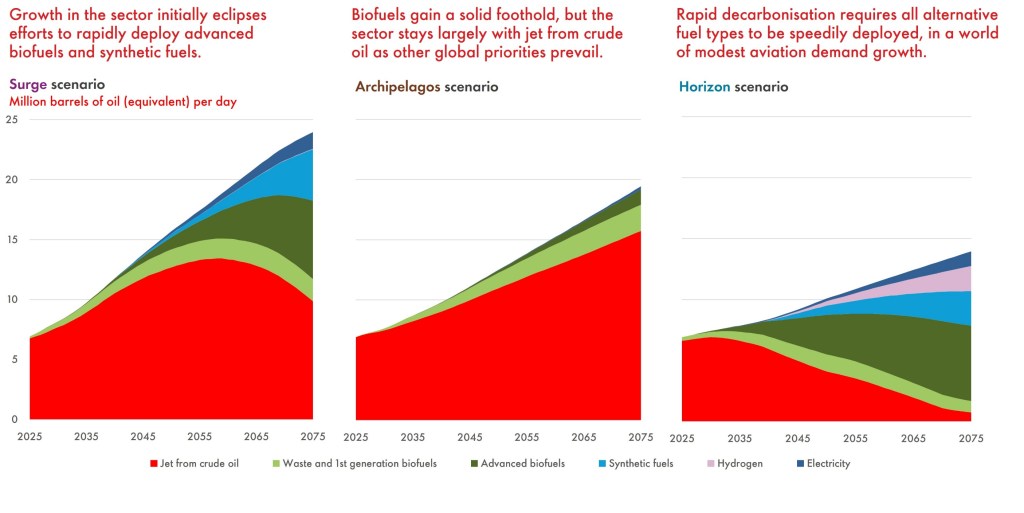
By contrast, while passenger demand growth in Archipelagos is considerably lower than Surge, the robust economic conditions and government supporting mechanisms to grow the SAF market just aren’t there, and e-SAF never even emerges as a viable commercial fuel. This comes about from a trend in Archipelagos where governments increase defence spending and to balance available fiscal resources various supporting mechanisms to foster the energy transition are removed or certain energy transition projects are cencelled.
The only scenario where fossil fuel use in aviation falls towards 2050 is Horizon, and this is by design. It emerges from both a lower demand growth outlook and the rapid scale up of SAF and e-SAF, similar to that in Surge. But that scenario also requires the more rapid emergence of new transformative aviation technologies, such as battery electric planes for short haul commuter trips and hydrogen for medium range trips. Although neither of these are truly substantial by 2050, they nevertheless add to the weight of alternatives to drive down the use of crude oil-based fuels. Battery electric planes also appear in Surge, but hydrogen does not. The scenario relies instead on the rapid development of e-SAF from about 2040, which in turn requires considerable renewable hydrogen.
While both Horizon and Surge reach the point of little to no use of crude oil derived aviation fuel by late in the century, reaching net-zero emissions as early as 2050 requires considerable use of carbon removal credits. The global supply of high-quality direct air capture and reforestation credits in 2050 is between 2 and 3 billion tonnes per year, which is more than enough to deliver net-zero CO2 emissions in Horizon, but is insufficient in Surge for 2050 although it can be achieved in the 2060s as emissions fall and credit supply rises. In Archipelagos, where direct air capture never emerges as a viable technology and land use change efforts are subdued at best, net-zero emissions cannot be achieved this century.
The Aviation Sketch produces some fascinating insights for a sector striving to manage carbon emissions and to do so on a rapid timetable. But it also highlights the dependency of the sector on energy system developments outside its direct influence, such as the emergence of direct air capture and the production of biofuels for various other sectors. Nevertheless, the sketch shows that given the right geopolitical and economic conditions, aviation can transition completely away from fossil fuels by adopting alternative fuel and propulsion technologies. However, the timeline for a full transition takes the sector towards the end of the century, with mid-century aspirations requiring extensive use of carbon credits.
Note: Shell Scenarios are not predictions or expectations of what will happen, or what will probably happen. They are not expressions of Shell’s strategy, and they are not Shell’s business plan; they are one of the many inputs used by Shell to stretch thinking whilst making decisions. Read more in the Definitions and Cautionary note. Scenarios are informed by data, constructed using models and contain insights from leading experts in the relevant fields. Ultimately, for all readers, scenarios are intended as an aid to making better decisions. They stretch minds, broaden horizons and explore assumptions.


