Skip to content
  • Home
  • About David
  • Twitter
  • Facebook
  • LinkedIn

David Hone

Climate Change Advisor for Shell

Hello and welcome to my blog. There's lots said about why climate change now confronts us, and what it means, but the real issue is what to do about it. Plenty is said about that too, but there's not enough discussion on the practical aspects of implementation. Focusing on energy, that's what my blog sets out to achieve.

More about me

RSS Feeds

RSS feed RSS - Posts

  • How RSS feeds work
  • My blog rules

Follow

  • View Shell’s profile on Facebook
  • View davidshellblog’s profile on Twitter
  • View davidhone’s profile on LinkedIn

My new Amazon book

Putting the Genie Back


Recent Posts

  • Where to next for aviation?
  • Can France be the first major economy to end fossil fuel use?
  • Temperature implications for a troubled world
  • A landmark announcement from China
  • Can a 90% reduction in greenhouse gas emissions be achieved by 2040 in the EU?
  • Different planes or new fuels?

I am also interested in...

  • Global Climate Change
  • Putting the Genie Back
  • RealClimate
  • Shell

Archives

  • Emissions Trading
  • Carbon capture & storage
  • Carbon price
  • Climate Science
  • UNFCCC
  • Low carbon economy
  • Policy
  • Net zero emissions
  • Renewables
  • Twitter
  • Facebook
  • LinkedIn

Shell Climate Change

David Hone – Chief Climate Change Advisor for Shell

  • Home
  • About David
  • Antarctica

Drake’s Passage

dchone March 19, 2009

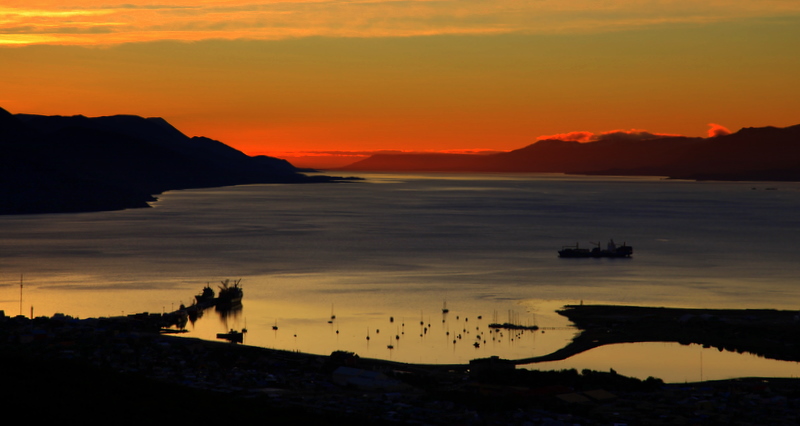
We departed Ushuaia on Monday evening for the Drakes Passage crossing to Antarctica. The Akademik Ioffe sailed east through the Beagle Channel amidst a blaze of evening sun streaming through the clouds, highlighting the last of civilization that we would see for 10 days.

Navigating the channel took us through to about midnight from when we were in open sea. Apparently it was calm; at least that is how the experienced expedition leaders describe a two to three metre swell. Still, the Akademik Ioffe took this in its stride and provided a relatively stable crossing. It has a sophisticated stabilization system which shifts the fresh water supply rapidly between tanks to counter the roll induced by the movement of the sea. The end result is a gentle but nevertheless noticeable rocking which has been fine for me but left some of the expedition members feeling somewhat less than ideal. However the turnout for meals has been pretty high so I guess most are OK.

During our passage through the Beagle Channel we all sat through the first instalment of our expedition leader’s story. Robert Swan is the founder of 2041 and can be best described as a courageous modern day explorer. He has trekked to both the North and South Poles on foot and uses his experiences to help people understand the principles and practices of leadership. It turns out that his first expedition to the South Pole in the mid 80’s was in part sponsored by Shell – we supplied the fuel for the ship and oil for the burners used on the walk. But extracting this had been a challenge in itself – Shell had initially declined but was eventually persuaded of the merit of such a gesture by evidence that the company had done the same for Captain Scott, the famous Antarctic explorer, when he first attempted the journey some 70 years earlier. Robert hadn’t taken “no” for an answer and instead had hunted through Scott’s papers in the British Library until he turned up proof of the connection in the form of a picture showing Scott sitting in his Antarctic hut on a drum of “Shell Spirit”.

Apart from good conversations with many of the expedition members and some excellent meals, the highlight of Tuesday was taking endless photographs of the various sea birds following the ship. It was pretty much that or nothing as there is little formal programme during the crossing itself.  Most spectacular are the huge albatross, which seem to effortlessly glide around the ship for hours on end with hardly a flap of their wings.

My “climate change team” met for the first time in the afternoon. This is a group of very knowledgeable people from within the expedition who have been drafted by the 2041 team to help me lead a series of discussions on climate change over the coming ten days. As I mentioned before, this is an issue that is high on almost every participant’s agenda and it simply isn’t going to be possible for me to sit in on every team discussion – so now I have a group of ambassadors to help do that – and very passionate ones at that.

We passed over the Antarctic Convergence at about midnight on Tuesday. This is the point at which the warmer waters – i.e. 10⁰C – of the Southern Ocean give way to the much colder waters of the Antarctic – it also means we are in the Antarctic region – finally.

  • Antarctica

On to Drakes Passage

dchone March 16, 2009

We head off in a few hours after some free time to look around Ushuaia and grab some lunch. This morning we had the first of a series of safety briefings with the very clear reminder than this is not “business as usual”. Drakes Passage presents a formidable obstacle between here and the Antarctic Peninsula and one that should not be taken lightly. Safety, awareness and common sense are everything and we were all reminded of this by the very expert and experienced team leaders on this expedition.

The real highlight of the last twenty four hours has been getting to know the people who I am sharing this experience with. They come from all parts of the world and all types of disciplines. There are about sixty of us (not including the 2041 team), including a number of corporate teams, students, teachers and inspired individuals. We had a session yesterday afternoon where each person gave a 90 second talk on why they are here and what they hope to get out of the expedition. Nearly 90% of the speakers mentioned climate change as a key issue for them and one that they really hoped to learn more about – so as the leader on the issue during the expedition the pressure is on me!! What was enormously impressive was the depth of feeling amongst the group. The passion runs strong and the motivation to foster change is remarkable.

I have just been told that communication is difficult in the Drake Passage, so don’t expect another blog posting until later in the week.

You can follow the progress of the ship by clicking on the IAE 2009 “Current Location” graphic: 

Thanks for taking an interest.

  • Antarctica

Ushuaia, Tierra del Fuego

dchone March 15, 2009
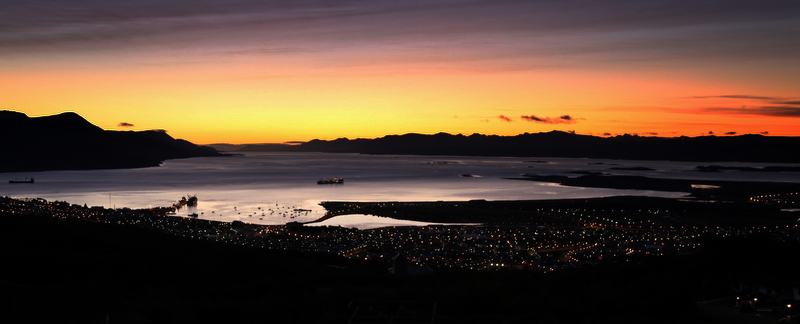
Sunrise over the Beagle Channel

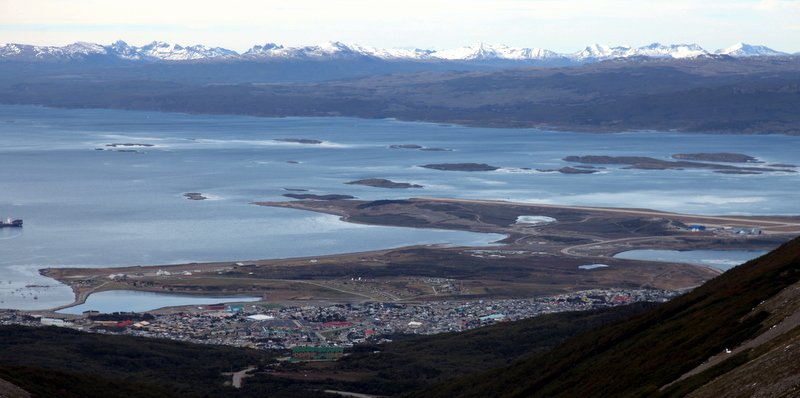
Sunrise over the Beagle ChannelUshuaia Airport in the Beagle Channel

Sunrise over the Beagle Channel
Ushuaia Airport in the Beagle Channel

Ushuaia Airport in the Beagle Channel

  • Antarctica

Finally here (well almost)

dchone March 15, 2009

Our maps of the world are generally flat and wide, which means that it looks like a major excursion to go from east to west, say from the UK to Australia, but not very far (at least in relative terms) to go from north to south. This is not the case.

In the time it took me to get from London to Ushuaia in Tierra del Fuego, I could have easily got to Melbourne, and even started coming back. First there was the two hour flight to Madrid, then a layover, then a twelve hour flight to Buenos Aires, another layover and airport change and finally a five hour flight south to Ushuaia, stopping briefly in Trelew – quite possibly one of the most barren looking places I have ever visited. Part of the west cost of Argentina is pretty much a desert and Trelew is in the middle of it. But lots of people got off – apparently it is a great place for whale watching.

We flew into Ushuaia as the sun was setting and the full moon rising. This is perhaps the most spectacular airport setting in the world. The landing strip sits on a narrow peninsula that juts out into the Beagle Chanel and the town of Ushuaia is completely surrounded by high mountains. The flight ended with a spectacular low level manoeuvre to orient the plane with the runway, having flown in through the mountain passes. We seemed to skim over the choppy waters of the Chanel to accomplish this in the limited space available.

This morning the 2041 team hiked up to a local glacier, which like many in this region has shrunk markedly in the past twenty years.

Tomorrow we get on the ship for Antarctica, so still more south bound travel in store. If you are busily looking on one of those flat wide maps of the world you might also notice that Antarctica isn’t even on it, or if it is then it will just be a white strip at the bottom. Little wonder we don’t know much about this place, given that it isn’t even always on the map.

  • Antarctica
  • Climate Science

Time to see for myself

dchone March 13, 2009

It´s late and I am in Madrid airport waiting for a flight to Buenos Aires. From there I fly down to Ushuaia, the southern most city in the world. Then on Monday evening I board the MV Akademik Ioffe to cross Drakes passage for Antarctica.

I have joined the Inspire Antarctic Expedition 2009, run by polar explorer Robert Swan and his organisation “2041”. Robert has dedicated his life to the preservation of the Antarctic and the organisation has been established to raise awareness with young people of the importance of the Antarctic, with a view to ensuring the continuation of the Environmental Protocol of the Antarctic Treaty when it is reviewed in 2041.

Through a somewhat tenuous connection via the Cambridge Programme for Industry (a guy from BP who heard me speak at one of the CPI events), Robert approached me last year to be the climate change speaker on the 2009 expedition. This presented a tremendous opportunity and with support from Shell, here I am. I am going to try and use this blog, via my colleagues in the Shell media office, to keep a journal of the trip. I have never really done anything like this before, so I only hope I can keep it interesting. At least the pictures should be good, but you may not see them until I am back – it all depends on the satellite bandwidth.

I will be using a Canon EOS 5D Mark II, with one of EF 24-105, 100-400 or 16-35 mm lenses. I also have a small Lumix G1 with me as well.

The people on IAE 2009 are from all parts of the world, some with corporate groups, some sponsored, some just doing it for themselves.

As for the speaking bit, I have been asked to give four talks, each of about an hour. I decided to cover the science, the energy challenge, policies and technologies and finally adaptation.

The slides for the first three talks are available on Slideshare, so feel free to browse.

  • Uncategorized

A Catch 22 for the EU

dchone March 12, 2009

The EU Spring Council 2007 set out its stall for a new international agreement, committing the EU to a 20% reduction by 2020 compared to 1990, but also to a further 10%, i.e. to 30%, if comparable efforts were put in place by other nations.

This is then supported by Article 28 of the revised EU Emissions Trading Directive (as of December 2008) and paves the way for deeper reductions than the 20% by 2020 already catered for. In addition, the Directive also says:

“In its resolution of 31 January 2008 on the outcome of the Bali Conference on Climate Change (COP 13 and COP/MOP 3), the European Parliament recalled its position that industrialised countries should commit to reducing their greenhouse gas emissions by at least 30% by 2020 and by 60-80% by 2050, compared to 1990 figures. Given that it anticipates a positive outcome to the COP 15 negotiations to be held in Copenhagen in 2009, the European Union should begin to prepare tougher emission reduction targets for 2020.“

All of the above has been broadly interpreted to mean that a successful outcome in Copenagen will result in a shift of the EU target from 20% to 30%. But this throws up some difficult issues and even leaves the EU in something of a Catch 22 bind.

For starters, the Obama administration has clearly said that the US will move decisively to reduce emissions, but to a 2020 level equivalent to 1990. Given that US emissions have risen by 20% since 1990, this then reads as a 20% reduction in US emissions from current levels. By contrast, EU-27 emissions have remained flat since 1990 (actually a very slight decline), so the EU pledge of a 20% reduction since 1990 could also read as a 20% reduction in emissions from current levels.

The plateau in EU emissions comes largely from big reductions in eastern Europe, including the eastern part of Germany, following the collapse of the old Eastern Bloc. The rest of the EU has seen emission rises not dissimilar to the USA; 20+% from Austria, 10% from Denmark, 50% from Ireland, 12% from Italy and so on, with the UK being one of a very few to register a decline.

The EU situation is such that if it agrees to something in Copenhagen but then doesn’t trigger the 20% to 30% shift, it will effectively be saying that it doesn’t agree to what it has already agreed to. But equally, there is almost no possibility for the US to agree to a 20% reduction compared to 1990, let alone a 30% reduction. Even the former would represent a 40% reduction in emissions in just 10 years, hardly a plausible scenario.

The issue is “compared to 1990”. But even if it comes off the table and everybody starts to talk more sensibly about what to do from where we are now (or say 2005), Article 28 of the Directive hard wires the “compared to 1990” into the EU position. It specifically links the shift in the EU target to an EU international commitment to reduce emissions by an amount exceeding 20% compared to 1990.

This means that the EU can’t put its 20% to 30% target shift on the table as a carrot for developing countries (i.e. space in the ETS for large scale project mechanism credits), since it will not be able to trigger it because nobody will be deemed to be taking comparable action. This in turn could undermine the very process the EU is trying to encourage. Hence the catch.

Is this all legal semantics, or a real stumbling block to a solid outcome in Copenhagen. We shall see in the months to come.

  • Carbon capture & storage
  • Emissions Trading

The price is right

dchone March 5, 2009

Over the past few months the price of allowances in the EU-ETS has fallen quite sharply, down from €25 per tonne of CO2 in the third quarter of 2008 to a low of some €8, although In recent days there has been some recovery back to around €12.

The fall is linked with the sharp decline in a wide range of commodity prices and also with the matching decline in overall economic activity – which in turn is leading to lower industrial emissions. There is also anecdotal evidence that some companies are selling banked allowances to raise cash, putting additional supply into the market. 

This price movement has brought the trading critics out again, claiming that emission reductions now won’t take place in the EU and that this means the trading system isn’t working. But the reality of the situation is very different.

Irrespective of the price, emission reductions are taking place and the cap is being met. The source of these reductions may not be from the low CO2 emission projects we all want to see, but principally through the reduction of industrial activity. Call it a side effect of the recession, but importantly the cap set for the EU-ETS continues to be met and continues to ensure that the EU is on track towards its 2020 target.

Some are already calling for government intervention to limit the price fall, but perhaps we should just let the market do its job. And it will.

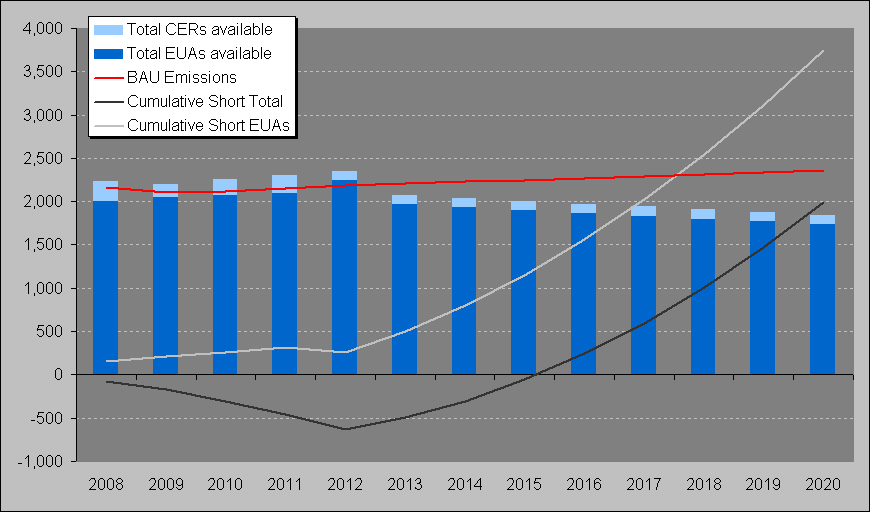
Using data available in the public domain, a colleague in Shell Trading put together the chart below. It shows that even with a recession led decline and consequent banking of a current allowance surplus, the trading system will need to deliver about 2 billion tonnes of additional emission reductions by 2020. This is equivalent to backing out some 10 GW of coal fired power station emissions with renewables, nuclear or carbon capture and storage every year from 2014 onwards. That’s 10 GW in 2014, another 10 GW in 2015 and so on. Bringing on such capacity is going to mean significant investment starting today. Of course it won’t all be power stations, but the example is uselful in that it helps establish the scale of what is going on in the EU.

Industrial companies and power generators in the EU can all do these calculations. Whilst the current market may reflect an immediate supply / demand situation, it isn’t going to derail the strategy that many companies across the EU have doubtless already put into play.

  • Policy

It begins with energy

dchone February 26, 2009

So said President Barack Obama in his pre-budget speech on Tuesday night as he unveiled the core elements of the budget that he will present in the coming days.

Then came the real content:

We know the country that harnesses the power of clean, renewable energy will lead the 21st century. . . . . .  we will double this nation’s supply of renewable energy in the next three years. We have also made the largest investment in basic research funding in American history . . . . . . . But to truly transform our economy, protect our security and save our planet from the ravages of climate change, we need to ultimately make clean, renewable energy the profitable kind of energy. So I ask this Congress to send me legislation that places a market-based cap on carbon pollution and drives the production of more renewable energy in America. And to support that innovation, we will invest fifteen billion dollars a year to develop technologies like wind power and solar power, advanced biofuels, clean coal and more fuel-efficient cars and trucks built right here in America.

On the day of Pearl Harbour, Japanese Admiral Yamamoto is now quoted as having said “I fear all we have done is to awaken a sleeping giant and fill him with a terrible resolve.” Whether he did or not is beside the point – but the sentiment is perhaps the same as that now seen within the new US administration. Don’t think for a minute that these issues will drop off the agenda or that the financial crisis will somehow deflect polictical attention away from energy and climate change.

But equally, don’t underestimate the job that must be done. On the one hand it is vast in scale, but on the other simple in terms of the actions that must be taken. There are only four areas on which to focus – energy efficiency, renewables, nuclear and carbon capture and storage. Alternatively, looking at it from a sectoral perspective it is power generation, industry, transport and buildings/commerce. To quantify the scale it is useful to visualise it, first graphically, then pictorially.

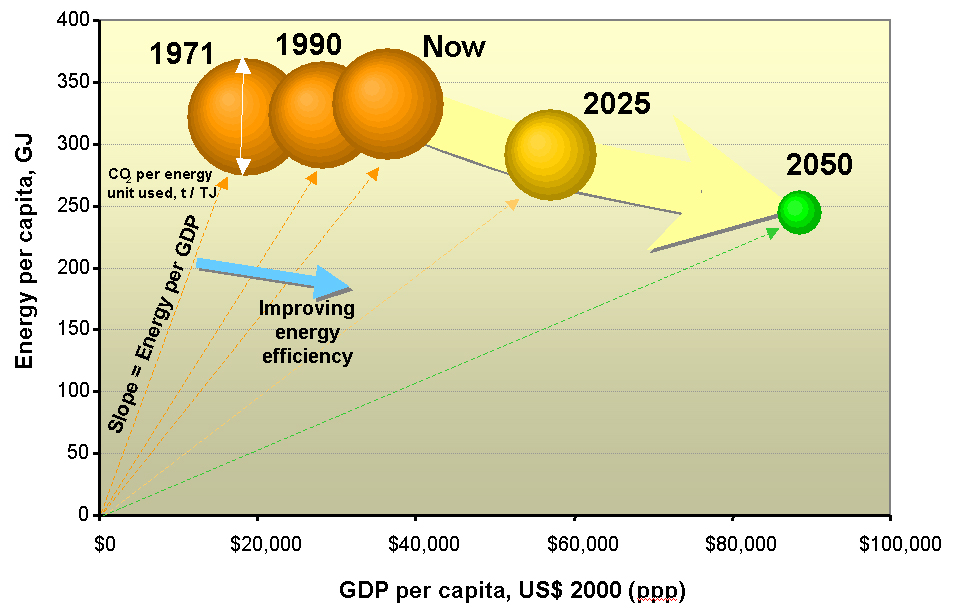
Graphically it looks something like this:

The US energy transformation through to 2050

The US energy transformation through to 2050

In this graph the position of each bubble represents progress up the energy ladder (as a highly developed economy the direct energy-GDP link has largely ended, as US per capita GDP continues to rise without a great need for additonal per capita energy). The slope of the line between a bubble and zero represents efficiency and it can be seen that the efficiency of the US economy has been gradually improving over the last three decades. The size of each bubble represents the type of energy being used, so the bigger the bubble the more CO2 intense the energy source.  From 1971 to 1990 the bubble shrank a little as nuclear and natural gas became significant parts of the energy mix, but that trend has stopped. Looking forward to 2025 and 2050, the change is significant compared to the last thirty years.

Pictorially it might look like this (run the slide show – full screen is best):

USA Energy Transformationhttp://static.slideshare.net/swf/ssplayer2.swf?doc=usaenergytransformation-pictorial-090226065507-phpapp02&stripped_title=usa-energy-transformation

View more presentations from David Hone. (tags: climate america)
  • Emissions Trading
  • Policy

The much maligned EU-ETS

dchone February 19, 2009

The EU Emissions Trading System (EU-ETS) started up successfully in 2005 and its critics haven’t stopped finding fault since. Unfortunately, these critics rarely tell the whole story and those who read the criticisms are probably not in a positon to know what is actually going on in the EU.

In a recent editorial, the Washington Post supports the arguement for a carbon tax by using the EU-ETS as “Exhibit A” in the case against emissions trading. Whilst the facts it presents are not incorrect, the context within which they are presented is questionnable.

  • “Emissions targets were set too high. . . . . The value of a carbon credit plummeted.” At the start of the ETS the data on which the EU Commission based its initial allocation was of poor quality and the Commission also took a very conservative approach to the cap. After all, this was a learning phase during which they were looking for participants to learn to measure, manage, trade and account for emissions – all of which happened. By design, the phase was stand-alone, in that there was no facility to bank surplus allowances into future periods. This meant that when the market realised the three year phase was in surplus, the price plunged quickly to zero as surplus allowances would have no future value. But the phase was a success in that a large liquid market with well prepared participants resulted.
  • “Companies made windfall profits by charging customers more for energy while selling allowances they didn’t need.” The Commission recognised that over time the CO2 price would be passed through to consumers and they indicated clearly that such pass through would trigger a shift to auctioning. That is exactly what has happened and in Phase III much higher levels of auctioning will be implemented – 100% auctioning for most of the EU power sector where price pass through is a reality. The lesson learned here, and picked up by the Regional Greenhouse Gas Trading System in the USA, is that a deregulated electricity sector can pass through the CO2 price very quickly and so should be subject to much earlier auctioning.
  • “And the Europeans have not had much success reducing greenhouse gas emissions.” Emissions within the traded sector are within the cap that has been set and continue to be. Emissions will only fall by the amount the cap dictates, no more. It is not a question of “success” as such, but a question of where the cap is set. And we know that this was set conservatively in the first phase for the reasons given above.
  • “Disputes on the next round of reductions led to the creation of a two-tiered system to appease Eastern European countries fearful of the cost to their industries.” A deal has been done between 27 sovereign states to move ahead with Phase III of the system. The cap is clear and is linked to the EU target of a 20% reduction by 2020. Most of the allowances in Phase III will be auctioned to participants, but some industries will still qualify for free allocation, but subject to a tough benchmarking process. Only only one in ten of these industries will actually get their full allocation for free and they will be the lowest emitters in any sector.

Put simply, the EU-ETS works. Yes, the first phase had its issues, but much has been learned from this. Others can put the learnings to immediate use. Phase III will be very different to Phases I and II. The EU now has a robust system in place that can and will deliver the needed reductions.

The editorial goes on to argue that “A carbon tax, by contrast, is simple and sure in its effects. Last summer, when gas prices shot up past $4 a gallon, average miles driven dropped significantly, as did energy consumption.” It is certainly true that a $2+ rise in the price of gasoline will change driving habbits, but that is equivalent to a tax of over $200 per tonne of CO2. Such a tax would roughly triple the price of cement for example. By contrast, the EU-ETS has traded in the range of $10-$40 per tonne of CO2 and that alone has resulted in a complete change in the way the power generation sector is operating. It has even been sufficient to get companies thinking hard about when they should start to implement carbon capture and storage.

David Presenting to UK Media

Presenting to UK Media

The policy solution is neither a blanket tax or a total reliance on cap-and-trade. The latter is ideally suited to the big emitters such as power generators and large industry. With a cap in place the power sector can begin its journey to zero emissions and get there in 30+ years. Much of the manufacturing sector can do the same, but probably not completely, so they may rely on some form of offset for many years to come. It is hard to imagine any lawmaker implementing an immediate $2 gasoline tax (which is quite possibly why some are advocating they do) and even that may only drive the US auto sector to look like more like its EU counterpart – where an even higher gasoline tax has been in operation for decades. A different approach is needed here, one that agressively targets vehicle efficiency, incentivises lower carbon fuels and implements road use policies such as the Congestion Charge in London. Finally, the built environment needs urgent attention as well, but revised building codes and efficiency retrofits (e.g. insulation) are probably the answer.

Yesterday I gave a short presentation to various London media folk on emissions trading:


Emissions Trading Media Briefing February 2009http://static.slideshare.net/swf/ssplayer2.swf?doc=emissions-trading-media-briefing-february-2009-1235007396523984-2&stripped_title=emissions-trading-media-briefing-february-2009

View more presentations from David Hone. (tags: climate change)

But I found a better presentation on the basics here:

Cap-and-trade through musical chairs: Short introhttp://static.slideshare.net/swf/ssplayer2.swf?doc=cap-trade-thru-musical-chairs-short-1196929999848068-4&stripped_title=cap-trade-thru-musical-chairs-short

View more presentations from grist. (tags: cap-and-trade change)
  • Policy

A bit of focus please

dchone February 15, 2009
Amongst the continuing gloomly financial news this week, we were reminded that the impact of climate change is unaffected by the short term prospects of the global economy. Professor Chris Field, speaking at the American Association for the Advancement of Science conference in Chicago, claimed future temperatures “will be beyond anything” previously predicted. “We are basically looking now at a future climate that is beyond anything that we’ve considered seriously in climate policy,” he said. Professor Field said his 2007 report, which predicted temperature rises between 1 deg.C and 6 deg.C over the next century, seriously underestimated the scale of the problem.
But the recession is having quite an affect on the response.
In Australia, after the Garnaut report, the government Green Paper and very recently the White Paper on the final design of the emissions trading system, the government has asked the parliamentary Economics Committee to “inquire into the choice of emissions trading as the central policy to reduce Australia’s carbon pollution”. This in the same month Melbourne saw record high temperatures, that I as a native of that city, never even imagined were possible. Whilst enquiry is the natural course of government, coming so late in the process will be unsettling for the markets that are already starting to form around the prospect of allowance trade in Australia. Unease, delay and caution in the face of recession are not what we need.
On the other side of the Pacific, again triggered by the recession, a massive stimulus plan has been approved by the House and Senate in Washington and now awaits the President’s signature. Within it are billions for renewable energy, carbon capture and storage and energy efficiency measures such as home insulation. This is all good, but where is the broader plan within which this sits and the emissions trading system to drive future deployment after the initial boost from the stimulus. In reality, it could still be three or four years away – and that will just be for the start-up phase. I alluded to the framework back in January and whilst I welcome the energy components of the stimulus package, the encompassing framework is really a necessity.
So, a mixed week for government staring down the twin barrels of climate change and recession. Whilst stabilising our economies remains an essential priority, a laser like focus on energy and climate change is an absolute necessity.

Posts pagination

Previous 1 … 52 53 54 Next
Shell Climate Change
Contact / Proudly powered by WordPress Theme: Booklet.
Loading Comments...