Skip to content
  • Home
  • About David
  • Twitter
  • Facebook
  • LinkedIn

David Hone

Climate Change Advisor for Shell

Hello and welcome to my blog. There's lots said about why climate change now confronts us, and what it means, but the real issue is what to do about it. Plenty is said about that too, but there's not enough discussion on the practical aspects of implementation. Focusing on energy, that's what my blog sets out to achieve.

More about me

RSS Feeds

RSS feed RSS - Posts

  • How RSS feeds work
  • My blog rules

Follow

  • View Shell’s profile on Facebook
  • View davidshellblog’s profile on Twitter
  • View davidhone’s profile on LinkedIn

My new Amazon book

Putting the Genie Back


Recent Posts

  • Temperature implications for a troubled world
  • A landmark announcement from China
  • Can a 90% reduction in greenhouse gas emissions be achieved by 2040 in the EU?
  • Different planes or new fuels?
  • Like it or not, carbon management is the future
  • Five years on from COVID-19 – a scenario perspective

I am also interested in...

  • Global Climate Change
  • Putting the Genie Back
  • RealClimate
  • Shell

Archives

  • Emissions Trading
  • Carbon capture & storage
  • Carbon price
  • Climate Science
  • UNFCCC
  • Low carbon economy
  • Policy
  • Net zero emissions
  • Renewables
  • Twitter
  • Facebook
  • LinkedIn

Shell Climate Change

David Hone – Chief Climate Change Advisor for Shell

  • Home
  • About David
  • Carbon price
  • Emissions Trading
  • Kyoto Protocol

Half time in Doha (a.k.a. one hundred days to change the world)

dchone December 3, 2012

After a week of talks in Doha at COP18, it is difficult to draw a clear conclusion about how the conference might conclude. Certainly there is discussion along the lines I discussed last week, but progress is slow and many of the historical divisions have resurfaced, despite the apparent progress made in Durban last year with the agreement for dialogue on the basis of all nations making commitments to act. I suspect that like many of these conferences, the last moments of the second week will see a rapid push for concluding text. Time will tell.

A key agenda item for this COP is the real start of discussions within the ADP, where the bulk of the negotiations towards a 2015 agreement should take place. There really isn’t a great deal of time for this to transpire, with perhaps as few as 100 negotiating days available between now and the end of COP21 in 2015. One hundred days to change the world and the process remains in the earliest of stages of thinking about what it needs to think about. To this end a roundtable was convened on Saturday such that the ADP Chair could seek input from the NGO community. Some industry colleagues approached me and said that the business community had a dozen seats in a lunchtime session with the ADP and as Chair of IETA, I was offered one. Initially this sounded like quite an opportunity, until we got into the room and realized that this was a single two hour session with all of the NGO community, not just those from business (otherwise known as BINGOs). Seated in a huge square in an enormous room in the cavernous QNCC (Qatar National Convention Centre) were the YOUNGOs, BINGOs, TUNGOS, INGOs, RENGOs, ENGOs, CINGOs, WGNGOs, FANGOs and RINGOs (young people, businesses, indigenous people, religions, environmentalists, cities, women & gender, farmers and researchers). Still, everybody was succinct and to the point and the business representatives were able to make three key points;

  1. It’s about putting a robust price on carbon. Don’t expect voluntary action to be effective (in response to a presentation by Ecofys, see below). Many businesses support putting a price on carbon, just look at the recently released Carbon Price Communiqué.
  2. A carbon price can deliver scale – just look at the large impact from the relatively small CDM. One billion CERs, ~$10-15 billion in carbon finance, about $100 billion in project investment.
  3. The interaction of business with the ADP is critical to a successful outcome and needs to continue.

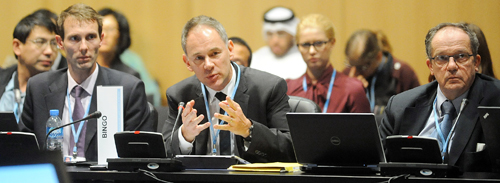
I delivered the first point – see below (thanks to ENB for the photo), between colleagues Jonathan Grant of PWC and Thierry Berthoud of WBCSD.
The session had started with a series of presentations from invited external presenters. Abyd Karmali of Bank of America / Merrill Lynch delivered a powerful presentation showing how tailored carbon price based financial mechanisms could deliver further project activity and therefore real reductions in the run-up to 2020. This was in stark contrast to a presentation prepared by Ecofys, which argued for a series of specific activities (wedges) to bridge the gap from where we might be in 2020 in terms of emissions to where we needed to be. This included activities such as company voluntary reductions, the voluntary “greening” of the assets of the 20 largest banks, the expanded use of voluntary offsets by companies and consumers and a global ban of incandescent lamps. These alone are supposed to deliver 5 GT of reductions by 2020.

While I won’t challenge the calculations themselves, the reality of implementing these measures is highly questionable, particularly the voluntary ones. This was the modus operandi of the late 1990s and it simply wasn’t a sustainable path forward. It certainly isn’t today. Even back then, company voluntary reductions were never meant to deliver a globally coherent pathway forward, rather they were to demonstrate to policy makers the types of actions that could be initiated given the right policy signals. In the case of Shell, we even established a modest internal carbon price through a small trading system to do this, again not to deliver major change but to demonstrate the possible. It concerned me that the ADP might take this proposal seriously, enough to overlook the real work that needs to be done to deliver the types of mechanisms discussed by Karmali. Such mechanisms are already being used, albeit on a modest scale, to drive real reductions using CCS in places like Alberta, the UK and the EU.

One of the features of a COP is the side event schedule. These are presentations put on by observer organizations which run in parallel with the main negotiations. They are attended by anyone interested in the subject, including national delegates, other observers and UNFCCC staff.  Today IETA, the Enel Foundation and the Harvard Project on Climate Agreements (Belfer Center for Science and International Affairs) joined forces to put on an afternoon session to discuss “New Market Mechanisms”. So far the attendance at COP18 side events has been a bit desperate, but this one attracted a huge crowd. The room was completely full with attendees standing 5+ deep at the rear.
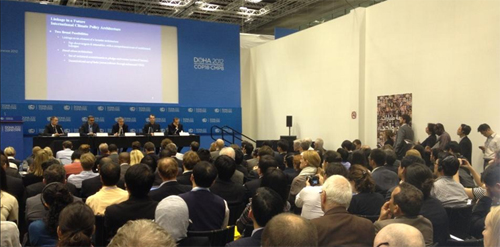
Rob Stavins from Harvard led off and gave a broad introduction to the work the Center was doing on international market mechanisms and made a number of observations about market design and linkage. This was further supported by a second Harvard presentation by his colleague. Two business presentations followed, one by me on a possible framework which would foster an eventual global carbon market (Establishing a Global Carbon Market) and similarly by a representative from the Italian energy company Enel. The Environment Minister from Costa Rica offered concluding remarks.

The content was solid and interesting, but the highlight was the crowd. Clearly there remains a real and vibrant interest in the use of carbon markets and carbon pricing to drive emission reductions.

So that is a bit about the week that was. The gigantic QNCC felt a bit on the empty side last week, but that is being corrected as Ministers, their support staff and more observers arrive today and tomorrow. We shouldn’t forget that this is still a complex multilateral negotiation, sometimes bedeviled by bureaucracy, mystery and intrigue. This was summed up for me when a colleague commented that he had been in one of the contact group meetings, where “they square-bracketed a semi-colon” (which means that the use of the semi-colon was still being negotiated)!!!

On to week two.

  • Canada
  • Carbon price
  • CDM

Expectations for COP 18 in Doha

dchone November 26, 2012

This week sees the start of the 18th Conference of the Parties of the UNFCCC, or COP18 for short, in Doha, Qatar. This should be a busy transitional COP, with much on the agenda to resolve and important steps forward being taken toward a long term international agreement. But procedural issues, agenda disagreements and fundamental sticking points could still dominate, leading to a two week impasse. Let’s hope not.

At the core of the process lie three work streams which have evolved over many years.

The oldest of these is the discussion on the Kyoto Protocol (KP), which has now been running in one form or another for most of the twenty year history of the UNFCCC. Discussion on a second commitment period (KP2) over the past years have embodied the toughest issues in the climate negotiations, such as the role of developing countries in reducing emissions, engagement with North America (neither Canada or the United States will participate going forward) and the need to put a robust price on CO2 emissions. I am a big fan of KP, despite its shortcomings. It was designed with carbon pricing as its central theme, allowed countries to trade to find lowest cost abatement pathways and through its architecture encouraged signatories to implement cap-and-trade based policy frameworks within their respective economies. The simple but clever ideas within it have not been matched since in terms of effectiveness and efficiency despite years of negotiations. Given sufficient willingness, there are clearly routes forward by which KP could evolve to become the much sought after “21st Century global agreement”, but instead it is reaching the end of its shelf life. There seems to be no resolution with North America under this banner, developing countries appear reluctant to let it be the approach to govern their much needed actions and even the country of its namesake city is unwilling to sign again on the dotted line. Australia and the EU remain as the KP bedrock, if for no other reason than to rescue the CDM and consummate their carbon market linkage with a common approach to accounting, offsets and single market currency (AAUs and CERs). The parties do need to agree on KP2, despite the lack of critical mass, and then roll forward its inherent carbon market architecture into the new grand design.

Next comes the discussion on long term cooperative action, or LCA, a workstream which appeared in 2007 at the Bali COP and is home to a broad range of developments from the Green Climate Fund (GCF), the Nationally Appropriate Mitigation Action (NAMA), the much discussed New Market Mechanism (NMM) and more recently the Framework for Various Approaches (FVA). It was meant to deliver the grand deal at Copenhagen in 2009 but didn’t and now labours on with many loose ends and partially thought through ideas which have not been implemented or even fully negotiated. Nevertheless it has been a useful testing ground for new thinking, but has not yet delivered any real mitigation action. It needs to stop now, but difficult issues remain such as the funding of the Green Climate Fund and the modalities for actually spending any money that may arrive in its coffers. These spinoffs from the LCA will need to continue under one of the Subsidiary Bodies or within the ADP (see below) discussions, but the parent discussion should be put to rest in Doha.

Now comes “the new hope”, the Durban Platform for Enhanced Action. For some, the parties at COP17 simply kicked the can 9 years down the road knowing that little new progress would be made, but for many this represents a much needed and major reboot of the process after years of making almost no progress at all on the respective roles of developed, emerging and developing economies. As Harvard’s Rob Stavins noted in his blog of January 2012;

Now, the COP-17 decision for “Enhanced Action” completely eliminates the Annex I/non-Annex I (or industrialized/developing country) distinction.  It focuses instead on the (admittedly non-binding) pledge to create a system of greenhouse gas reductions including all Parties (that is, all key countries) by 2015 that will come into force (after ratification) by 2020.  Nowhere in the text of the decision will one find phrases such as “Annex I,” “common but differentiated responsibilities,” or “distributional equity,” which have – in recent years – become code words for targets for the richest countries and a blank check for all others.

We should not over-estimate the importance of a “non-binding agreement to reach a future agreement,” but this is a real departure from the past, and marks a significant advance along the treacherous, uphill path of climate negotiations.

Although there have been some opening salvos fired in the ADP (Ad-Hoc Working Group on the Durban Platform for Enhanced Action) in various inter-sessional meetings this year, the heavy lifting for this work stream needs to start at COP18. In recent months the IEA, the World Bank, PWC and others have all made it abundantly clear that unless some truly meaningful progress is made in the sort term, the 2 deg.C goal will pass us by (it may already have) and that before we know it we will be looking at a 4 deg.C outcome, along with all its consequences. Even the timetable for the ADP, which seeks to reach agreement by 2015 for implementation in 2020 is problematic in terms of the need for immediate action, but it is what it is.

The ADP needs to define a work programme that embraces the five primary strands of action coming out of the KP and LCA, namely;

  • National action defined through specific targets, goals and actions, but aligned with the overarching mitigation objective. This would also include REDD.
  • An underlying carbon market infrastructure as currently embodied by the KP but adapted to the applicable framework for mitigation action. Without an evolving price on carbon in the international energy markets, mitigation action will stall. This work stream should also pick up the NMM discussion.
  • A funding mechanism that can leverage private sector finance for kickstarting technologies and helping less developed economies invest in a low carbon pathway forward. This is the GCF.
  • A continuation of the work of the TEC and CTCN to share knowledge and best practice arising from technology implementation.
  • A robust approach to adaptation.

Recently the World Business Council for Sustainable Development resurfaced work that it undertook back at the start of the LCA, but which is highly relevant to the first of the two prospective work areas above. “Establishing a Global Carbon Market” looks at how the substance of the KP carbon market can be applied much more broadly to an evolving world of various approaches.

The above represents a tall order for two weeks work, but with some 10,000 people in tow there is certainly enough labour at hand to get this heavy lifting done. A refined single track approach will bring much needed focus back to the discussions which then paves the way for at least some hope that the 2015 goal for a new agreement can be met. In summary, the big asks for this COP are:

  1. Agreeing a continuation of the Kyoto Protocol through to 2020 and then politely ushering this Grand Dame of the UNFCCC off the stage with some reverence and applause.
  2. Bringing closure to the LCA work programme and shifting some key components (e.g. GCF, TEC) into the formulation of the ADP.
  3. Establishing a clear work programme for the ADP, which incorporates as a priority, the foundations for a continuing and evolving global carbon market.

Good luck and success to all the delegates.

  • Carbon capture & storage
  • Carbon price
  • Climate Science

A simple choice – 4°C or a carbon price

dchone November 20, 2012

As if following on deliberately from the PWC report which I wrote about last week, come two new initiatives announced this Monday.

The first is a report from the World Bank and is the flip side of the PWC finding that a 2°C goal is now effectively out of reach. Turn Down the Heat: Why a 4°C Warmer World Must be Avoided, has been commissioned by the Climate Change Adaptation team at the World Bank, utilising the expertise of the Potsdam Institute for Climate Impact Research. Starting with the impacts that we are already seeing in a 0.8°C world, it looks at the unsettling prospects of a 2°C world and then the somewhat alarming implications of letting the climate issue slide and all of us wandering, eyes wide open, into a 4°C world.

The report is measured in its approach, not relying on histrionics to gets its message across. Rather, by stepping through the issue in terms of areas of concern against current observations, 2°C and 4°C impacts it gives the reader clarity in terms of where we are now, the political space currently targeted and the expected consequences in the medium term of not acting. The report also notes that impacts such as sea level rise will play out over many hundred of years, causing ongoing disruption over that period. A wealth of data is presented from a variety of sources, covering concerns such as ocean acidification, ice loss (sea level rise), extreme temperature events, agricultural impacts, water stress, disease vectors, non-linear change and changes to critical eco-systems.

The President of the World Bank Group, Dr. Jim Yong Kim sums up the issue very clearly in his forward:

We are well aware of the uncertainty that surrounds these scenarios and we know that different scholars and studies sometimes disagree on the degree of risk. But the fact that such scenarios cannot be discarded is sufficient to justify strengthening current climate change policies. Finding ways to avoid that scenario is vital for the health and welfare of communities around the world. While every region of the world will be affected, the poor and most vulnerable would be hit hardest. A 4°C world can, and must, be avoided.

Avoiding 4°C brings me to the second initiative of the day, the Carbon Price Communique. This is a statement released at an event in Brussels by the The Prince of Wales’s Corporate Leaders Group on Climate Change (CLG), a group which brings together business leaders from major UK, EU, and international companies who believe that there is an urgent need to develop new and longer term policies for tackling climate change. The statement serves as a timely reminder of the need for a carbon price within the global energy system, ideally delivered through national and regional market based policies such as the ETS in Europe. The Communique follows from similar statements in previous years, but is much more focussed on a specific policy recommendation that all governments now need to take on board. At launch, the Communique had been signed by well over 100 companies, with the numbers growing daily.

The Communique goes beyond the CLG and includes input from the International Emissions Trading Association (IETA) and the World Business Council for Sustainable Development (WBCSD). This adds strength to the effort and hopefully brings even wider business support.

At the heart of the Communique is the key ask:

Putting a clear, transparent and unambiguous price on carbon emissions must be a core policy objective. Although there are a number of mechanisms that can be used to do this, as businesses we would focus on working through the market, utilizing approaches such as emissions trading which offer both environmental integrity and flexibility for business. A price on carbon will reveal the lowest cost pathway to existing emissions reduction goals and can open the door to increased ambition. 

The strongest evidence for the need for a carbon price comes from one technology, carbon capture and storage. Without it, there is little possibility of balancing rapidly growing energy needs against an atmosphere with a finite capacity to hold CO2 and stay below a given temperature threshold. But getting CCS will require a price on CO2 emissions. Along the way, a clear pricing structure will deliver rapid fuel switching, new bioenergy technologies and renewable power generation. But the eventual prize is CCS, also because it is currently the only known approach to deliver a reliable negative emissions scenario which the World Bank 4°C report identifies as the necessary approach to actually reverse some of the damaging impacts it identifies (e.g. ocean acidity beginning to recover by the end of this century).

More companies need to read, recognize and sign the Carbon Price Communique in the coming weeks.

The PWC report is a reminder that the lack of substantive action today has consequences. In support, the World Bank has given us a clear heads up on what those consequences are. Finally, there is the Carbon price Communique and the growing level of business interest behind it. This is what governments now need to do and it is clear that a significant portion of the business community is there to support such action.

  • Climate Science
  • Greenhouse gases

A grim warning about the 2°C target – but then what?

dchone November 12, 2012

Last week PWC released the 2012 version of its “Low carbon economy index”, the fourth edition of a publication that started just prior to the Copenhagen COP. The main message delivered by the publication is a grim one, although hardly surprising, that the much discussed 2°C target is now effectively out of reach.

 We estimate that the world economy now needs to reduce its carbon intensity by 5.1% every year to 2050 to have a fair chance of limiting warming to 2°C above pre-industrial levels. Even to have a reasonable prospect of getting to a 4°C scenario would imply nearly quadrupling the current rate of decarbonisation. The decarbonisation rate required for a 2°C world has not been achieved in a single year since World War 2. The closest the world came to that rate of decarbonisation was during the severe recessions of the late 1970s/early 1980s (4.9% in 1981) and the late 1990s (4.2% in 1999). The expected reduction in emissions resulting from the current economic slowdown has not materialised, partly because of sustained growth in emerging markets.

Even more bad news follows, with an analysis of the various national pledges made following the Copenhagen COP. Not only does the publication make it clear that the cumulative impact of the stated contributions is insufficient for a 2°C pathway, but that many nations appear to be falling short of actually meeting them.

Even more worryingly, with eight years to go, it is questionable whether several of these pledges can be met.

The resurgence of gas in the global energy mix features in the report as an important driver of change, albeit with the concern about long term lock-in. Nevertheless, growth in natural gas production is leading to a real reduction in emissions in some parts of the world, but particularly the United States.

No matter which country or region you look at, progress made is pretty dispiriting. In a table of some 20 key countries, the worst performer in 2011 was Australia, although over the last decade it hasn’t done too badly in terms of its change in carbon intensity. I suspect that is more due to the fact that it didn’t plunge into recession like almost everybody else, so carbon intensity continued to fall as growth remained high. Therein lies a problem with using carbon intensity as the metric – appearances can sometimes be deceiving.

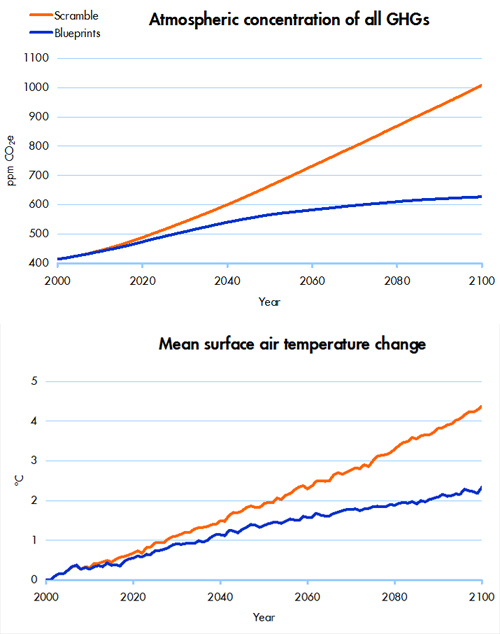
With 2°C pretty much condemned to the history books, the report goes on to look at the increasing risk of a much higher temperature rise over this century. Even the possibility of an excursion to 6°C is mooted. This outlook isn’t too far off the Shell Scramble (2008) scenario which resulted in CO2e levels approaching 1000 ppm by the end of the century and a consequent temperature rise of over 4°C and rising. By contrast, Blueprints saw temperatures beginning to plateau at between 2°C and 3°C.

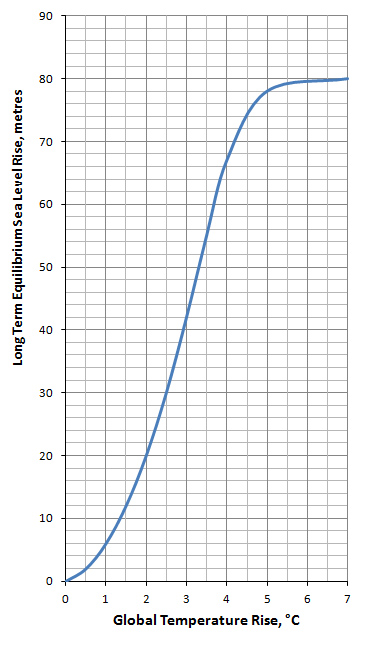
None of this is good news, particularly given the amount of change that can take place in the global ecosystem as a result of small changes in temperature. Take sea level, for example. Although it could take well over a millennium to reach a new equilibrium level, the end result is incredibly temperature sensitive. We shouldn’t be surprised by this given that sea level was over 100 metres lower than today during the previous ice age, when temperatures were lower by about the amount we are worried they may rise in the future. As indicated below, a shift from 2°C to 2.5°C adds about 10 metres of eventual sea level rise (although not anytime soon).


All this raises the question as to what we should or could do, given that 2°C is not feasible. The “numbers guys” at PWC don’t go there and arguing for a higher target is a political non-starter, but at some point the discussion is going to have to happen.

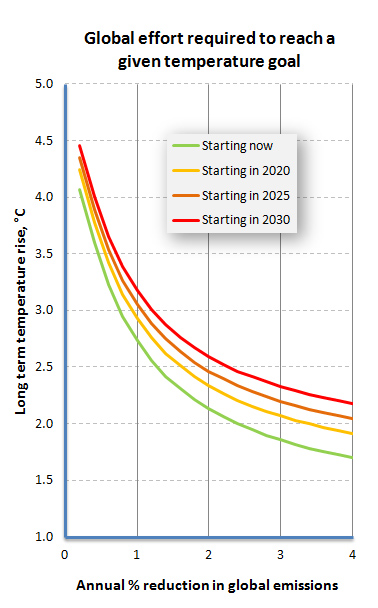
 Based on the work of Allen, Meinshausen et al, which equates a given stock of atmospheric CO2 with long term temperature rise, it is possible to derive a chart which shows, for a given annual reduction until emissions are zero, the impact in terms of expected (midpoint) temperature rise.

For example, starting today, 2°C requires about a 2.5% year on year reduction in emissions – and this is now deemed infeasible by PWC. But if we delay until 2025, the required reduction is over 4% p.a.

Knowing that the world isn’t going to do much until 2020 when a new global agreement is scheduled to kick in, a 2.5°C goal requires about a 1.6% p.a. reduction, assuming action starts immediately. This would mean no new emissions from 2020, plus some 100 very big CCS projects (1 GW power station) starting up each year through the 2020s on existing facilities – and so on. This isn’t very different to the rate at which new coal fired power plants are appearing today, so it is probably feasible from an implementation perspective. Of course keeping all other emissions in check will be a further challenge, but that task could potentially be achieved by aggressive fuel switching and renewable energy deployment, supported by efficiency improvements.

The PWC report is a timely reminder of the situation that we are now in and the ambition that the proposed new global agreement is going to have to aspire to.

  •  Allen, M. R. et al (2009) Warming caused by cumulative carbon emissions towards the trillionth tonne, Nature, 458:1163-1166, which argues that a one trillion tonne release of carbon gives a most likely warming of 2°C, with a likely (one-sigma) uncertainty range of 1.6-2.6°C.
  • Meinshausen, M. et al (2009) Greenhouse gas emission targets for limiting global warming to 2°C, Nature, 458:1158-1162, which argues that a total release of 0.9 (0.71) trillion tonnes of carbon gives a 50% (25%) risk of temperatures exceeding 2°C.
  • Allen, M. R. et al (2009) The Exit Strategy, Nature Reports Climate Change, 3:56-58, which provides a commentary on the implications of the above papers for non-specialists.


  • Climate Science
  • South Korea
  • United States

Simplifying the Planetary Boundaries

dchone November 2, 2012

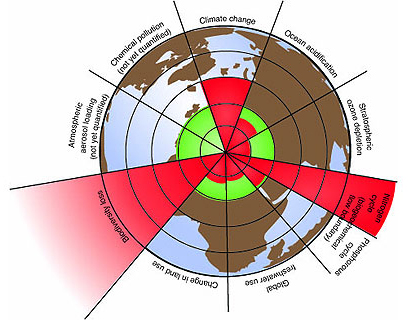
I have just got back from the annual Council meeting for the World Business Council for Sustainable Development (WBCSD) where it was good to hear the new President, Peter Bakker, talking about a much more focused and serious response from the organisation to key issues such as climate change. During the week real challenge has come from the likes of Paul Gilding and Will Steffen of The Stockholm Resilience Centre. The latter is well known for the development of the Planetary Boundaries framework, which seeks to quantify the limits on a set of critical parameters impacting the stability of the conditions of the Holocene period (which has seen the development of human civilization during a 10,000 year period of relative global stability).

The nine Planetary Boundaries are shown in the figure above and are;

  • Stratospheric ozone depletion
  • Nitrogen cycle
  • Phosphorous cycle
  • Global freshwater use
  • Change in land use
  • Biodiversity loss
  • Atmospheric aerosol loading
  • Chemical pollution
  • Climate change (level of CO2 in the atmosphere)

These have become a useful metric, but Will Steffen admitted that the complexity of the subject has been a challenge. A further challenge to simplify the structure has been posed back to the Stockholm Resilience Centre. They have taken up this challenge and revisited the approach, reducing it to three critical metrics. They are as follows;

  • Climate change – rather than just measuring this in terms of CO2 in the atmosphere, the metric is the global heat balance. Because of increasing levels of greenhouse gases in the atmosphere, the atmosphere is no longer in heat balance, rather there is more heat coming in than going out. This situation needs to be brought back into check.
  • Biodiversity – this is key to the production of goods and services from the biosphere, including most critically food for human consumption.
  • Introduction of novel entities – this is about the introduction of new “stuff” into the environment.  Perhaps one of the best examples of this was the use of Chlorinated Fluoro-carbons (CFC). These offered tremendous economic benefit but with no concept of the damage that would be done to the ozone layer. Will Steffen made an interesting observation about this and noted that we missed a major catastrophe almost by chance. CFCs could well have been BFCs or bromine based. Had this been the case, the more reactive nature of bromine would have devastated the ozone layer by the time the interaction was unravelled, with no chance of recovery. Fortunately this wasn’t the case, but the point was clear.

The nine boundaries work still stands and will continue to be critical to their thinking, with this new model more an “aide memoire” to the bigger picture.

P.S. This is becoming old news now, but in the same session at the WBCSD meeting, a comment was also made about Hurricane Sandy, its impact and climate change. The view expressed was that these are linked for three reasons;

    1. This was by far the biggest hurricane ever recorded north of the Carolinas. It was driven by increasingly warmer waters in the Atlantic.
    2. It should have tracked out into the Atlantic as many hurricanes have done, but didn’t because of a large blocking high pressure system. There is growing evidence that the appearance of such high pressure systems is linked to the change in ice cover in the Arctic. 2012 saw the lowest September Arctic sea ice cover on record.
    3. New York infrastructure was built in a different era. Even the 20cms of additional sea level over the past century made a significant difference to the water volume in the storm surge and the consequent flooding of lower Manhattan and other low lying areas.

C2ES also released a paper on this subject during the week, which you can view here.


  • Carbon capture & storage
  • Carbon price
  • Emissions Trading

Is technology push sufficient as a policy approach?

dchone October 18, 2012

I came across an article from the Breakthrough Institute which argues for the benefits of government support for new energy technologies. The story is a few months old, but still highly relevant – in any case a related story is back on their front page this week. The technology in question is hydraulic fracturing (fracking) to extract natural gas from shale formations (shale gas). Breakthrough have come to the conclusion that the boom in shale gas is largely the result of considerable early investment in the technology by the US DOE. The article argues that this technology has transformed the USA energy scene, also resulting in a drop in US CO2  emissions. But the crunch point is the comparison with the EU, where the focus on emissions reduction has been through the development of carbon pricing. Breakthrough argues that the US is shifting rapidly to a lower carbon economy on the back of successful technology push policies, whereas the EU has a failed carbon market which is now even seeing a resurgence in coal use, some of it imported from the USA.

The differing experiences in Europe and the United States illustrate the relative efficacy of direct technology push versus carbon pricing in emissions reduction and advanced technological deployment. As we wrote in a February 2012 article in Yale e360, “the existence of a better and cheaper substitute has made the transition away from coal much more viable economically, and it has put wind at the back of political efforts to oppose new coal plants, close existing ones, and put in place stronger EPA air pollution regulations.”

. . . . .

America’s investments in technological innovation contrast strongly with the European Union’s preference for pricing signals. As Europe follows through on plans to build new coal plants that will burn for decades and America leads recent global decarbonization trends, we continue to find little evidence of success from the ETS or any other major carbon pricing schemes around the world.

There is no doubt that from an emissions perspective, the US is benefitting from the current gas boom. Back in June the IEA reported;

US emissions have now fallen by 430 Mt (7.7%) since 2006, the largest reduction of all countries or regions. This development has arisen from lower oil use in the transport sector (linked to efficiency improvements, higher oil prices and the economic downturn which has cut vehicle miles travelled) and a substantial shift from coal to gas in the power sector.

However, the story that Breakthrough is telling is more about linking events after the fact, rather than analyzing the real policy drivers. According to both Breakthrough and an analysis by Associated Press, DOE funding of fracking goes back decades, as does DOE funding for a range of energy technologies. However, this funding wasn’t linked to emissions reduction, but more to the general need for energy supply diversity, energy security and therefore the cost of energy. I have always argued for technology funding, it is an essential part of the policy landscape, particularly for technologies such as CCS. Canada has been active in this regard, with significant funding for CCS demonstration, such as for the Shell Quest project.

But it wasn’t the technology funding on its own that has delivered the change in the US. Price signals have played a key role, it is just that they are less transparent than the carbon price in the EU. Although there isn’t a carbon price mechanism operating in the USA today (across the whole economy), existing coal fired power stations and almost certainly any new ones being considered are still exposed to carbon pricing. This comes from the expectation of carbon pricing in the future, through regulation under the CAA or a later Congress implementing direct pricing. Shell uses such a price premise in its own projects, including those in the USA. We are on record at $40 per tonne of CO2. There are also more price signals for coal, such as from the new mercury rules.

What has worked in the USA is the combination of funding for new energy technologies and a price signal in the market which then drives deployment. It also happens that the coal fleet is old and even the longevity optimists amongst the power producers are starting to count down the number of years before replacement is due. Eventually, the combination of age, cost of natural gas, expected cost of emissions and likely investment required to keep the coal running delivers the knockout blow.

Turning to Europe, the modest resurgence in coal use comes from a similar set of sums, it’s just that the answer is different. The natural gas prices currently seen in the USA aren’t available, coal is getting cheaper thanks in part to US exports and the carbon price signal can even be locked in at relatively low and known levels by using the market. The result is less than desirable from the atmosphere’s perspective, but it is the reality of the current pricing signals. Back in June, Bloomberg reported;

Europe is burning coal at the fastest pace since 2006, as surging imports from U.S. producers such as Arch Coal Inc. (ACI) helped cut prices 26 percent in a year and benefited European power companies including EON AG. Demand for coal, the dirtiest fuel for making electricity, grew 3.3 percent last year in Europe while sales of less- polluting natural gas fell 2.1 percent, the steepest drop since 2009 . . .

None of this means that the EU approach to managing CO2 emissions is wrong or that price signals don’t do anything. Quite the reverse. It’s just that the answers coming out are currently giving some unexpected outcomes.

  • Carbon capture & storage
  • China
  • Europe

The Global Status of CCS

dchone October 11, 2012

The Global Carbon Capture and Storage Institute has just released its 2012 report on the current status of CCS around the world. The headline is that CCS is clearly up and running and CO2 is being sequestered. Around the world, eight large-scale CCS projects are storing about 23 million tonnes of CO2 each year. With a further eight projects currently under construction (including two in the electricity generation sector), that figure will increase to over 36 million tonnes of CO2 a year by 2015. This is approximately 70 per cent of the IEA’s target for mitigation activities by CCS by 2015.

The flip side of this is that the rate of deployment is far below anything that remotely passes for a 2°C trajectory. The report finds that in order to maintain the path to the 2°C target, the number of operational projects must increase to around 130 by 2020, from the 16 currently in operation or under construction. Such an outcome looks very unlikely as only 51 of the 59 remaining projects captured in the Global CCS Institute’s annual project survey plan to be operational by 2020, and inevitably some of these will not proceed.

I have discussed CCS many times in the past. Given the continued abundance of fossil resources, their ease of use for both mobile and stationary energy generation, combined with the fact that they continue to be very cost competitive as new extraction technologies are introduced, it is therefore highly likely that we continue to make use of them. But as the report notes, we need to limit the increase in the stock of CO2 in the atmosphere to 1000 Gt this century (giving a 50 per cent chance of limiting global temperature rise to 2°C) which in turn requires energy-related CO2 emissions to fall to zero by 2075. The only way to square this circle will be large scale deployment of CCS.

One of the surprising aspects of the report is the review of where CCS is actually happening. Conventional wisdom says the EU then North America and that is certainly true for many of the more advanced projects, but close behind is China which has a number of projects in the identification stage of development. In fact the report finds that more than half of all newly-identified projects are located there. Using CO2 for Enhanced Oil Recovery (EOR) is being investigated as a revenue option in all the projects.

  • Daqing Carbon Dioxide Capture and Storage Project (Identify stage) – a super-critical coal-fired power plant that would capture around 1 Mtpa of CO2 through oxyfuel combustion, developed by the China Datang Group in partnership with Alstom.
  • Dongying Carbon Dioxide Capture and Storage Project (Identify stage) – a new build coal-fired power generation plant with a planned capture capacity of 1 Mtpa of CO2, also developed by the China Datang Group.
  • Shanxi International Energy Group CCUS Project (Identify stage) – a new, super-critical coal-fired power plant with oxyfuel combustion being developed in partnership with Air Products, with a capture capacity of more than 2 Mtpa of CO2.
  • Jilin Oil Field EOR Project (Phase 2) (Identify stage) – EOR operations at the Jilin oil field, where around 200,000 tpa of CO2 from a natural gas processing plant are currently being injected, are scheduled to be expanded to more than 800,000 tpa from 2015.
  • Shen Hua Ningxia Coal to Liquid Plant Project (Identify stage) – a new build coal-to-liquids (CTL) facility developed that would capture around 2 Mtpa of CO2.

Perhaps the most disappointing news comes from Europe, where the value of the main CCS capital support mechanism has been reduced to a fraction of its anticipated amount following the collapse of the EU carbon market to some €8 per tonne of CO2. The EC policy objective of having up to 12 commercial-scale demonstration plants operating in Europe by 2015 is no longer achievable, with 4–5 projects operating in the next 5–6 years being a more realistic scenario. I commented on this back in June.

As well as giving a comprehensive breakdown of all the current projects, the report does the same for policy development, support mechanisms, storage potential and the progress in the technology itself. If you want to know more about CCS then this is truly a “one stop shop”.

The report download page with laptop, iPad and Kindle versions can be found here. Alternatively, you can go directly to the PDF version here.

  • Arctic
  • Climate Science

Time to think in 3D about Arctic sea ice

dchone October 3, 2012

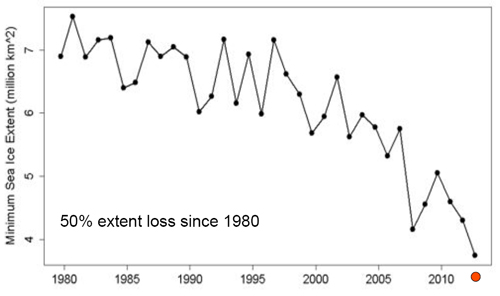
The recent rash of news alerts about the all-time-low, end of summer, Arctic sea ice extent has certainly given new food for thought about the state of the climate. Of course we shouldn’t be entirely surprised by this state of affairs as more rapid warming at the poles was anticipated long before the issue of rising emissions became a reality that we would have to deal with.


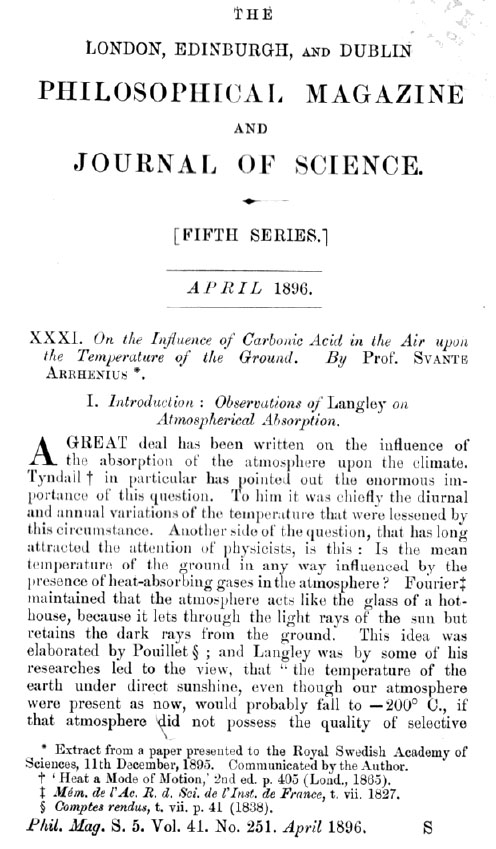
 Back in 1895, Svante Arrhenius came to the conclusion that “temperature of the Arctic regions would rise about 8 degrees or 9 degrees Celsius, if the carbonic acid increased 2.5 to 3 times its present value”. Fortunately we haven’t reached this level of atmospheric CO2 or warming just yet, but nevertheless the message was there 120 years ago.


So it was timely to be able to hear from a current expert on the subject of the Arctic at the 34th MIT Global Change Forum held in Canada last week. The speaker was Professor Louis Fortier, Scientific Director, ArcticNet, Université Laval. Somewhat depressingly, the news was worse than the already worrying news of that week, shown above.

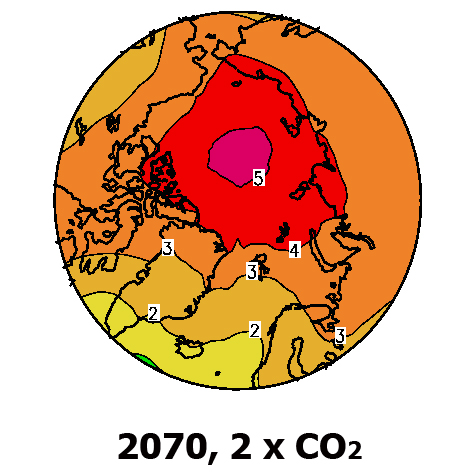
Firstly, Professor Fortier showed how climate models verified the findings of Arrhenius. In a 2070 world with CO2 at 550 ppm, warming in the Arctic is seen to be 5°C, compared to 2-3°C in lower latitudes.

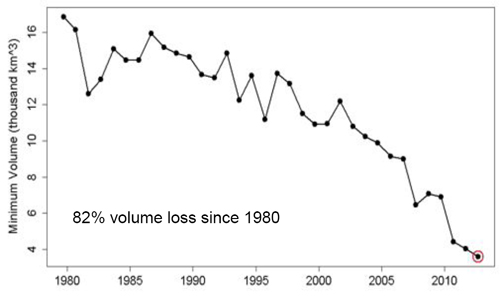
But the really alarming news came when the discussion moved from 2D to 3D. Although we think of floating ice in the 2D context, it does have some thickness. This is caused by the buildup of ice from year to year, starting with ice that survives the previous summer melt which then increases in thickness during the winter. Thirty years ago, “old ice” (layers in the pack some 5-10 years old) made up some 50% of the floating pack at the end of the summer melt. Today, there is almost none of this remaining, with the ice at the end of summer consisting of the thin remnants of the winter freeze.

The 2D view shows that September ice extent has declined by about 50% since 1980.


But the 3D view which incorporates the measurements of ice thickness shows an even more worrying trend.  Ice volume has declined by 82% since 1980.

  • Carbon price
  • CDM
  • Durban

In search of a new home for CERs

dchone September 26, 2012

Two recent publications highlight the challenges ahead in the multilateral process that continues to seek an equitable global approach to the issue of growing CO2 emissions. But comparing and contrasting them illustrates the contradictions that exist as negotiators attempt to maintain existing structures and work within the spirit of the Durban agreements.

Two weeks ago, a major report issued by the High Level Panel on the CDM Policy Dialogue recommended a very broad range of actions for stabilizing and reversing the ongoing price collapse in the CER market (Certified Emission Reduction, the carbon unit within the CDM), with a view of re-establishing the CDM as the cornerstone of the global carbon market and thereby kicking off a further round of emissions mitigation action.

This week, the Harvard Project on Climate Agreements issued a policy brief  which outlines the shape of the new paradigm that the UNFCCC process has hopefully entered following the creation of the Durban Platform for Enhanced Action at COP 17 last December. Their ambitious interpretation of the agreement sees the Berlin Mandate effectively consigned to history (which enshrined the notion that emission reduction was effectively the responsibility of developed countries and which led to the 95-0 vote on the Byrd-Hagel Resolution in the United States Senate) and a new order emerging which results in all countries acting to manage emissions. There is no doubt that the latter interpretation is the only one that makes sense, but only time will tell if this represents the new reality. The Harvard think piece ends with the challenge;

Having broken the old mold, a new one must be formed. A mandate for change exists. Governments around the world now need fresh, outside-of-the-box ideas, and they need those ideas over the next two to three years. This is a time for fundamentally new proposals for future international climate-policy architecture, not for incremental adjustments to the old pathway.  We trust that this call will be heard by a diverse set of universities, think tanks, and advocacy and interest groups around the world.

Rescuing the CDM as recommended by the Policy Dialogue is a laudable ambition, but perhaps falls into the category of “incremental adjustments to the old pathway” rather than “outside of the box ideas”. Conversely, the Policy Dialogue proposal is attempting to stave off the collapse of the very idea of “carbon markets” by rescuing the one global example of their application. While “out of the box” thinking is certainly welcome, it is also hard to argue that we are done with carbon pricing/markets and now need something new. In fact, carbon pricing remains core to the solution.

As such, we end up with the dichotomy of needing new ideas but not wanting to see the structures of the past slip through our fingers; but should we mind that they institutionalize some of the ideas within the Berlin Mandate?

The CDM was a bold idea when conceptualized in the Kyoto Protocol, starting with the simple phrase;

A clean development mechanism is hereby defined.

But has it reached its use-by date and should it be consigned to the dustbin along with the Berlin Mandate? Unfortunately the answer is both “yes” and “no”. It does represent an era of action and financing being the responsibility of developed countries only, which is no longer a tenable paradigm within which to operate. It was designed to help developed countries meet their mitigation goals and to channel funding from developed to developing countries for the purpose of sustainable development. Yet it did demonstrate a mechanism which allowed a broader range of actors to get involved in the carbon market than those immediately impacted by the cap on allowances. This has become a design feature of more recent cap-and -trade systems, albeit with home grown offset systems.

The solution for the CDM, both to rescue the market today and to prepare it for the “out of the box” solution of tomorrow, must be to disentangle it from the Kyoto Protocol and make it available as a general offset resource under the UNFCCC, perhaps even one that any nation could use when it wants to involve part of its economy in the market without actually applying a cap to it (such as the farming sector in Australia).

Considerable resource is required to establish an offset mechanism, both in design and operation. Reinventing this multiple times around the world hardly seems like the best use of government resources, but that is what is happening. Unshackling the CDM wasn’t discussed in the Policy Dialogue report, perhaps because it then enters into the complex realm of Kyoto Protocol politics. The closest it got to this was a proposal to broaden the use of CERs.

To unlock the full potential of the CDM, all countries should be enabled to use CERs, not only those with mitigation targets under the Kyoto Protocol.

But the Kyoto Protocol represents the Berlin Mandate and, according to the Harvard Project, the new paradigm is a world without such a legacy. It also makes little sense under the accounting rules of the Kyoto Protocol to have other parties dipping into that market when their compliance obligation may be governed by another system. This leaves only the more radical approach of decoupling the CDM from the Kyoto Protocol, but then following the recommendations of the Policy Dialogue to broaden its scope and expand its use.

This also takes the CDM into the world of another discussion, that of the New Market Mechanism. Under such an approach, the CDM could migrate to become the NMM, but for all nations to use within the design of their emission trading systems.

  • CDM
  • Coal
  • Electricity

Is the CDM now increasing emissions?

dchone September 18, 2012

Late last week Point Carbon reported that the Executive Board of the UNFCCC’s Clean Development Mechanism has (re)agreed to allow energy efficient coal fired power plants to be included under the mechanism. Point Carbon said:

The governing body of the U.N’s Clean Development Mechanism (CDM) has agreed to allow the most energy efficient coal-fired power plants to earn carbon credits under the scheme, causing outcry from green groups who claim the carbon market could be overrun by millions of low-quality offsets. The CDM Executive Board’s decision to lift its ban that prevented coal plants from seeking credits could allow some 40 projects, mostly based in China and India, to earn Certified Emission Reductions (CERs).

The credits are awarded to projects that cut emissions of greenhouse gases and can be used by companies and governments to meet carbon reduction targets.

. . . . .

. . . . .

The Board approved six coal plants for CDM registration before agreeing in November 2011 to suspend and review the methodology that outlines how many credits the schemes could earn, effectively stopping new projects from earning credits.

While it is always good to use a resource more efficiently, this move has potentially negative consequences for the very issue it is setting out to address, a reduction in the total emissions of CO2 to the atmosphere.

In this instance the CDM is not acting as a carbon pricing mechanism, rather it is simply incentivizing energy efficiency. In a recent paper written by a colleague (featured in a July posting), the secondary impacts of energy efficiency policy as a climate change response are explored. This particular action by the CDM Executive Board falls right into one of the problem areas.

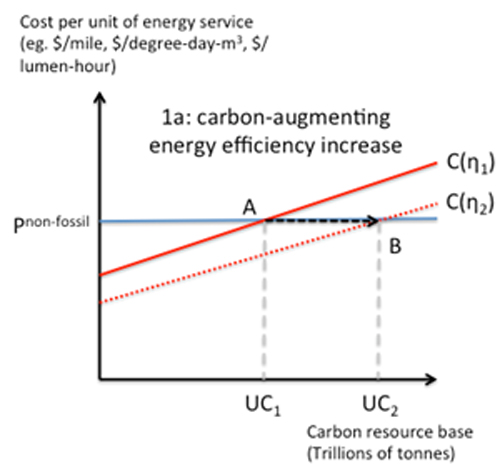
The paper presented the argument that energy efficiency action on its own could actually result in an increase in CO2 emissions. The diagram below explains this. On the vertical axis is the cost of providing an energy service, such as electricity. At the margin, this may be driven by non-fossil provision operating within the economy, such as a wind farm or the like. On the horizontal axis is a measure of the available carbon resource base. As the price of non-carbon alternative energy rises or falls, so too does the long term availability of the fossil alternative for a given technology set. At high alternative prices, more money is available to spend on expanding the fossil resource and vice versa. As the fossil resource expands, the cumulative number of tonnes of CO2 emitted will also grow, even if it takes longer for this to happen.

Assuming a given alternative cost of providing electricity (pnon-fossil), the more efficient the power stations that burn coal, the more the electricity provider can ultimately afford to pay for the coal that is used. As more coal is used and the price rises (all other things being equal), so the resource base expands (from UC1 to UC2 in the figure above) and so does cumulative CO2 in the atmosphere. Further, as the CO2 issue is basically an atmospheric stock problem, this then drives up long term warming, even if the rate at which CO2 is emitted happens to fall in the short term.

From a climate finance perspective the CDM has been a successful mechanism, albeit with some significant operational difficulties. It has paved the way for carbon pricing in many countries and has been an important catalyst for change in some areas (e.g. landfill methane). But subsidizing more energy efficient coal fired power plants, while well intentioned, may in fact have negative environmental consequences. The CDM needs to act in its purest sense, which is as a carbon price in the energy system of true developing economies.

N.B. Just prior to posting this, a colleague noted that the Executive Board may have only allowed the issuance of CERS against already approved projects to proceed, rather than allowing future projects to apply by releasing the current hold on the underlying methodology. Hopefully this is the case, but in any case the argument still stands.

Posts pagination

Previous 1 … 33 34 35 … 54 Next
Shell Climate Change
Contact / Proudly powered by WordPress Theme: Booklet.
 

Loading Comments...