Skip to content
  • Home
  • About David
  • Twitter
  • Facebook
  • LinkedIn

David Hone

Climate Change Advisor for Shell

Hello and welcome to my blog. There's lots said about why climate change now confronts us, and what it means, but the real issue is what to do about it. Plenty is said about that too, but there's not enough discussion on the practical aspects of implementation. Focusing on energy, that's what my blog sets out to achieve.

More about me

RSS Feeds

RSS feed RSS - Posts

  • How RSS feeds work
  • My blog rules

Follow

  • View Shell’s profile on Facebook
  • View davidshellblog’s profile on Twitter
  • View davidhone’s profile on LinkedIn

My new Amazon book

Putting the Genie Back


Recent Posts

  • Temperature implications for a troubled world
  • A landmark announcement from China
  • Can a 90% reduction in greenhouse gas emissions be achieved by 2040 in the EU?
  • Different planes or new fuels?
  • Like it or not, carbon management is the future
  • Five years on from COVID-19 – a scenario perspective

I am also interested in...

  • Global Climate Change
  • Putting the Genie Back
  • RealClimate
  • Shell

Archives

  • Emissions Trading
  • Carbon capture & storage
  • Carbon price
  • Climate Science
  • UNFCCC
  • Low carbon economy
  • Policy
  • Net zero emissions
  • Renewables
  • Twitter
  • Facebook
  • LinkedIn

Shell Climate Change

David Hone – Chief Climate Change Advisor for Shell

  • Home
  • About David
  • Canada
  • Carbon capture & storage
  • Carbon price

A CCS project for Canada

dchone September 11, 2012

I don’t normally use this blog to write about Shell, but last week saw an announcement that is very relevant and worthy of some further elaboration. Shell Canada, as operator of the Athabasca Oil Sands Project joint venture (with Chevron and Marathon), announced plans to proceed with a carbon capture and storage project (Quest) within the current oils sands project. This is a project that has been under discussion in one form or another since almost day one of production from the facilities, but the lack of a workable economic justification for the project has been the major impediment to progress.

In recent years the story has changed though. The Government of Alberta has developed a carbon pricing system which provides a level of underlying support for the project. The World Bank “State and Trend of the Carbon Market 2012” report describes the Alberta system (on page 89) as follows:

Alberta is Canada’s largest greenhouse gas (GHG) emitting province, accounting for 34% of the country’s total GHG emissions in 2010. This represents 235 MtCO2e, a 41% increase from 1990 levels, driven primarily by increased production activity in its oil and gas sector. On July 1, 2007, Alberta launched a mandatory GHG emission intensity-based mechanism, enacting the first GHG emissions legislation in Canada. Approximately 100 entities with annual emissions exceeding 100,000 tCO2e (ktCO2e), are required by the legislation to reduce their emission intensity by 12% from average 2003-2005 levels. Entities that do not meet reduction requirements on a given year may choose to meet these obligations by:

  • Trading “Emissions Performance Credits” (EPC) that are awarded to covered entities that reduce emissions below their set target;
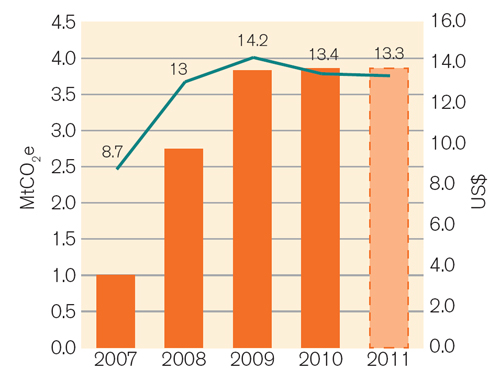
  • Paying CN$15 (US$15.2) into a technology fund; and/or
  • Purchasing Alberta-based offsets issued by the Alberta Offsets Registry under an approved protocol.

N.B. The World Bank chart below shows the number of offsets retired annually through the system with an estimate for 2011 (not announced at the time the report was published). The price has remained very close to the technology fund alternative.
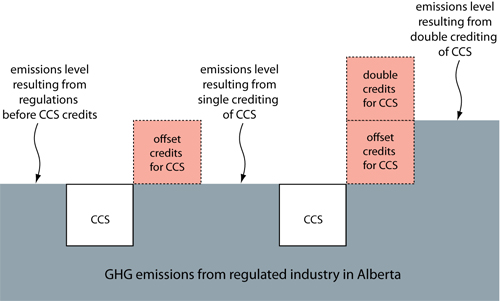
As such, this system provides an underlying base level of support of some CAN$15 per tonne of CO2 for the CCS project. In addition, in 2011 the Alberta Government announced a further support mechanism for CCS though the system, which now grants a second bonus credit for CCS projects meeting certain criteria. The Canadian based Pembina Institute published the diagram below, challenging the environmental integrity of the approach, but it also gives a simple explanation of how the mechanism works. In a completely closed system the environmental integrity  argument would be correct, but in the open ended Alberta system with payment into a technology fund as a compliance option, the argument is hardly valid. 
A further, but much less quantifiable, price signal is that coming from the California Low Carbon Fuel Standard (LCFS) and to a much lesser extent the EU Fuel Quality Directive (FQD). These mechanisms place a carbon footprint target on the fuel in the transport sector with a starting baseline about equal to the carbon footprint of oil products processed through a conventional production and refining route and then declining by about 1% per annum. When oil sands products arrive in these markets, their higher carbon footprint generates a penalty on the use of the component in the fuel pool which manifests itself as a price on carbon emissions associated with the production and use of the product. Of course the product may be targeted at other markets, but even a small location constraint on a product can lead to a trading discount in some market circumstances. This is also a carbon price of sorts. In any case, the prevalence of LCFS type approaches could well increase over the years ahead, which could penalize oil sands relative to some other production routes.

The combination of Provincial and Federal grants, a Province based carbon pricing system and its bonus credits and consideration of the role played by fuel standards in export markets in the future has allowed the project to get the green light. This should be seen as good news. CCS is the critical technology for real long term reductions in emissions – I have argued in the past that it may well be the only technology, so supporting it now and getting at least some early projects up and running should be an essential policy goal. Support remains a dilemma for policy makers, particularly in challenging economic times. However, there is a valid role to play here in that almost every carbon roadmap to 2030 and beyond shows CCS being required, yet there is currently no carbon price signal strong enough in any jurisdiction to actually build one now and therefore begin the process of demonstration and commercialization.

The project itself is medium in scale, storing about one million tonnes per annum of CO2 coming from the Hydrogen Manufacturing Unit (HMU) linked to the oil sands bitumen upgrader. The HMU produces hydrogen by steam reforming of natural gas, with a nearly pure CO2 stream as a byproduct. At high temperatures (700–1100 °C), steam (H2O) reacts with methane (CH4) to yield syngas.

 CH4 + H2O → CO + 3 H2

 In a second stage, additional hydrogen is generated through the lower-temperature water gas shift reaction, performed at about 130 °C:

 CO + H2O → CO2 + H2

 Heat required to drive the process is supplied by burning some portion of the natural gas. A very simple overview of the process is shown below.
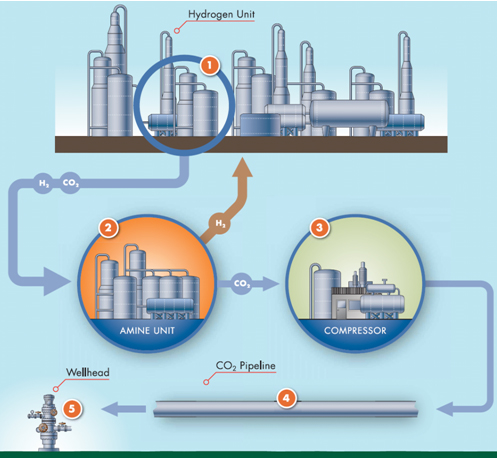
 

The capture plant is located in Fort Saskatchewan, approx 50 km N.E. of Edmonton, Alberta. The CO2 will be transported by 12 inch pipeline to storage, approximately 65 km north of the upgrader site. The CO2 will be stored in a saline aquifer formation called Basal Cambrian Sands (BCS). At 2,300 metres below the surface it is some of the deepest sandstone in the region, with multiple caprock and salt seal layers and no significant faulting visible from wells or seismic activity. The BCS is well below hydrocarbon bearing formations and potable water zones in the region. Relatively few wells have been drilled into the BCS and none within 10 km of the proposed storage site.

It’s been a long road from initial discussion, to early concept and finally the investment decision last week. But the end result is a real CCS project!!

  • Australia
  • Carbon price
  • Carbon tax

A link up between Australia and the EU

dchone September 3, 2012

As Australia struggled through the ill fated CPRS legislation and finally landed with its carbon pricing mechanism, I often thought that it would be much simpler if they just joined the EU ETS. Governments don’t tend to do simple practical things like that, perhaps it makes them feel they are giving away some portion of national sovereignty or that they aren’t doing the job they were elected for (i.e. “we must invent it here” syndrome). But despite all this and having gone the very long way around to get there, Australia has, in effect now joined the EU ETS (or perhaps the ETS has joined the Australian trading system).

Last week the Australian Government and the European Commission announced that their respective emission trading systems would link up progressively over Phase III of the EU system, but for Australian entities from the start of full carbon allowance trading in 2015. This is a bold move by both parties and quite possibly one that will make others with nascent trading systems sit up and think about where they want to go. For Australia, provided the changes can be implemented by a parliament that isn’t exactly friendly towards carbon pricing (but a wafer thin majority currently is), the move cements the system into place even further, in that undoing it would likely cause some embarrassment on the international stage. For the EU, it puts the ETS back in the frame and maybe introduces some additional demand at a time of allowance oversupply, depressed prices and a consequent lack of confidence in the system. Let’s hope this move helps both sides to deliver confidence and stability in their respective systems.

A full two-way link between the two cap and trade systems will start no later than 1 July 2018. Under this arrangement businesses will be able to use carbon units from the Australian emissions trading scheme or the EU Emissions Trading System (EU ETS) for compliance under either system. To facilitate linking, the Australian government will make two changes to the design of the Australian carbon price:

  • The price floor will not be implemented;
  • A new sub-limit will apply to the use of eligible Kyoto units. While liable entities in Australia will still be able to meet up to 50% of their liabilities through purchasing eligible international units, only 12.5% of their liabilities will be able to be met by Kyoto units.

In recognition of these changes and while formal negotiations proceed towards a full two-way link, an interim link will be established enabling Australian businesses to use EU allowances to help meet liabilities under the Australian emissions trading scheme from 1 July 2015 until the full link is established.

Various Australian, EU and other websites cover all the details, so I won’t repeat them here. Rather, let me spend some time on a key issue that this move raises, namely the future design of any international framework via the UNFCCC (or other process). Both Australia and the EU have stressed that this is a bilateral linkage, to the extent that the allowance transactions will not be processed through the International Transaction Log (ITL), but CER transactions will be. However, there will still be a Kyoto AAU balancing at various times to ensure compliance in that system (although there remains considerable uncertainty with regards the issuance of Kyoto Second Period AAUs as there has been no firm agreement on the full nature of that period).

Despite this apparent distancing from the Kyoto based ITL, it must still be the case that the overarching Kyoto framework has helped this linkage – I might even go a step further here and say “allowed this linkage to happen”. Thanks to the UNFCCC architecture, these two systems grew up with enough harmony to make a linkage possible.  They “count” the same way, “track” the same way and “comply” the same way.  Both the systems have common offset arrangements through CERs under the Kyoto Clean Development Mechanism and the units created under the Australian Carbon Farming Initiative are also Kyoto compliant. This means we have the makings of a linked system with global reach.

This could be the primary goal of a new international framework, i.e. to provide sufficient tools, rules and mechanisms which countries can use in developing their carbon trading systems, thus facilitating linkage at a convenient time for those interested in doing so. Such a linkage framework could deliver the global market that we need, as shown in my illustration below (which by the way has been around for about 5-6 years now, so for me it is great to see that one of my linkage lines has finally been filled in!!).

The opportunity to devise such a framework now exists under the Durban Platform for Enhanced Action, which aims to see a new international agreement in place by 2015, for commencement not later than 2020. The agreement between Australia and the EU should be seen as a catalyst for the thinking behind what is to come.

Finally, as something of an aside, one of the major complaints by Australian companies has been that the current $23 fixed price and the future market floor price put the Australian price of carbon “out of line with the international price”. I challenged this notion in a recent post, but irrespective those who called for such alignment have pretty much got what they wanted, although obviously not in the very short term. There may be eventual irony in this, should the EU system go through something of a recovery in its fortunes. While every indicator today points to a continued depressed price through to Phase IV, stranger things have happened in commodity markets.

P.S. I still think that the simplest approach for Canada, which has been putting off economy wide carbon pricing legislation for years, would be to join the EU ETS.

  • Copenhagen
  • Greenhouse gases
  • Natural gas

US emissions continue to fall

dchone August 24, 2012

If you dig down a few layers through the US State Department website, you will come across a Press Release from February 2010 where the USA pledged to reduce its greenhouse gas emissions.

Press Statement

Todd Stern,  Special Envoy for Climate Change Washington, DC

February 4, 2010

Special Envoy Stern: We are pleased to be among 55 countries – including all of the world’s major economies — that have submitted pledges to limit or reduce their greenhouse gas emissions under the Copenhagen Accord. These countries represent nearly 80% of global emissions. In supporting the Accord, we are taking an important step in the global effort to combat climate change.

In addition to the countries that have submitted targets or actions, a number of others have conveyed their support for the Accord. We urge all countries to join this broad coalition by promptly conveying their support for the Accord to the UNFCCC Secretariat.

The Copenhagen Accord includes important advances on funding, technology, forestry, adaptation and transparency. The United States is committed to working with our partners around the world to make the Accord operational and to continue the effort to build a strong, science-based, global regime to combat the profound threat of climate change.

I have commented on the commitment in previous postings, but just to be reminded of what was said, here is a copy of the letter sent by the US to the UNFCCC. 

Last week the US EIA released the latest greenhouse gas emission figures and they show that the country is well on track to meet this pledge, even though there is no formal program in place to ensure delivery. 

Following the sharp recession led drop, two continuing drivers for the change are the drop in coal emissions as older coal fired power plants close and the fall in automotive emissions due to tougher vehicle efficiency standards and the continuing higher oil price. As expected, natural gas emissions have risen as this fuel replaces coal in power generation, but with less than half the carbon footprint of the coal.

This trend could well continue over the coming years as further coal capacity is closed in response to the combination of EPA air quality regulation, expected greenhouse gas regulation and the growing supply of natural gas. In addition, CAFE standards should ensure further improvements in vehicle efficiency.

My original analysis of this trend produced the following chart. Two years on and we still seem to be at least in the same ballpark.

  • Climate Science
  • Policy
  • UNFCCC

How important is the two degree target?

dchone August 17, 2012

In a speech given at Dartmouth College at the beginning of this month, US Lead Climate Negotiator Todd Stern caused some consternation in the media by opening up the subject of the global two degree Celsius target. Bylines such as “US Abandons 2° Target” appeared soon after, to the extent that a further statement was made two days later by Todd Stern to say;

 “The U.S. continues to support this goal. We have not changed our policy.”

Reading the speech more closely, Stern had not dismissed the target at all nor questioned the necessity of making substantial reductions in global emissions. Rather, he had outlined a negotiating strategy which might bring nations to the table and actually get them to agree on something, rather than the status quo situation which has so far resulted in little progress.

 For many countries, the core assumption about how to address climate change is that you negotiate a treaty with binding emission targets stringent enough to meet a stipulated global goal – namely, holding the increase in global average temperature to less than 2° centigrade above pre-industrial levels – and that treaty in turn drives national action. This is a kind of unified field theory of solving climate change – get the treaty right; the treaty dictates national action; and the problem gets solved. This is entirely logical. It makes perfect sense on paper. The trouble is it ignores the classic lesson that politics – including international politics – is the art of the possible. . . .

. . . . .

. . . . .

This kind of flexible, evolving legal agreement cannot guarantee that we meet a 2 degree goal, but insisting on a structure that would guarantee such a goal will only lead to deadlock. It is more important to start now with a regime that can get us going in the right direction and that is built in a way maximally conducive to raising ambition, spurring innovation, and building political will.

The 2°C target has been around for a while, but has no particular scientific basis. Rather, it represents an integrated assessment based on many inputs. From what I have been able to find, it appears to be the point at which various systems may see a step change in their response to rising temperatures. This includes the collapse of some major ice shelves, changes in major ocean current circulation, the demise of some marine ecosystems, extensive coral bleaching and so on. Much of this is summarized in an output document from a 2005 conference, Avoiding Dangerous Climate Change, convened by the British Government prior to their hosting of the G8. Although the EU had proposed a 2°C target well before 2005, it was at this conference and the following G8 meeting where it really took hold. Finally, at the UNFCCC COP in Cancun it was agreed as a formal goal, given that the objective of the Convention is to “avoid dangerous anthropogenic interference with the climate system”.

But the 2°C objective is just the beginning  of a long chain which must ultimately stretch down to the allowable emissions of a given power plant or the need to store a tonne of CO2 in a subsurface reservoir. This chain is riddled with uncertainty which almost never gets a mention. For example, many now link the 2°C objective with atmospheric stabilization of CO2 at a level of 450 ppm and in previous postings I have talked about 2°C equating to an atmospheric stock of one trillion tonnes of carbon. But these are levels that are associated with something around a 50% probability that global temperatures will plateau below a 2°C rise. In trillion tonne terms, based on a “business as usual” scenario, we will cross that point in about mid-2043. Shifting the bar such that we have a better than 75% chance of limiting the temperature rise to 2°C moves the crossover point back 15 years, to early 2028.

There is also no guarantee that we can collectively limit the temperature rise to below 2°C. Even if emissions stopped today, the range of possible outcomes from a 400 ppm CO2 level includes 2°C, albeit at quite a low probability. This is because the atmosphere is not in a state of heat equilibrium and will continue to warm at current levels of CO2.  As such, determining a target atmospheric CO2 concentration becomes difficult. 450 ppm is convenient in that it is above current levels, was feasible (at a stretch) when first raised and coincided with a 50% chance of limiting the temperature to 2°C. More recently James Hansen of GISS / NASA has argued for a target of 350 ppm, in that this would restore the current heat imbalance in the system and therefore stop the temperature rising. The problem with this goal is that we have already passed it and nobody really likes setting a target which can’t be met.

Further to the problem of determining a desired plateau for atmospheric CO2, comes the even more difficult task of translating this into a physical limit on global emissions. The task of halving emissions by 2050 is often discussed, but little mention is made of the fact that after 2050 the trajectory must head pretty rapidly to zero. Even the “half by 2050” goal has been obscured by a forgotten baseline year. For some it is 1990, others it is 2000 / 2005 or even just half compared to now. These are all very different. The original baseline when the “half” was first discussed was 1990, which for energy related emissions translates to a goal of 10 GT per annum – China today is at about 8 GT.

As already noted, CO2 acts like a “stock pollutant” in that it collects in the atmosphere. The best approach for this is to find a mechanism for limiting the cumulative CO2 emitted, in other words never emitting that trillionth tonne of carbon.

Framing the problem in this way then perhaps makes us think differently about the comments made by Todd Stern. Trying to carve up the space left in the atmosphere between 190+ nations may be a diplomatic stretch too far, so we should at least move with haste towards what we can do now. In the interim, as actions start to take root and countries realize that limiting emissions isn’t the end of life, the universe and everything, the door then opens to a more comprehensive approach. This would be an “evolving legal agreement” .

Such an approach isn’t the ideal, but given that “immediate global agreement” has very little chance of happening, it would appear to be the prudent way forward, but with the our sights still set on the 2°C goal.

  • Climate Science
  • Copenhagen
  • Durban

The inconvenient evidence piles up!

dchone August 10, 2012

As the NASA Curiosity rover touched down gently on Mars and began its 2+ year observation and exploration of its surrounding terrain, the NASA Goddard Institute of Space Studies announced the publication of a new paper in the journal Proceedings of the National Academy of Sciences. I reported on a pre-publication release of this paper back in April and was able to reproduce a much simpler version of the analysis using New York Central Park data in a more recent posting. As demonstrated by Curiosity, NASA is a formidable science based organization and one whose findings should not be taken lightly. An early version of the paper appeared back in March, before the extended heat wave experienced in the USA through most of July.

The analysis shows how the distribution of summer temperatures has shifted in recent decades, to the extent that there has been a notable change in the frequency of what were extreme outlying events. This in turn led NASA to assert that “the recent bouts of extremely warm summers, including the intense heat wave afflicting the U.S. Midwest this year, very likely are the consequence of global warming”.


As it turns out, July has been confirmed as the single hottest month ever recorded in the continental United States. The average temperature across the Lower 48 was 77.6 °F, 3.3 degrees above the 20th-century average, the National Oceanic and Atmospheric Administration (NOAA) reported. That edged out the previous high mark, set in 1936, by two-tenths of a degree, NOAA said. In addition, the seven months of 2012 to date are the warmest of any year on record and were drier than average as well, NOAA said. U.S. forecasters started keeping records in 1895.

Some of course will question the validity of the data used by NASA GISS, but just days before their announcement came a second release of findings from the Berkeley Earth Surface Temperature project. They found that the average temperature of the Earth’s land has risen by 1.5 °C over the past 250 years. The Berkeley study noted that the good match between the temperature record and historical carbon dioxide suggests that the most straightforward explanation for this warming is human greenhouse gas emissions. One of their key charts is shown below.


While the analysis from NASA and the data validation from Berkeley will still not satisfy everyone, they will hopefully begin to put to rest the ongoing science controversy that seems to hamper any rational thought about the best approach to actually addressing the issue of rising levels of atmospheric CO2.

Since the creation of the UNFCCC 20 years ago after the first Earth Summit, many have lost hope that a multilateral approach can achieve anything, particularly after the setback of Copenhagen (another attempt plagued by science and temperature controversy just as world leaders gathered) and the eventual failure of that process to agree anything substantive in terms of mitigation efforts for the period 2013-2020. Yet it will ultimately only be such a multilateral approach that can eventually tackle the problem of global emissions – not necessarily to dictate to the world how to do it, but to at least set the direction and timetable for what will ultimately be a bottom up approach. No one country, region or industrial sector can solve this unilaterally. Even if the big three, China, the USA and the major EU economies acted alone (with China reaching a plateau in the short term and then reducing by 50% by 2050 and the US and EU reducing by 80% by 2050), global emissions would plateau at best (see chart below) assuming that the rest of the world emissions grew by no more than 1.5% per annum over the next 40 years (in fact they have been growing at well over 2% p.a. over recent decades). So this issue needs a response from all nations.

As the agreement at COP 17 in Durban “to try once again” gains momentum and turns into a full negotiation process it will be important to lay down foundations that might actually deliver a workable outcome. This is a subject that I hope to revisit in a number of posting between now and the end of the year.

  • Carbon capture & storage
  • Carbon price
  • Europe

Encouraging CCS in Europe

dchone August 3, 2012

In a recent post I discussed the problems that the EU flagship programme to demonstrate CCS (carbon capture and storage) is having. With an allowance surplus building up in the ETS and a resulting low carbon price, the urgent need for commercial deployment of CCS has diminished. Furthermore, with natural gas availability growing and renewable energy becoming a sizable factor in the EU electricity mix, it may be well into the 2020s before large scale deployment of CCS is actually needed.

These developments might instill a false sense of security, in that we imagine there is no need to do anything now with regards large scale CCS commercialization. While it is clear that there is no immediate need for rapid rollout, every low carbon energy scenario still shows CCS as an essential component of energy delivery. In a posting late last year, I argued that global emissions are unlikely to be reduced at all without CCS.

Even with widespread deployment starting as late as 2030, action in this decade is still important. Early demonstration and commercialization of new technologies can be a long process. Take for example Shell’s own experience with Gas to Liquids technology. A very large scale plant is now operating successfully in Qatar, but the advanced catalysts used in the process started development in the 1980s and the small commercial scale demonstration plant in Malaysia was an early 1990s development. A final investment decision for the first full commercial deployment was made in 2006 and even then construction and startup took five years. A 10-20 year timeline for first commercial deployment is not unusual, which is one of the reasons why it takes 25+ years for new energy technologies to become globally material (>1% of the energy mix). I discussed this in a post back in late 2009.

All this still points to the need for some CCS activity in Europe this decade and for project development to proceed next decade for startup around 2030 (at the very latest). It may also be the case that a need for deeper cuts in emissions brings CCS forward.

The question of how to promote CCS activity today, in the midst of difficult economic times and carbon markets that are clearly not calling for it, is discussed in a new report issued today by the European Technology Platform for Zero Emission Fossil Fuel Power Plants (ZEP).The ZEP report, Creating a Secure Environment for Investment in Europe, looks comprehensively at short (through to 2020), medium (the 2020s) and long term (post 2030) measures. In the short term the focus must be on recalibrating the ETS, but the report also calls for a number of the measures similar (but not necessarily identical) to those being implemented in the UK as part of the Electricity Market Reform. CCS Feed-In Tariffs, CCS Purchase Contracts and CCS Capacity Payments are all discussed. These measures could also continue in some form into the 2020s, but securing early clarity on 2030 and 2040 EU carbon targets is seen as the key priority for the medium term. For the longer term, the 2050 emissions target is the key driver, but the introduction of an auction reserve price for ETS allowances post 2030 would provide investment certainty for large scale project decisions made in the 2020s. Such investments would be exposed to the prevailing carbon price in the 2030s and beyond.

The EU has put considerable effort into stimulating CCS, but the goal of early demonstration has proved to be intractable. The ZEP report provides some further thinking on the issue and because of the ZEP constituency, is backed by industry, academia and NGOs.

  • Carbon price
  • Emissions Trading
  • Europe

The bureaucracy in Europe blinks

dchone July 26, 2012

A year ago as the EU ETS price showed clear signs of a second step change downwards (in 2008/9 from €25 to €15 then in 2011 from €15 to €7), the EU Commission was resolute in its view that the mechanism was working, that it was responding to changes in the market and that all was well in the house of emissions trading. Rightly or wrongly, that view was backed by most of the major industry and business groups as well, to the extent that even if the Commission had thought that action was necessary it had absolutely no mandate for action. 

But a year is a very long time in business and politics and this week, with the backing and support of many business groups, the EU Commission released its first concrete thinking on the state of the emissions market and began the political process necessary to attempt to address the problems.

The initial report (with the somewhat long title “Information provided on the functioning of the EU Emissions Trading System, the volumes of greenhouse gas emission allowances auctioned and freely allocated and the impact on the surplus of allowances in the period up to 2020”) spells out in pretty stark terms the scale of the allowance surplus that now weighs down the price. It also highlights the fact that it won’t be until well into the 2020s that this shows any real sign of going away through the natural development of the system and its declining cap. The report then lays out a course of action, with three proposed levels of severity examined. 

That course of action involves skewing the allowance distribution in Phase III, such that less allowances are auctioned in the early years (2013 to 2016) and more are auctioned in the later years (2017-2020) – but the total number of allowances to be released remains unchanged, which means that there is no overall change in the surplus position that is forecast for 2020. The proposal is called “backloading”. The Commission has limited power in this area and even this step has required them to propose a very minor change in the Emissions Trading Directive to clarify the role that they have in the carbon market.


The largest backloading proposed is (quoting the Commission working paper):

 “a reduction by 1.2 billion in the first three years of phase 3. This would result in a large reduction in the surplus in 2013. Nevertheless the reduction in the surplus remains significantly below the increase experienced in 2011 and expected over 2012. By 2015 the surplus would be below 1 billion unused allowances compared to a case where no changes in the auction time profile were implemented. After 2015 the auctioned amounts would actually increase significantly, resulting in an issuance of allowances well above future emission levels. This would drive a re-emergence of the surplus. Total annual issuance in the period 2016 to 2019 would be higher than in any year in phase 2 bar 2012. The decrease in auctioned volumes early in phase 3 would require drawing on the existing surpluses to make available the necessary allowances to the market to comply with emissions. This type of change of the auction time profile is thus likely to give strong temporary support to prices in 2013 to 2015, but would put downward pressure on prices in the second half of phase 3.”

At best, the move buys time and gives the Commission some breathing room to gain agreement on the necessary Phase IV parameters (rate of cap decline, possible use of auction reserve pricing, sectoral coverage, free allocation levels etc.), but doesn’t inflame the whole ETS target debate by proposing a full set aside and cancellation of allowances. This latter step is what is really needed, but may be politically too big a bite to chew on given the recent animosity over the Low Carbon Roadmap to 2030 and beyond. As such the Commission has opted for something that it thinks can be done today, rather than fighting the bigger fight over targets which it will have to do anyway in the context of Phase IV. Better leave it for that discussion!!

It is important to reflect on the role of the business community in all this. None of this would have happened were it not for a shift in position from opposition to market intervention to support. This isn’t to say that all business groups support such a move, but today many do. The catalyst for support was the gradual realisation that if the ETS failed to trigger a change in the (power sector) investment profile going forward, governments would inevitably make the decisions for business by applying mandates.

Some business groups remain opposed to intervention, but these now appear to be the ones that have always opposed action to reduce CO2 emissions. While they claim to support the ETS, they strongly argue the case that the market should be left to its own devices. The real agenda is often very different. With the high levels of free allocation that have existed during Phases I and II, the businesses involved are more than happy with the status quo which requires little more than administrative compliance (it certainly doesn’t require emissions reduction through projects and investment).

The battle isn’t over yet and much remains to be done, but this week saw an important step forward and one that hopefully leads to the restoration of the ETS as the primary driver for emission reduction investments across Europe.

  • Carbon price
  • Energy efficiency
  • Low carbon economy

The limits of energy efficiency

dchone July 13, 2012

With the recent passage of the Energy Efficiency Directive through the key EU parliamentary committee on Industry, Research and Energy (ITRE), it is clear that the idea of managing emissions, improving energy security and increasing the competitiveness of the economy through managing energy efficiency remains a key policy objective. The Directive has only one more stage to pass: a vote in the whole plenary in September. The Directive obliges Member States to prepare a long-term strategy to increase the energy efficiency of their entire building sector by 2050 and to set up an energy efficiency obligation scheme that ensures that utilities reach 1.1 – 1.5% energy saving of their end-users. In addition, the Directive aims to stimulate technologies such as Combined Heat and Power in the utilities sector.

In fact many commentators and policymakers continue to believe that energy efficiency alone can address much of the CO2 problem – and that it can do so at very low cost (or even negative cost), at least compared to a ‘do nothing case’.  But  any successful policy toward mitigation of CO2 emissions must centre on CO2 pricing. Energy efficiency can only be a contributory factor and, in some circumstances, can even have a negative long-term impact if the centrality of CO2 pricing is not recognised.

The impact of energy efficiency policy on CO2 emissions is explored in a paper by a Shell colleague, Jonathan Sample and was recently published in The European Energy Review, but also attached here [The Limits of Energy Efficiency]. The paper looks at the issue of energy efficiency and examines some of the established beliefs about its benefits and impacts. It highlights some important missing nuances in the logic linking efficiency improvements with reductions in CO2 emissions and argues that in the absence of a credible price on CO2 emissions, the effectiveness of energy efficiency measures is greatly reduced. In fact, in some cases they may even make the problem of CO2 emissions worse in the long term.

The key to understanding the impact of energy efficiency on CO2 emissions lies in the long-term competition between the costs of using fossil fuels on the one hand, and of using non-fossil fuels (the latter of which, in this paper, includes fossil-based fuels using CCS technology) on the other. Specifically, innovations that improve the efficiency with which fossil fuel is converted into energy service, but which don’t do the same for non-fossil fuels,  make fossil fuels fundamentally more affordable compared to non-fossil fuels, even though they reduce the rate of consumption in the short term. An example of this is a policy which encourages improvements in (internal combustion) vehicle efficiency. In the paper, this is referred to as a “carbon-augmenting” policy (versus a carbon-neutral policy).

Consider the example of a driver who initially uses a 30 mpg (miles per gallon) car to drive 300 miles per week when gasoline costs $4/gallon. If at some point in the future, that same driver acquires a car that achieves 60 mpg, he can carry on driving the same distance per week even if the price of gasoline were to rise to $8/gallon (all other things being equal).

At first sight, the improvement in efficiency seems a good thing: after all, there has been an immediate improvement in the driver’s living standards, as driving is now cheaper than it was before. So how might there be a problem? The greater affordability of fossil fuels caused by such improvements in energy efficiency serves to increase the future supply of fossil fuels – again a matter that Jevons brought up. The increased efficiency of the car effectively has made it profitable to produce oil with higher extraction costs without causing the driver to drive fewer miles. In the short term, the increase in productivity, net income and wealth, which is brought about by higher efficiency, contributes an additional boost to energy affordability (this ‘income effect’ will not be considered further in this paper, however).

In the long run, then, the initial halving in the rate of consumption from replacing a 30mpg car with a 60mpg car does not represent a reduction in CO2 emissions: instead of avoided emissions, it may represent only a postponement, plus a long-term addition to the stock of economically extractable resources.

CO2 pricing (through measures such as cap-and-trade or taxation) is the key to unlocking the full potential of energy efficiency to reduce CO2 emissions. In the absence of an offsetting price on CO2 emissions, measures to encourage (specifically carbon-augmenting) energy efficiency can lead to higher ultimate/potential emissions. However, where an offsetting CO2 price is applied, this can be avoided. Importantly, where there is an increase in carbon-augmenting efficiency, it is the price placed on CO2 emissions that leads to the offsetting reduction in economically extractable fossil fuels. In other words, it is the CO2 price, which does most of the work to avoid emissions, and not the efficiency increase. Unless such a price on CO2 emissions is established, carbon-augmenting energy efficiency increases should not be viewed as an “alternative” or equivalent means of reducing CO2 emissions.

In the short term, more effective and less risky options than energy efficiency measures are available in the form of transitions such as coal-to-gas switching. The effectiveness of energy efficiency measures (particularly in their carbon-augmenting form) will be greatly constrained until a CO2 pricing system is in place. Before this comes about, it is necessary to pursue more realistic, yet cost-effective alternatives.

  • Climate Science
  • United States

Extreme hot weather in the USA and climate change

dchone July 5, 2012

The current spate of very hot weather across much of the USA (and not forgetting the balmy “winter” days in many states back in the early part of the year) raises the question of the role of climate change in relation to such extremes. Of course long term changes in the climate and the occurrence of daily and weekly weather events are very different things, with the latter being the direct result of chaotic movement within the atmosphere. But weather does follow some pattern and over the longer term these patterns can be influenced by a shift in the climate.

A few months back I commented on a paper written by James Hansen which examined this issue in some detail. As illustrated in the figure below, Hansen showed that the distribution of seasonal temperature has indeed shifted, leading to an increase in anomalous events. An important change is the emergence of a category of summertime extremely hot outliers, more than three standard deviations (σ) warmer than the 1951-1980 baseline.  This hot extreme, which covered much less than 1% of Earth’s surface in the base period, now typically covers about 10% of the land area.  He concluded that extreme heat waves, such as that in Texas and Oklahoma in 2011, Moscow in 2010 and now the US heat wave (which has seen thousands of temperature records topple), were “caused” by global warming, because their likelihood was negligible prior to the recent rapid global warming.


Hansen produced an analysis of temperature data which showed this phenomena was indeed happening. Given the current interest in the issue from friends and colleagues in the USA I thought I would try to see what I could establish by doing my own analysis. Long term US temperature data is readily available for download, so I loaded 110  years (1902-2011) of New York Central Park temperature data into Excel and did some number crunching. I looked at the summer period only (June, July and August) and focused on the maximum daytime temperature in °F. I divided the data into two parts, pre 1950 and post 1950. The respective distribution curves are shown in the chart below. 

There is certainly a shift in the distribution curves, although it is quite small. The median temperature in the pre-1950 data is 82, whereas in the post 1950 data it is 83. But even such a small shift changes the probability of a very hot day. The chart below shows that while the probability of an 80°F day has barely shifted, the chance of a 95°F day has risen from 1.8% to 2.3%, or about a quarter. 

Even such a small shift can have a noticeable impact. A chance of 1.8% means that before 1950 there were about 2 summer days with a maximum temperature of 95°F,  but since 1950 there has been an extra day every two years. Another way of looking at this is to examine the incidence of heat waves in New York. In the chart below, I have counted the number of days where that day and the previous three days were 90°F or above. Adding a trend line to the graph shows that over 110 years the number of “heat wave” days has increased from one to over three, or alternatively a single annual four day heat wave in 1900 to at least two per year by 2010 or one lasting more than a week (and there are other combinations as well).


Finally, a more marked change shows up when comparing the period from 1902-1925 with the period 1990-2011. Now the chance of a 95°F day in the summer has about doubled!! The Post 1990 distribution is also starting to show the appearance of very hot days (more than 100°F), which hardly existed prior to 1925.

  • Australia
  • Carbon price
  • Carbon tax

Is $23 per tonne the right price for Australia?

dchone June 29, 2012

Next week the carbon pricing mechanism gets going in Australia, starting at a fixed price of AU$23 per tonne of CO2 in the first year, but later on shifting to a full cap-and-trade (probably around 2015). Early on the system will behave more like a carbon tax, in that the government will make available as many allowances as are required at the fixed price, but the infrastructure for the market based system will begin to appear, i.e. allowances, registries, compliance by surrender of allowances etc. A full description of how the Australian Carbon Unit works (the allowance) can be found here.

Apart from the side issue (although not so for some) as to whether Australia should be acting to reduce emissions, the debate has now shifted to whether or not the selected price of $23 is the right one. Many argue that as the “prevailing global price” of carbon is much lower, then Australia is out of step and therefore undermining its own competitiveness. The call seems to be for a price closer to $10, rather than $23.

The problem with this argument is that there is no prevailing global carbon price. Rather there are pockets of carbon pricing in many different jurisdictions. The largest of course is the EU, where the price is currently €8, low by historical standards. But this is a market responsive mechanism and has traded as high as €30 back in 2008 to €6 very recently. In Australian dollar terms, the high coincided with an exchange rate of $2 per €, so the price briefly touched AU$60. The average cost of compliance for Phase II of the ETS (i.e. 2008-2012), assuming purchasing throughout, has been very close to €17. The average exchange rate over the same period has been about 1.5 $/€, so that cost in Australian dollar terms is $25.50. As little as a year ago the ETS price was €15 at an exchange rate of 1.35, or just over AU$20, but the move down started shortly after that. There is something of an upward trend underway at the moment, perhaps in response to moves by the European Commission to support the market through backloading or a set aside of allowances. A look at the forward prices for EU allowances shows a 2020 contract at about €11-12 per tonne of CO2.

Other jurisdictions show variability as well, but in a different way. Canada does not have a Federal carbon pricing scheme, but provinces are beginning to act. Resource heavy Alberta has had a baseline and credit system up and running for a few years now which imposes a carbon price of CAN$15 per tonne on industrial emitters. British Columbia has had a carbon tax in place for some time, which is currently at CAN$25 per tonne, but rising this year to $30. This is about the same in Australian dollars.

The USA currently has two carbon pricing systems, the cap-and-trade system due to start in California in 2013 and the existing RGGI system in the North East States. California allowances currently trade at around US$16-17 (so about the same in Australian Dollars), but the RGGI price has always been relatively low, trading between $2-$4 since 2008. What is not apparent in the USA is the underlying implied CO2 price that will result from the regulatory approach through the Clean Air Act.

A variety of other carbon prices also exist around the world. The UK is introducing a domestic carbon price floor in the electricity sector, initially at £15.70 per tonne of CO2, or about AU$23.55 (at an exchange rate of 1.5 AU$/£). Norway has had a carbon tax in operation since 1991, with the price varying by sector. The average price is about AU$22 per tonne of CO2. In Sweden it is even higher, with the price around $AU100 per tonne of CO2. Switzerland has had a carbon tax in operation from 2008. The current price is up to CHF 36 per tonne, or about AU$37 per tonne.

Finally, there is the one price that could be argued to be global, which is the price of CERs in the Kyoto Protocol’s Clean Development Mechanism. This is currently very low (€4) due to lack of demand from its one main market, the EU ETS.

The price being imposed in Australia is the decision of the government and has been reached on the basis of some objective that it wants to meet. Whether or not this is “right” in terms of emission reductions remains to be seen, but the argument that Australia is “out of line” with the rest of the world is questionable at best. The rest of the world is all over the place, with carbon prices ranging from just a few dollars to over one hundred Australian dollars. On that basis, the Australian price is probably about “right” in terms of starting the system, giving it some grit and getting everybody going. Full cap-and-trade isn’t far off with allowance auctions due to begin as early as 2014, after which a floating price will prevail.

Posts pagination

Previous 1 … 34 35 36 … 54 Next
Shell Climate Change
Contact / Proudly powered by WordPress Theme: Booklet.
 

Loading Comments...