Skip to content
  • Home
  • About David
  • Twitter
  • Facebook
  • LinkedIn

David Hone

Climate Change Advisor for Shell

Hello and welcome to my blog. There's lots said about why climate change now confronts us, and what it means, but the real issue is what to do about it. Plenty is said about that too, but there's not enough discussion on the practical aspects of implementation. Focusing on energy, that's what my blog sets out to achieve.

More about me

RSS Feeds

RSS feed RSS - Posts

  • How RSS feeds work
  • My blog rules

Follow

  • View Shell’s profile on Facebook
  • View davidshellblog’s profile on Twitter
  • View davidhone’s profile on LinkedIn

My new Amazon book

Putting the Genie Back


Recent Posts

  • Temperature implications for a troubled world
  • A landmark announcement from China
  • Can a 90% reduction in greenhouse gas emissions be achieved by 2040 in the EU?
  • Different planes or new fuels?
  • Like it or not, carbon management is the future
  • Five years on from COVID-19 – a scenario perspective

I am also interested in...

  • Global Climate Change
  • Putting the Genie Back
  • RealClimate
  • Shell

Archives

  • Emissions Trading
  • Carbon capture & storage
  • Carbon price
  • Climate Science
  • UNFCCC
  • Low carbon economy
  • Policy
  • Net zero emissions
  • Renewables
  • Twitter
  • Facebook
  • LinkedIn

Shell Climate Change

David Hone – Chief Climate Change Advisor for Shell

  • Home
  • About David
  • Uncategorized

Losing the lead? Europe’s flagging carbon market

dchone June 22, 2012

Very recently I participated in the launch of a new report on the state of the EU Emissions Trading System. The event took place in the House of Commons and featured Secretary of State for Energy and Climate Change, Ed Davey. The report was compiled by UK NGO Sandbag, an organization which focuses on carbon pricing and the role of market based systems in delivering such a price.


 The report highlights in stark terms the problems facing the ETS today and calls for even more drastic measures than those currently under consideration by the European Commission.

Sandbag argue:

There remains a serious disconnect between the crisis facing the ETS and the solutions tabled to rescue it. The scheme was intended to deliver a significant shortage of allowances against business-as-usual emissions and thereby oblige ETS installations to pollute less. But the debate has focussed on the surplus allowances sitting above the revised emissions projections rather than restoring the levels of scarcity originally envisaged.

Even those stakeholders who have argued for a return to the intended levels of scarcity have been handicapped by a dearth of analysis and consistently invoked inadequate quantities to achieve their stated aim.

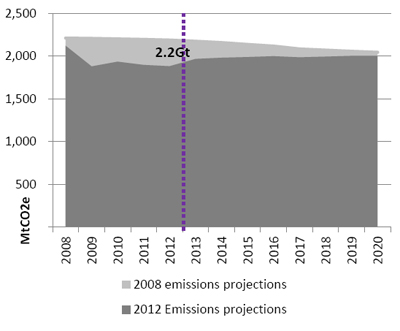
The business-as-usual emissions baseline against which both the EU climate target and the ETS caps were set are totally obsolete. Expectations of Europe’s GDP growth out to 2020 are down by a third since the climate package was agreed. This has left the ETS caps with 2.2 billion tonnes less demand than was anticipated.

We recommend this 2.2Gt in European Union Allowances be removed to restore the original scarcity envisaged for the ETS cap. This will also help restore domestic effort proportional with the level of expected offshore abatement in the offsetting provisions.

We identify a further 900 million excess allowances in the scheme against the original emissions forecasts, resulting from industrial overallocation. A full correction to the cap would require withdrawing 3.1Gt of allowances from the scheme.

 They use the chart below to illustrate the issue.


This report is a worthwhile contribution to the current debate over the ETS, but it doesn’t really pinpoint the other lurking issue in the EU. Much of the surplus that has built up in the system can be attributed to the Renewable Energy Directive, which forces a certain renewable energy build rate to meet a 2020 goal. Climate Strategies recently published a report which argued that up to 0.9 billion tonnes of emissions will be removed from the power sector by 2020 as a result. They point out that although the recession has further fueled the issue, the surplus problem would likely have appeared anyway, albeit somewhat later. A further contributing factor would be the impact of the proposed Energy Efficiency Directive (up to another 0.9 billion tonnes). While it may be laudable that these reductions have taken (or will take) place, what is not clear is the cost of doing so. It almost certainly isn’t the lowest cost pathway for the economy.

Carbon price driven reductions are entirely cost transparent and we can know simply by looking at the carbon price over time what it has cost society to reach a certain emissions reduction goal. But today the CO2 market is effectively at zero (in my view the €7 price does not reflect any current abatement opportunity, rather it is simply the price that the market is putting on allowances on the understanding that some emitters are buying them and sitting on them for much longer term), which means we have no idea about the cost of reaching the 2020 reduction target. That cost is now hidden in the capital investment required to develop renewable energy, but of course reappears buried in the overall cost of our electricity in the years to come.  


  • Carbon capture & storage
  • Carbon price
  • Emissions Trading

The plight of CCS in the EU

dchone June 15, 2012

This week I attended the quarterly review meeting of the European Technology Platform for Zero Emission Fossil Fuel Power Plants (ZEP), a coalition of stakeholders united in their support for CO2 Capture and Storage (CCS) as a key technology for combating climate change. ZEP serves as advisor to the European Commission on the research, demonstration and deployment of CCS. Many topics related to CCS and the underpinning technology set are discussed at the quarterly meetings, as well as various overview presentations to look at the current status of deployment. It is this latter aspect that is in trouble.

Over the last five years the EU has put great effort into promoting CCS. The Commission has led this, creating a legislative framework for the technology to exist in the field, agreeing on the need for a 10-12 project demonstration programme, supporting that programme with funding mechanisms and of course institutionalizing a carbon price within the industrial economy to act as the principal driver for implementation and longer term deployment.

With such an effort and so much political capital spent, one would expect to see a burgeoning CCS industry, or at least the beginnings of it, appearing across the EU. Unfortunately this is not the case. With the possible exception of the UK, it could be that by 2020 there will not be a single large scale CCS project operating across the 27 member states. This was certainly not the plan.

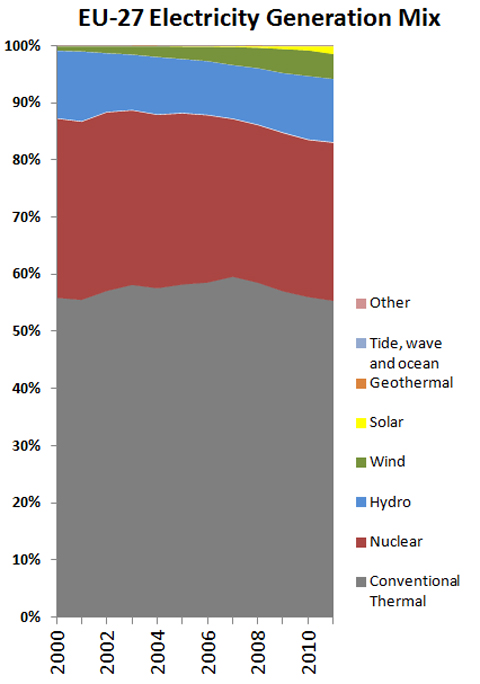
Looking forward, CCS is clearly going to be required in the EU. The region continues to burn it’s considerable coal and gas resources for power generation and more recently, with the exception of France and the UK, there has been some trepidation with regards further deployment of nuclear for power generation. Renewable energy use may be growing and there have been some remarkable, albeit brief, instances of near 100% power generation from renewables in some parts of the EU, but overall renewable energy growth remains modest (see below).

The first barrier to CCS implementation is a simple political one. Progress on member state transposition of the EU CCS Directive remains stubbornly slow with some member states seemingly less enthusiastic than they first appeared. In particular and despite a wealth of R&D activity and small pilot projects, German interest with regards CCS implementation now appears very low, despite its significant coal capacity. Rather, the focus is on renewable energy. Of the 27 countries required to transpose the directive, only 9 countries are acting. However, these do at least make up the key locations for potential demonstration projects.

The next barrier is a tough one. Public acceptance of on-shore storage has weakened considerably. This has always been a concern, but more recently this concern has resulted in the termination of projects. A Shell project in the Netherlands is one example. The alternative is off-shore storage such as the Sleipner project in Norway, but the cost of this for on-shore produced CO2 is higher.

But the real problem rests with the economics of CCS. In the middle of 2008 the picture looked relatively robust.

  • The ETS CO2 price was in the high €20’s and even broke through the €30 barrier.
  • The Energy and Climate package making its way through the EU Parliament included a provision to set aside allowances as a funding mechanism for the demonstration programme (now called NER300 – short for 300 million allowances from the ETS New Entrant Reserve). The Directive describes the support mechanism as follows and the Commission has established a website to allow bidders and other interested parties to follow the process:

Up to 300 million allowances in the new entrants’ reserve shall be available until 31 December 2015 to help stimulate the construction and operation of up to 12 commercial demonstration projects that aim at the environmentally safe capture and geological storage (CCS) of CO2 as well as demonstration projects of innovative renewable energy technologies, in the territory of the Union.
The allowances shall be made available for support for demonstration projects that provide for the development, in geographically balanced locations, of a wide range of CCS and innovative renewable energy technologies that are not yet commercially viable. Their award shall be dependent upon the verified avoidance of CO2 emissions.
Projects shall be selected on the basis of objective and transparent criteria that include requirements for knowledge-sharing. Those criteria and the measures shall be adopted in accordance with the regulatory procedure with scrutiny referred to in Article 23(3), and shall be made available to the public.
Allowances shall be set aside for the projects that meet the criteria referred to in the third subparagraph. Support for these projects shall be given via Member States and shall be complementary to substantial co-financing by the operator of the installation. They could also be co-financed by the Member State concerned, as well as by other instruments. No project shall receive support via the mechanism under this paragraph that exceeds 15 % of the total number of allowances available for this purpose. These allowances shall be taken into account under paragraph 7.

The mechanism, in combination with a robust underlying carbon price, meant that a viable demonstration programme could emerge. The 300 million allowances could conceivably generate €9 billion in funds, which meant up to €1.35 billion for some projects (i.e. the 15% limit). With potential Member State co-funding adding additional support, a 500 MW end-to-end CCS power station was even feasible and some of the projects originally submitted to the Commission for consideration were on this scale.

But the collapse of the CO2 price in the EU throws a huge question mark over the viability of the programme. So far the European Investment Bank (charged with monetizing the 300 million allowances) have sold over a 100 million allowances at a price of around €8.10 each. That’s a good effort in the current market, but it substantially changes the economics of a project. Now the maximum grant that any given project can collect is €360 million and it will be operating in a €6 CO2 market. Even with matching funds from the relevant member state, now much more challenging due to EU financial circumstances, a large scale project looks very unlikely. Large scale early CCS projects require a CO2 price in the range €60-100, not €20-25 (assuming €6 ETS price, maximum NER 300 financing and some member state co-financing).

The selection process for projects will proceed over the balance of this year with an announcement expected in December, but at least for the CCS part of the NER300 (innovative renewable energy projects are also supported) one wonders how this will pan out.

An exception to all this is the UK, which has taken matters into its own hands and which I have written quite a bit about in the past. A new UK CCS competition has been announced with £1 billion in funding and the UK is implementing a CO2 floor price for facilities operating under the EU ETS. In addition a clean energy CfD (Contract for Differences) construction will provide further support. A single viable CCS project (at least) should emerge from this approach.

Back in the rest of the EU, organizations like ZEP are stepping up their advocacy for a revised package of EU measures to ensure that at least some part of the demonstration programme is delivered. Without it, there will be real problems commercializing and gaining experience with CCS in the limited time available before much wider deployment is actually needed. The ZEP proposals should be available for a posting in the next week or so.

  • Carbon price
  • Emissions Trading
  • Europe

The case for an auction reserve price

dchone June 7, 2012

There has been considerable discussion over recent months as to what action needs to be taken both in the short and long term to ensure that the EU ETS continues to provide the necessary investment signal for major investments such as carbon capture and storage. The current price of €6.50 isn’t going to drive any change at all. I have discussed short term action in recent postings and the Commission now seems to be coming around to the idea of at least re-phasing upcoming auctions so as to “backload” the available allowances to the later part of this decade.

But the longer term also needs some thought. The UK has already acted in this regard and introduced its own floor price, although such unilateral local action in an EU wide system is problematic. But the idea here may be right. A floor price, even if not pitched particularly high, shifts the carbon pricing risk on a project at least to some extent. This is what lies behind the UK approach with the proposed £17 carbon price CFD (contract for difference).

Not all economists see this the same way though. In an opinion piece in the UK Daily Telegraph today, Tim Worstall, a Senior Fellow at the Adam Smith Institute in London, argues against the need for such a mechanism.

We’ve also an inspired misunderstanding about carbon prices. The EU has a cap and trade system: if you want to emit a tonne of CO2, you’ll need a permit to do so. Many of these are given to industry but some have to be bought. Our Ed Davey – you know, the man in charge of this whole climate change thing – has recently announced that there must be a minimum price for such permits. Showing, sadly, that he doesn’t understand the first thing about such a permit system. In the carbon tax that I recommend, yes, it is the tax which limits the emissions. In a permit system it is the number of permits: the price of the permits shows how expensive or cheap it is to meet the target. Thus we should all want to have very low permit prices, for that shows us that it is very cheap to meet that target. At which point the minister in charge says no, my goodness no, we can’t have it being cheap to save Gaia – we’ll have to artificially raise the price! I’m sure you’ll agree that this is just drivelling absurdity.

On the other hand, there is a body of literature that suggests there are good reasons to combine certain features of both price-based and quantity-based instruments, to create so-called hybrid policies (Fankhauser and Hepburn 2010, Fankhauser et al., 2010, Roberts and Spence 1976, Pizer 2002, Jacoby and Ellerman 2004, Hepburn et. al 2006, Grubb and Newbery 2008, Grubb 2009).  Hybrid instruments offer the potential for providing greater certainty regarding prices and investment signals, while maintaining the advantages of a trading scheme (Grubb 2012).

One approach is to introduce an auction reserve price which ensures that no allowances are released onto the market if the reserve auction price is not met.  This requires a sufficient proportion of allowances to be auctioned, instead of being allocated free of charge and auctions to be held periodically throughout the commitment period. It is too late to do this for Phase III of the EU ETS (2013-2020) but it could be introduced as part of the expected legislative process to set the parameters for Phase IV (2021 and beyond, probably extending to 2030). Such a reserve would also impact Phase III as buying allowances now and banking them to 2021 would offer an alternative to paying the reserve price at that time.

Summarizing the various pieces of literature on the subject of price floors (or an auction reserve price);

  • A price floor gives investors in low-emission assets greater certainty about the minimum return to their investments—it effectively provides insurance against low carbon prices, analogous to the insurance function of a price ceiling against cost blow-outs to owners of existing high-emissions assets (Wood and Jozto, 2011).
  • A very low carbon price could seriously undermine the credibility of emissions trading and undermine the EU’s attempts to forge a platform of leadership in the post-Durban negotiations. Moreover, the historical pattern of ‘boom and bust’ points to the inherently volatile characteristic of emissions trading systems to date, and the potential benefits of building in a more robust design. There are various options that could be considered. Amongst these, reserve price auctions merit particular attention (Grubb 2009).
  • An auction reserve price would imply that there is no strict price floor, because although there would be a minimum price that firms would pay at auctions, the market price could fall below the reserve price. An advantage of having a reserve price is that independent of its function as a price floor, it is an auction design feature that can protect sellers and in some cases buyers from unexpected outcomes in the auction (Hepburn et al., 2006).
  • Project investment and finance is hindered by the risk of low carbon prices. A reserve price in auctions addresses this risk (Neuhoff 2008). 
  • There are interesting hybrid schemes, such as auction releases with a commitment to a floor and ceiling price that could evolve in response to success in reducing GHG emissions or otherwise in limiting the cumulative emissions available through the scheme (Grubb and Newbery 2008).
  • Under a pure cap-and-trade approach, innovation will only increase abatement if the regulator adjusts emissions targets in response to a lower, or lower than expected, carbon price. A price floor by contrast provides a mechanism for additional emission reductions to be achieved automatically (Wood and Jotzo).
  • Irrespective of the initial level set, establishing a rising floor price through a European Reserve Price for Auctions would give confidence for investors regarding a minimum allowance price in the EU ETS. It would remove large perceived downside risks, support low-carbon investment decisions, and reduce the cost of capital, which could result in substantial economic savings (Grubb, 2012).
  • Investment certainty would be improved by price floors. Investments such as power plants, buildings, and infrastructure involve long-term time horizons. Uncertainty about the future carbon price increases costs for both investors in mitigation and investors in polluting technology. Policy design that reduces cost uncertainty can therefore limit the overall effective cost of achieving a mitigation outcome and is more likely to attract political support from business constituencies (Wood and Jozto 2010).
  • A recent blog posting by Prof. Robert Stavins states that if complementary policies exist alongside an ETS then there will be interaction and if the objective of the ETS is to provide a signal for low emission investment then the concept of a price floor may be required.

Price floors (through an auction reserve price) in an emissions trading system can reduce excessive price volatility and provide better management of cost uncertainty in the event of lower than expected abatement costs, which in turn improves predictability of returns and increases expected returns for low-emissions investments.  All in all, price floors could fulfill an important supporting role in ensuring effective and efficient climate change mitigation. They can be implemented without compromising vital aspects of emissions trading and their budgetary properties might be attractive to governments (Wood and Jozto 2011). The core benefit of hybrid systems is that they provide policy makers with greater control over the supply curve of emissions allowances. Like all markets, the market for emission reductions has a demand curve, determined by the marginal abatement costs of regulated entities and a supply curve, which is determined by policy (Fankhauser and Hepburn, 2010).

For those interested, the complete reference list is as follows:

Fankhauser, S. and Hepburn, C. (2010). Designing carbon markets. Part I: Carbon markets in time.  Energy Policy 38 (2010) 4363–4370

Fankhauser S., Hepburn, C., and Park, J. (2010). Combining multiple climate policy instruments: how not to do it. Climate Change Economics 1 (33), pp. 209-225. ISSN 2010-0078

Grubb, M. (2009). Reinforcing carbon markets under uncertainty: the role of reserve price auctions and other options. Climate Strategies Briefing Paper (www.climatestrategies.org).

Grubb, M. (2012). Strengthening the EU ETS. Creating a stable platform for EU energy sector investment. Climate Strategies Full Report (www.climatestrategies.org).

Grubb M. and D. Newbery (2008), ‘Pricing carbon for electricity generation’, in Grubb, Jamasb and Pollitt(eds), Delivering a low-carbon electricity system: technology, economics and policy, CUP, 2008.

Helm, D., Hepburn, C. and Mash, R. 2003. Credible carbon policy. Oxford Review of Economic Policy, 19:3, 438‐50.

Hepburn, C. 2006. Regulation by prices, quantities or both: a review of instrument choice. Oxford Review of Economic Policy, 22:2, forthcoming.

Hepburn, Cameron, Grubb, Michael, Neuhoff, Karsten, Matthes, Felix and Tse, Maximilien (2006) Auctioning of EU ETS Phase II Allowances: How and Why? Climate Policy, 6, 137-160.

Jacoby, H. D. and Ellerman, A. D. (2004). The safety valve and climate policy. Energy Policy, 32(4):481-491.

Neuhoff, K. (2011). Carbon Pricing for Low-Carbon Investment.  CPI and Climate Strategies

Neuhoff, K. (2008). Tackling Carbon: How to Price Carbon for Climate Policy. Climate Strategies Report.

Pizer, William A. 2002. Combining Price and Quantity Controls to Mitigate Global Climate Change. Journal of Public Economics 85(3): 409–434.

Roberts, M. and Spence, M. (1976). Effluent charges and licenses under uncertainty.

Journal of Public Economic, 5(3):193-208.

Stavins, R.(2012) Low Prices a Problem? Making Sense of Misleading Talk about Cap-and-Trade in Europe and the USA.  (http://www.robertstavinsblog.org/2012/)

Weitzman, M. L. (1974). Prices vs. quantities. Review of Economic Studies, 41(4):683-691.

Wood, P.J. and Jozto, F. (2011). Price floors for emissions trading, Energy Policy 39 (2011) 1746–1753

UK Government, Department of Trade and Industry (2006).  The Energy Challenge, Energy Review Report 2006. Page 157.

Thanks to my colleague Helen Bray for the research work behind this.

  • Carbon price
  • CDM
  • Durban

A new market mechanism from the UNFCCC

dchone May 30, 2012

While much of the focus in the recent UNFCCC meeting in Bonn was on the protracted discussion around agenda and chair for the ADP (Ad-Hoc Working Group on the Durban Platform for Enhanced Action), some progress was made in other meeting rooms. On the middle Saturday a workshop was held for initial discussions around the call for a “New market Mechanism” (NMM). A report out from the workshop can be found here.

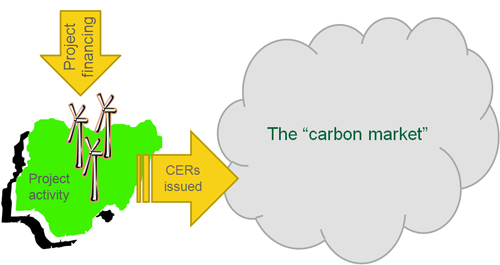
So far, the discussion on a NMM has tended to focus on the crediting of mitigation activities in developing countries, such as the role performed by the CDM. The talk is often about up-scaling rather than having an initial discussion about the market conditions necessary for crediting to be effective or alternatively to ask what a market mechanism actually is. For some, the CDM can be represented as shown below. 

This is a very supply biased conversation, when in fact the full description of the mechanism must include both the creation of supply and the likely demand. The mechanism is much broader than the CDM and involves the core design of the Kyoto Protocol and the various elements within it. 

There are many definitions of “market mechanism”, but all talk about the process of the whole market rather than just a sub-part within it. Here are three;

  1. Means by which the forces of demand and supply determine prices and quantities of goods and services offered for sale in a free market.
  2. The use of money exchanged by buyers and sellers with an open and understood system of value and time tradeoffs to produce the best distribution of goods and services.
  3. The process by which a market solves a problem of allocating resources, especially that of deciding how much of a good or service should be produced, but other such problems as well. The market mechanism is an alternative, for example, to having such decisions made by government.

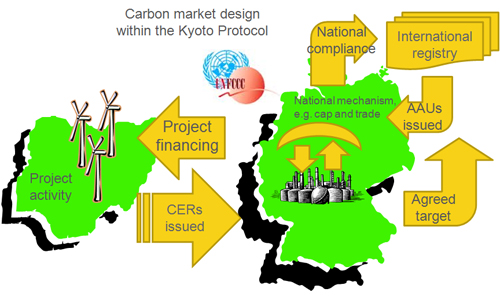
As the NMM discussion matures and eventually becomes part of the ADP, a much broader discussion on the need for a viable carbon market will be necessary. This cannot be limited to a discussion on crediting mechanisms because these, if standing alone, are not market mechanisms. A working mechanism requires some means of establishing price and particularly demand, a feature not inherent to the CDM.

The assumption that demand for credits will somehow be created is arguably a flawed one. The Kyoto Protocol addressed this by assigning AAUs to certain countries and making the CER (from the CDM) a fungible instrument, thereby allowing interchange for compliance. The AAU approach created demand in countries that had compliance obligations which in turn completed the market mechanism. Nations that held AAUs tended to cascade the instrument directly into their economies or if not, a proxy (e.g. the EUA under the EU ETS). Either way, the compliance obligation remained and allowed private investors to participate in the market.

There was a certain elegance in the market mechanism design of the Kyoto Protocol, one that shouldn’t be lost in the transition to a new international agreement. While it may not be smart politics in some quarters to highlight the benefits within the KP, the NMM discussion will do well to learn from what was developed in years gone by and not throw the baby out with the bathwater.

  • Canada
  • Carbon capture & storage
  • Carbon price

Oil sands and atmospheric CO2

dchone May 21, 2012

In a recent New York Times opinion piece, NASA climate scientist James Hansen again puts forward his very compelling argument for strong action on limiting global CO2 emissions. Some observers have challenged his thinking, but the warnings he has given over the last thirty years have proven to be pretty much on the mark as observations show that the world is warming.

In the most recent piece, Hansen links the production of synthetic crude from oil sands bitumen in Alberta as a game changer for the climate. He states;

That is why I was so troubled to read a recent interview with President Obama in Rolling Stone in which he said that Canada would exploit the oil in its vast tar sands reserves “regardless of what we do.” If Canada proceeds, and we do nothing, it will be game over for the climate. . . . . . . The concentration of carbon dioxide in the atmosphere has risen from 280 parts per million to 393 p.p.m. over the last 150 years. The tar sands contain enough carbon — 240 gigatons — to add 120 p.p.m.

There is no doubt that the oil sands bitumen reserves in Canada are very significant. In a recent report the Alberta Energy Resources Conservation Board (ERCB) estimates that provable reserves stand at some 170 billion bbls, with a potential total reserve of some 1.7 trillion bbls. The first figure represents the current estimate of recoverable oil on the basis of existing technology, whereas the latter is indicative of the total amount of oil in the region, recoverable or not. The second figure is the one that equates to 240 gigatons of carbon quoted by James Hansen.

But actual production of oil from the region gives rise to a completely different set of figures. Production of oil sands bitumen started in the late 1960s and by 2010 had reached some 1.6 million bbls per day (ERCB figures). ERCB estimates production at about 3.6 mbbl/day by 2020. Assuming an increasing trajectory which sees production doubling again by 2050 (to 7 million bbbls/day), total cumulative production over 80 years would be 74 billion bbls, which equates to some 35 billion tonnes of CO2 emitted through the production and use of the oil. This equates to an increase in atmospheric CO2 of about 2 ppm (by contrast, Saudi production over the same period could contribute about 6 ppm). If production continued through to 2100 and reached 10 million bbls/day, cumulative production would exceed current proven reserves (so assuming technology improvements) and would equate to an increase in atmospheric CO2 of about 7 ppm over 130 years of production. The resource may be vast, but production is limited by the rate at which new projects come on stream. Given a scenario of complete inaction on climate change over the very long term, it may well be that oil sands might eventually contribute some 100 ppm to atmospheric CO2 levels, but that could take 1000 years. Current trends would likely have us hitting a climate induced “brick wall” long before that.

The point here is not to argue that this is all OK or that James Hansen is wrong, but to illustrate that the issue of CO2 emissions and the resulting climate impact cannot be linked to any individual fossil fuel extraction. Each and every major reserve on the planet can clearly only contribute a few ppm at most over the coming 50 to 100 years, but so goes the tragedy of the commons. This of course highlights the critical need for collective action.

The point that Hansen is really making is that oil sands is illustrative of an ongoing global trend to extract or mine increasingly challenging reserves of oil, gas and coal and bring them to market. Global energy markets are driving this behaviour and will probably continue to do so as population increases and economies develop. Put simply, energy is in demand and the market will respond.

Given the recent change in estimates for global natural gas supply, there is now evidence that the availability of fossil fuels may not be self limiting, at least for a century or so (and possibly much longer as extraction technology improves). This argues strongly for the introduction of carbon pricing, which Hansen also calls for in his opinion piece.

Carbon pricing is the essential precursor to technologies such as carbon capture and storage (CCS), which may be the only available route forward to allow both energy demand to be met and CO2 emissions reduced. Alberta has at least started down this route, with a C$15 price driving behaviour in oil sands operations. That price, in combination with a technology incentive package, should see CCS activity emerge as part of future oil sands development.

  • Australia
  • Carbon capture & storage
  • Carbon price

Getting the message right – public perception and climate change

dchone May 11, 2012

This week in Australia the carbon pricing mechanism (no, it isn’t a tax, despite some similarities) is back in the news as the government releases it’s budget for the coming fiscal period. The fixed price period of $23 per tonne (and rising) represents a significant new source of income for the government, although when the mechanism was announced so too were a number of cost offset measures for the consumer and trade exposed industries. As such, the system is largely revenue neutral, but this has done little to quell the noisy opposition to the policy package. On Wednesday, the day after the Budget was released, many newspapers again raised the issue of increasing prices related to the carbon pricing scheme and therefore falling living standards, despite statements by the government over recent months that the system recycles its revenue back through the economy. Unfortunately, public perception appears to be on the side of those who argue that this is a new and unnecessary cost burden.

This isn’t the only negative view that the public have of climate change policy. The other is that energy austerity is the mechanism we must adopt to reduce emissions. The source of this is many and various, including the government itself, some NGOs and even a few business organisations. “Turn out the lights to save the planet” has become a common rallying cry and is amplified by campaigns such as Earth Hour which calls for cities to be blacked out for one hour a year to highlight the issue of energy use and climate change.

So the public are left with the view that energy austerity and extra cost are the two routes to follow if climate change is to be robustly addressed. Little wonder it is an uphill battle gaining political traction on this issue. Perhaps some new and more accurate messaging should be formulated to help sell the need for policy action.

The energy austerity issue is one that can and should be tackled. Reducing energy use and improving energy efficiency are both good things to do, but should be advocated for on the basis of managing energy costs, not attempting to address climate change. For reasons discussed in an earlier posting, local energy austerity may not even be an effective emissions reduction strategy at all. At issue with energy is the emissions from our current sources, not necessarily how much we use. After all, energy availability is almost unlimited, it’s just harnessing it economically that is the challenge.

The austerity message has its roots in various social agendas, but has kept into the environmental agenda as well. It is easy to see why this has happened, given the clear link between ecosystem welfare and overuse (e.g. logging in tropical rain forests), but for the climate change debate this particular approach may not be helping the issue at all.

The climate change issue needs to return to its roots, which is managing, reducing and ultimately eliminating anthropogenic CO2 emissions. This is done by changing the primary energy mix, implementing upstream CCS and shifting final energy use in homes and transport (where emissions are very to capture) to carriers such as electricity, hydrogen and bio.

Such a change won’t come at no cost, but elements of it can be conveyed to the public more easily. For example, running a home entirely on electricity is very doable today, both in hot and cold climates. The option of electric, hydrogen fuel cell or bio mobility is also becoming a reality – and potentially an attractive one as oil prices remain in the realms of $100 per barrel. These are very different value propositions to the austerity message.

The emphasis then shifts to the upstream and the use of renewable energy in the electricity sector together with technologies such as CCS in combination with natural gas. Here costs can be managed and change implemented over time as the grid is renewed and expanded. This can be achieved through carbon pricing, either directly in a cap and trade system or indirectly through emission performance standards. Although the scale of change is less, over the last thirty years many countries have managed to almost eliminate sulphur emissions from both the electricity and transport sectors and have done so without great public rancour. Costs have dropped and the job has just been done.

Getting the message right is essential if we want to make progress on this issue. Pedalling austerity and high cost is neither helpful or even correct.

  • Carbon price
  • Emissions Trading
  • Europe

Broadening the EU ETS debate

dchone May 3, 2012

The ongoing debate in Europe about the current state of the Emissions Trading System (ETS) and the low carbon price outlook is gaining momentum and importantly gaining advocates for action. In response, Commissioner Hedegaard announced a much earlier than planned review of EU auctioning, which could potentially pave the way for a removal of allowances from the system.

There is no doubt that pressure for action is building, with a number of senior EU business figures making representation at a recent meeting of EU Environment Ministers in Denmark. Short statements were delivered by video, including one by the Shell CEO, Peter Voser. These can be viewed on the Danish Presidency website, with the Shell piece at the end (starts at 13:40).

But it isn’t just business in the EU getting into the debate. The academic community on both sides of the Atlantic are also weighing in. Rob Stavins, Albert Pratt Professor of Business and Government and Director of the Harvard Environmental Economics Program has offered some useful insights into the issues facing the ETS. He cuts to the heart of the issue, that being the proliferation of “complimentary” policies at both EU and member state level. Quoting from his blog:

 But, in any event, the European Commission’s Energy division, Environment division, and Climate division should sort out the real effects of the “complimentary policies” that have contaminated the EU ETS, and which fail to bring about additional emissions reductions but drive up costs.  Whether any of this is feasible politically is a question that my European colleagues and friends can best address.

I have written quite a bit about complimentary measures in the past. For me, the clearest example of the issue is the impact of the UK Carbon Floor Price, shown in the illustration below.


I won’t repeat the explanation for this, but you can find it here.

 The complimentary policy issue is also addressed by Climate Strategies in their recent analysis of the ETS, which can be found here. They argue that;

 . . . . the combined impacts of recession, response to the carbon price in 2008-11, and complementary measures, have led to a surplus of emission allowances that will last out to 2020. As a result, EU ETS allowance prices have collapsed. This undermines the EU ETS’s value as a driver of either emission reductions or investment. At a time of economic uncertainty and fiscal crisis, EU energy-related industries have lost orientation for investment, and governments have lost an expected €100bn of auction revenue.

 Climate Strategies conclude the following:

 A triad of measures are required to meet three distinct needs:

  • Set-aside to restore the ETS price (and auction revenues) to meaningful levels, and restore confidence that EU policy will provide market signals that are consistent with science, international and strategic processes.
  • Rising Reserve Price Auctions or other measures to cap downside risks for investors and to stabilize minimum auction revenue expectations in the face of deep uncertainties; these would also reduce tensions between the ETS and complementary measures, and preclude the prospect of ongoing interventions through further set-aside.
  • Negotiations towards 2030 goals, initially based around sector specific needs and building up to a comprehensive agreement on 2030 commitments, set in the realities of both domestic possibilities and international developments.

The three measures address different needs and are mutually reinforcing.

For those interested in what Peter Voser, CEO of Shell said, here is the transcript:

Over ten years ago Europe set itself the challenge of reducing emissions while maintaining economic growth. The EU ETS was developed to do this by establishing a carbon market, guiding investment along a path of lowest cost CO2 mitigation. A robust carbon price was envisaged to encourage rapid turnover of legacy infrastructure and therefore deliver new investment. By 2008, this journey was well underway. But today the ETS is in danger. There is a risk it will fail to deliver on its promise to drive new energy investment and reduce emissions.

There is a surplus of allowances and the CO2 price is currently too weak.  The drop in energy use as a result of the financial crisis is one factor. If this was the only cause, there might be an argument to let the system correct itself over time.

But, there is also a policy design cause, arising from the superimposition of multiple layers of policy, such as renewable targets, nuclear build rates, efficiency mandates and more. As the ETS has weakened, this process has accelerated.

  • The impact is that the cost to society of decarbonisation is rising because the ETS is not working as a competitive mechanism. 
  • Secondly, a depressed carbon price signal within the EU is failing to stimulate investment or create certainty for investment decisions.
  • Consequently, the central role of the ETS is undermined and prospects for an EU ETS in a global carbon market are diminished.

The low carbon price, far from bringing relief to industry during a period of financial austerity, is a result of the high cost and uncompetitive energy pathway we are on. We should not forget that the ETS was designed to deliver the lowest cost route to CO2 targets in 2020 and beyond.

Against this backdrop, I would like to contribute to your deliberations with the following proposals:

  • Firstly, I would encourage the Commission to implement an immediate recalibration of the system by setting aside some 1 billion or more allowances – in effect recasting the baseline upon which the system rests. This will restore some of the economic relevance to the system and would make the ETS politically significant again. We should reset the level of ambition agreed in the 2009 Energy and Climate package, while maintaining the safeguards for industries exposed to carbon leakage.
  • Secondly, we must consider climate policy after 2020. The ETS must drive long term change. Overlapping policies should be avoided or tested for alignment to prevent conflicting objectives. Simply put, we need a single EU CO2 target for 2030 as the key policy driver guaranteeing technology neutrality. We would also recommend a reserve price in post 2020 auctions to guard against unexpected macroeconomic changes, provide a level of investment risk support and restore market confidence.

A signal from Ministers assembled here today would be a significant step towards restoring confidence on the EU’s flagship climate policy.

  • Carbon capture & storage
  • Carbon price
  • Electricity

The Energy Mix

dchone April 27, 2012

The World Business Council for Sustainable Development (WBCSD) held its annual company delegate conference in Switzerland this week. For the WBCSD Energy and Climate team the event marked the launch of the latest WBCSD publication “The Energy Mix”. This is a document that started life back in the middle of last year, originally as a response to the reaction from a number of governments to the events in Fukushima. The initial aim was to inform policy makers on the implication of sudden changes in energy policy, such as the decision by the German government to rapidly phase out the use of nuclear power. But as the work got going, the document took on a number of additional dimensions. Many have been covered in previous postings on this blog, but the document does a nice job of bringing a lot of information together in a crisp fold-out brochure format (at the moment the PDF is in regular page format, so the fold-out aspect is rather lost through this medium).

Sitting behind this effort is the WBCSD Vision 2050 work which charts the necessary pathway to a world in 2050 which sees “Nine billion people living well within the means of one planet”. A number of key themes are explored in “The Energy Mix” brochure:

  1. The risk of carbon lock-in, in other words current and “on the drawing board” infrastructure and related emissions being sufficient to consume the remaining global carbon budget (related to a 2°C temperature goal) within the normal remaining lifespan of those assets.
  2. The need for clear energy policy framework to guide the necessary changes over the coming decades.
  3. The importance of carbon pricing within that framework.

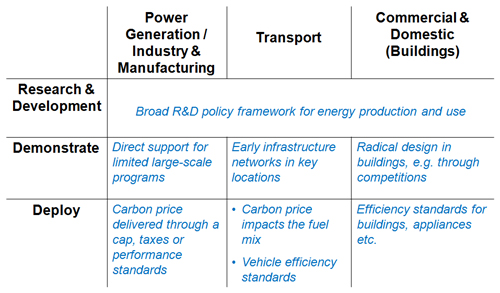
The document uses some fifteen vignettes to illustrate a variety of points. For example, to illustrate a) that policy can make a difference and b) it takes a long time, but c) its still very hard to reduce emissions by a big amount, take the case of France. Back in the 1970s the government intervened in the energy system and have progressively forced the construction of substantial nuclear capacity and a national high speed rail network, operating in combination with (like the rest of the EU) high transport fuel taxes. While these measures were not originally intended to reduce CO2 emissions, they are nevertheless compatible with such a goal and could just as easily be the route forward for a country. France now gets about 80% of its electricity from nuclear and has one of the best rail systems in the world, yet emissions have only fallen by 28% in 40 years. Economic growth and population growth continue to eat into the gains made, which might argue for yet further measures in the longer term. However, French emissions on a CO2/GDP basis are about 60% less than in the USA. With a very low CO2 per kWh for power generation, France would be in an excellent position to further decarbonize if electric cars entered the vehicle population in significant numbers. Interestingly, the car company with perhaps the worlds most progressive electric vehicle production programme also happens to be French. 

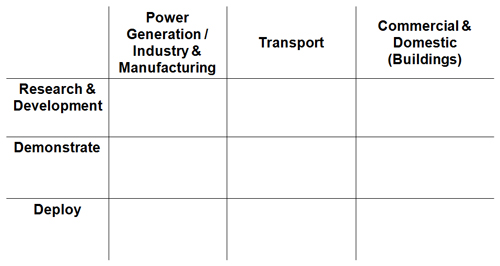
 The key message on the required policy framework is a pretty simple one – cover the key sectors and focus on the elements of the technology development pathway (Discover, Develop, Demonstrate, Deploy). The resulting grid looks like this:

 Filling in the boxes results in something that looks like this:

The framework shouldn’t be a big surprise, many of the elements are alive in the EU (but not so well in all cases- such as the carbon price).

The new WBCSD Energy Mix document can be downloaded here.

  • Australia
  • Carbon tax
  • Emissions Trading

Is the first offer the best?

dchone April 12, 2012

Energy policy development over the last decade has shown one thing for certain, governments the world over are persistent in their desire to alter the energy mix and/or at least begin to manage emissions. Whether this is purely for environmental reasons or for concerns about energy security or perhaps for long term fiscal security almost doesn’t seem to matter, energy policy development and emissions management continues to be a high priority. This then opens up the question as to how business should best respond to this trend and what role it should play?

Recent developments in Australia present a useful case study. When the CPRS (Carbon Pollution Reduction Scheme – a national cap-and-trade system) was proposed in 2008, an unintended coalition of certain business interests, the Federal Opposition and Green Party opponents eventually managed to see the bill fail. Many businesses actually supported the bill at the time, but seemingly the planets were not suitably aligned for passage. Had things been different, Australia would now have been in the late implementation phase of a relatively benign approach to managing emissions with a carbon price very likely around AU$10 per tonne, trading on the back of the global price for a Certified Emission Reduction (the UNFCCC offset mechanism) and its link to the EU ETS. Instead, events have resulted in a very different outcome. A fixed carbon price of $23 per tonne will be implemented from July, albeit transitioning to a market related price in a few years time. Recent media reports tell of a heated national debate now underway, with many arguing that the price is out of line with the “prevailing global price” and therefore leaving Australia competitively exposed. Not surprisingly, those that first opposed the CPRS and those concerned about the current price are in many cases, one in the same. The first offer in the form of the CPRS was arguably the better deal, yet it was turned down.

At least two offers have been made in the USA. In 2001 the Bush Administration offered a science and technology based approach which has delivered some results, but given a general lack of enthusiasm for implementation by the NGO community in particular with some business groups as unintended allies, the initiative failed in key areas such as the development of carbon capture and storage. Had real progress been made, rollout of the technology might have been underway today. Eight years later the second offer came from the Obama Administration in the form of a national cap-and-trade approach in combination with technology incentives, but this was also declined. Both of these were also relatively benign, the first because it represented an early start and would had been largely government funded and the second because the overall structure of the deal offered significant competitive protection for key industries and included both a long lead time for implementation and a soft start. The Clean Air Act offer now on the table appears to be the least palatable of all these and could well prove to be less effective in terms of actually reducing emissions. Given that it will require specific actions of large emitters, the implied carbon price for some facilities may be very high. In addition, the approach will address individual sources but may not result in a real reduction of national emissions because no overall cap will be in place.

Canada has also followed a fairly tortuous path in recent years. No substantive national programme to manage emissions has emerged, yet various forms of market based policy have been tested and rejected. Although carbon pricing mechanisms now exist in some provinces, a national standards based regulatory approach may well emerge, keeping pace with the Clean Air Act developments now underway in the USA. This is bound to be more complex and almost certainly more costly for business than the cap-and-trade approach that was first proposed back in about 2003. In 2005 a North American cap-and-trade approach was even studied by a combined EPA / Environment Canada Task Force.

Canada United States ccap and trade.jpg

 The increasing number of standards based or fixed price approaches that are now “on offer”, bring into question the wisdom of defeating “cap-and-trade”. The latter offers compliance flexibility through offset mechanisms, banking and limited borrowing, competition protection through free allocation in the early phases of implementation and even technology incentives through constructions such as the NER300 in the EU-ETS. By contrast, a standard has limited flexibility, no price transparency and potentially onerous penalties. This would appear to represent something of an “own goal”.

The EU faces a related issue today. Despite some initial grumbling, businesses in Europe actually accepted the first offer of the EU ETS (cap and trade). But its effectiveness has slowly eroded over time. This is partly due to the recession but there is also a policy design cause arising from the superimposition of multiple layers of policy, such as specific renewable energy targets, nuclear build rates, efficiency mandates and more. These policies are well meaning but often misaligned. As the ETS has weakened, this process has accelerated therefore compounding the problem. The business community is split over what to do about this with various proposals involving the set aside of allowances favoured by some, but others arguing that the system is naturally responding to events and should be left to find its own way. The problem with the latter position is that it could result in an ETS that becomes politically and economically irrelevant, leaving a standards based approach as the way forward in Europe as well. Another “own goal” in the making!

  • Uncategorized

Starting to understand extreme weather

dchone April 5, 2012

With a new report from the IPCC on managing the risks associated with extreme weather and continued weather phenomena attracting media attention, it is important to attempt to get to grips with the science and statistics behind this rapidly emerging field of research. Back in January I posted a story on the current trend to label any and sometimes all extreme weather events as symptomatic of climate change. I argued that a much more rigorous approach is required to understand the links between extreme weather and rising global temperatures.

Work along such lines is starting to develop. Some early work was done by Professor Myles Allen of Oxford University following the extraordinary European heat-wave of 2003. His analysis showed that the event lay so far out of the normal 2-standard deviation band around the historical average, that it could be argued that the event would never have occurred without a certain level of background warming. The figure below illustrates this phenomenon.

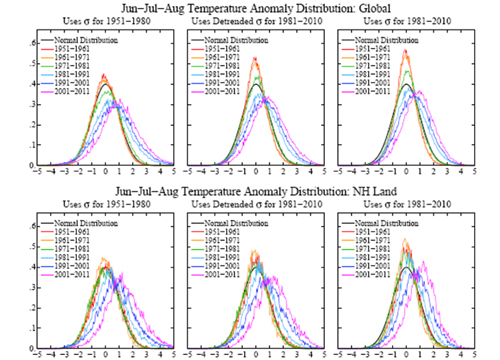
A recent paper by NASA climatologist James Hansen explores the phenomena in considerable depth and shows with some conviction that extreme heat events should be a cause for concern. As illustrated in the figure above, Hansen has shown that the distribution of seasonal temperature has indeed shifted, leading to an increase in anomalous events. An important change is the emergence of a category of summertime extremely hot outliers, more than three standard deviations (σ) warmer than the 1951-1980 baseline.  This hot extreme, which covered much less than 1% of Earth’s surface in the base period, now typically covers about 10% of the land area.  He concludes that extreme heat waves, such as that in Texas and Oklahoma in 2011 and Moscow in 2010, were “caused” by global warming, because their likelihood was negligible prior to the recent rapid global warming.

The variability in global temperatures (weather) can be approximated as a normal (Gaussian) distribution, the so-called ‘bell curve’.  A normal distribution has 68 percent of the anomalies falling within one standard deviation of the mean value.  The tails of the normal distribution decrease quite rapidly so there is only a 2.3% chance of the temperature exceeding +2σ, where σ is the standard deviation, and a 2.3% chance of being colder than -2σ.  The chance of exceeding +3σ is only 0.13% for a normal distribution, with the same chance of a negative anomaly exceeding -3σ.

Hansen’s analysis of temperature data over the period 1951-2011 (see figure below) showed that the expected shift in the distribution is actually occurring, with the consequent emergence of a new category of “extremely hot” summers, more than 3σ warmer than the base period. +3σ anomalies practically did not exist in the base period, but in the past several years these extreme anomalies have covered of the order of 10% of the land area. The increase, by more than a factor 10, of area covered by extreme hot anomalies (> +3σ ) in summer reflects the shift of the anomaly distribution in the past 30 years of global warming. One implication of this shift is that the extreme summer climate anomalies in Texas in 2011, in Moscow in 2010, and in France in 2003 almost certainly would not have occurred in the absence of global warming with its resulting shift of the anomaly distribution.  In other words, we can say with a high degree of confidence that these extreme anomalies were a consequence of global warming.

Hansen has concluded that the extreme hot tail of the distribution of temperature anomalies shifted to the right by more than +1σ in response to the global warming of about 0.5°C over the past three decades.  He goes on to say that additional global warming in the next 50 years, if business-as-usual emissions continue, is expected to be at least 1°C and that in that case, the further shifting of the anomaly distribution will make +3σ anomalies the norm and +5σ anomalies will be common.

The chance of summer falling in the “hot” category of 1951-1980 is now about 80%.  This change is sufficiently large that the perceptive person (old enough to remember the climate of 1951-1980) should recognize the existence of climate change.

While the perceptive person may be starting to recognize that things are not what they were (even the NBC News anchorman recently commented after reading a weather story, “It sure wasn’t like that when I was a kid”), it remains unclear how long it will take the general public to recognize that change is underway. An increased incidence of +5σ events may well trigger such a reaction, although such a change may not be apparent until the 2020s or 2030s (assuming a shift of one standard deviation every 15+ years).

Posts pagination

Previous 1 … 35 36 37 … 54 Next
Shell Climate Change
Contact / Proudly powered by WordPress Theme: Booklet.
 

Loading Comments...