Skip to content
  • Home
  • About David
  • Twitter
  • Facebook
  • LinkedIn

David Hone

Climate Change Advisor for Shell

Hello and welcome to my blog. There's lots said about why climate change now confronts us, and what it means, but the real issue is what to do about it. Plenty is said about that too, but there's not enough discussion on the practical aspects of implementation. Focusing on energy, that's what my blog sets out to achieve.

More about me

RSS Feeds

RSS feed RSS - Posts

  • How RSS feeds work
  • My blog rules

Follow

  • View Shell’s profile on Facebook
  • View davidshellblog’s profile on Twitter
  • View davidhone’s profile on LinkedIn

My new Amazon book

Putting the Genie Back


Recent Posts

  • Temperature implications for a troubled world
  • A landmark announcement from China
  • Can a 90% reduction in greenhouse gas emissions be achieved by 2040 in the EU?
  • Different planes or new fuels?
  • Like it or not, carbon management is the future
  • Five years on from COVID-19 – a scenario perspective

I am also interested in...

  • Global Climate Change
  • Putting the Genie Back
  • RealClimate
  • Shell

Archives

  • Emissions Trading
  • Carbon capture & storage
  • Carbon price
  • Climate Science
  • UNFCCC
  • Low carbon economy
  • Policy
  • Net zero emissions
  • Renewables
  • Twitter
  • Facebook
  • LinkedIn

Shell Climate Change

David Hone – Chief Climate Change Advisor for Shell

  • Home
  • About David
  • China
  • Coal
  • Energy efficiency

Five short stories from WEO

dchone March 28, 2012

The IEA’s World Energy Outlook (WEO) is an annual tradition, the result of much work, data analysis and presentation. A formative volume is produced for all to read and digest, but few of  us have the time to do so in the detail required. As such we rely to some extent on IEA presentations and summary documents. One such presentation was given by IEA Chief Economist Dr. Fatih Birol in Shell Centre last week, not for Shell but for the British Institute of Energy Economics. Rather than a WEO “tour de force”, the format was closer to storytelling, or more correctly short stories. Here are five pearls that emerge from the most recent WEO:

1.  A new trend in energy efficiency

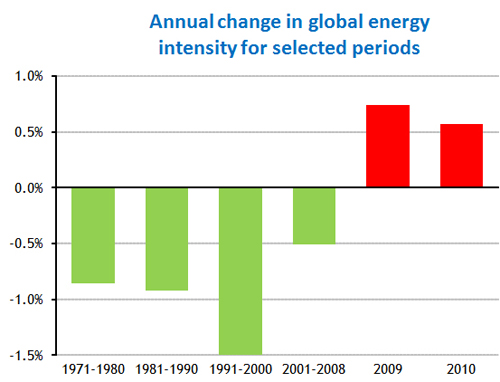
Much emphasis is placed on the need for energy efficiency from policy makers and business leaders. We hear about how well certain enterprises are doing and how we need to replace our domestic boiler, insulate our homes and use public transport. Some leaders have even argued that energy efficiency is close to a single solution to energy prices, emissions and access in developing countries. But the stark reality of energy efficiency trends at the global level is the opposite to that which is desired. There is doubtless an impact here related to the financial crisis, but even before that the trend had started shifting.
2.  Oil security concerns shift

Perhaps since the gasoline lines of the 1970’s but certainly since 9/11 in 2001, a focus of US foreign policy has been security in the Middle East and by implication oil supply security. Although Europe has long been a significant importer of oil its attention has been more focused on Russian gas supplies. But all that is due to change. In the timeframe of the WEO (to 2035) China will become the world’s largest oil importer and the US dependence on oil from outside North America will decline. With increased domestic (NA) production from oil sands and light tight oil (using a similar extraction technology to shale gas), in combination with much tougher energy efficiency standards for cars, light trucks and trucks, US import demand will fall. This could have an eventual impact on global governance as China starts to look at Middle East supply and worries about its security. 

3.  The winner was coal

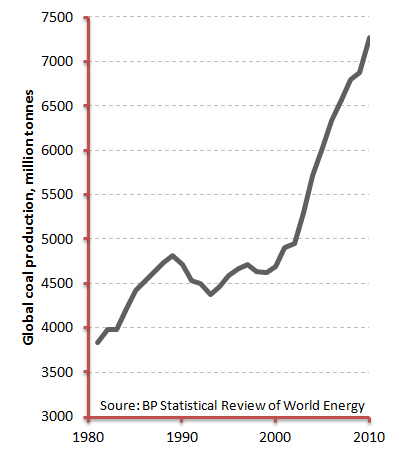
In the first decade of this century, coal accounted for nearly half of the increase in global energy use, with the bulk of the growth coming from the power sector in emerging economies. Next was natural gas, then oil and after that renewable energy. Nuclear was a distant fourth. That’s an order which is almost the opposite of where we should be going with emissions reduction as a high priority.

4.   Modern energy for all

Basic energy services are an essential part of life today, yet 1.3 billion people in the world live without electricity and 2.7 billion live without clean cooking facilities. The need to correct this has become a global imperative and remarkably this could be done with almost no impact on global energy demand and global emissions.

The flip side to this story is the point that I raised back in December when the UNFCCC declared that alleviation of poverty and energy access would become a key priority with mitigation and adaptation. Although “energy for all” is a critical issue, arguably it shouldn’t be on the agenda of the UNFCCC. Their focus needs to be squarely on the other 99.3% of emissions. “Energy for all”, as the IEA have clearly demonstrated, is not a climate change issue.

5.  The weight of a world issue shifts to Chinese shoulders

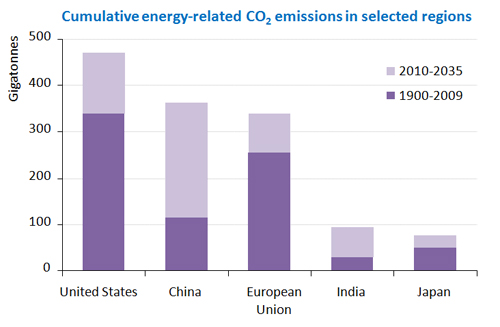
One of the longstanding arguments in the global debate on climate change has been that the burden rested with developed countries in that they had created the problem during their long industrial development era. But that situation is rapidly changing. By 2035 cumulative emissions from China will have exceeded the EU and will be rapidly approaching the US. China’s per capita emissions will also match the OECD average by then. This by no means puts the USA and EU in the clear, but it does shift the burden solidly to a tripartite response. 
Thanks to Dr Birol and the IEA for a stimulating presentation.


  • Carbon capture & storage
  • Carbon price
  • Electricity

The dash isn’t over yet

dchone March 21, 2012

Over the weekend the UK Secretary for Energy and Climate Change, Ed Davey, announced plans to secure a continuing role for natural gas in the UK power generation sector. Mr Davey noted;

“Gas will continue to play a vital role in a low-carbon economy. Modern gas-fired power stations are relatively quick to build and twice as clean as many of the coal plant they’re replacing. Carbon capture and storage promises to give gas an even longer term future in the mix.”

The announcement from the Department of Energy and Climate Change (DECC) introduced further policy additions to the Electricity Market Reform as follows;

The Energy and Climate Change Secretary set out measures to be included in the intended Electricity Market Reform legislation to provide certainty to gas investors:

  • The level of the Emissions Performance Standard (EPS), designed to limit the emissions from individual plant, will be enshrined in primary legislation. Power stations consented under the 450g/kWh-based level would then be subject to that level until 2045, a process called ‘grandfathering’ which provides long-term certainty to gas investors.
  • The Capacity Market will be designed to bring forward sufficient investment in new reliable capacity, including gas, in order to ensure security of electricity supply. This will help to ensure that there is sufficient capacity in place to cope with peaks and troughs in demand.

The Government intends to bring forward this legislation, subject to the Queen’s Speech, in the next Session of Parliament.

He also announced plans to publish a new gas generation strategy in the Autumn.

So continues the rollout of a comprehensive policy framework designed to decarbonise the UK power sector, ensure security of supply / cost and provide sufficient certainty for the necessary investments to take place. The announcement fits well with the statements made by Oliver Letwin MP, Minister of State (providing policy advice to the Prime Minister in the Cabinet Office) and Cabinet attendee, at a recent panel debate held by the Daily Telegraph. At that event Mr Letwin argued that there was a need for the government to ensure that the resulting energy mix was built on a variety of energy sources and technologies. These included renewables, nuclear and fossil fuels, the latter also supported by CCS. 

Regular readers will note that I have grumbled about some of the EMR provisions in the past, particularly the role of the carbon floor price in the context of an EU wide ETS (Emissions Trading System). However my concerns pale in comparison with those of a number of correspondents and NGOs who argued in the media this week that the level (450 g/kWh) and longevity (until 2045 for those receiving consent) of the EPS would threaten the core UK target of near complete power sector decarbonisation by 2030.

I can’t subscribe to this view.

They seem to have missed the fact that the UK power sector, like the power sector in the rest of the EU, is covered by the EU ETS. Ultimately this is what will determine the level of decarbonisation on any given date, not for the UK in isolation but for the EU as a whole. The targets set at EU level may well embed a certain desired trajectory for the UK, but once allowances are auctioned and trade is underway, actual decarbonisation in the UK may take a variety of courses. This will be influenced by the overall EU cap and the prevailing price of carbon, the economics of various UK power generation options and any local supplementary measures unique to the UK, such as the carbon floor price and the EPS. Gas will almost certainly find a home within the mix, particularly given the favourable capital cost for new facilities and the relatively low emissions from modern high efficiency gas fired CHP.

What the UK government has done is provide a level of investment certainty for the generators. This has been done for renewable energy, nuclear and now fossil energy. But the eventual mix will be determined by the overall carbon constraint in combination with other factors discussed above. The UK will find its own way forward within this, with each generator surrendering allowances against CO2 emitted. Actual UK power sector emissions in 2030 and beyond will not be determined by the EPS details announced on the weekend, but by a complex mix of factors, including the value of EU allowances.

  • Climate Science
  • Coal
  • Low carbon economy

Data, more data and climate change

dchone March 15, 2012

Climate change is one of those subjects that is awash with data, leading to an almost endless capacity for analysis and ultimately conclusion drawing. The same data can be used to create different analytical output and a single analysis can lead to more than one conclusion. This comes about not just from the climate data itself, but from energy use data, energy use projections and the combination of all of these into both simple and highly complex models which seek to map out climate scenarios for the balance of this century and beyond.

A recent paper from Carnegie Institution, Stanford, CA looks at the differential climate impacts for the transition away from coal to various lower greenhouse gas energy systems, ranging from natural gas to hydro electricity. The authors modeled the temperature impact by 2100, based on a shift of 1 TW of coal generation capacity over the balance of this century. 1 TW was about the global coal capacity in 2000. Coal was picked as the base case because it is the most widespread method of generating electricity and is the most CO2 intense way of doing so. In the base case, warming from the continued use of 1 TW coal generation through to 2100 gives a temperature rise of 0.3°C.

The paper clearly illustrates the transition challenge inherent within the energy system, both from the perspective of the time it takes to replace the existing infrastructure stock and the latency of CO2 in the atmosphere. As a result of this, even the complete switch off of 1 TW of coal through conservation in the medium term does not deliver a 100% benefit. It would take some time to achieve such conservation during which the coal plants continue to emit and that CO2 then remains in the atmosphere. By 2100, the benefit is about 0.25°C out of a possible 0.3. Various other alternatives are also considered.

This is an interesting analysis, but it only looks at the 1 TW case, whereas current coal capacity is 1.7 TW and forecast by IEA (Current Policies Scenario) to reach 3.0 TW by 2035. The conclusions from this analysis vary depending on the reporter. The actual conclusion of the paper was given in the final paragraph and is as follows;

Despite the lengthy time lags involved, delaying rollouts of low-carbon-emission energy technologies risks even greater harm in the second half of this century and beyond. This underscores the urgency in developing realistic plans for the rapid deployment of the lowest-GHG-emission electricity generation technologies.

But  one coal blogger came to a very different conclusion when reporting on this paper.

. . . . . studies such as this one, which recently appeared in Environmental Research Letters, which show the limited impact eliminating all coal-fired power generation would have, according to the study eliminating coal from the mix would only reduce global temperatures by 0.2 degrees over the next 100 years. Such a change would come at a massive economic and no doubt social cost, with no real change in climate outcomes.

That post implies there is questionable benefit in tackling coal because of the claimed limited climate impact that results from doing so (0.2°C) and the potential high (but not quantified) cost of the transition, but it does not appear to account for the expected growth of coal use to three times the level used in the analysis (presumably a 0.9°C impact if we do nothing). The Carnegie analysis also assumed that the starting point was a new coal fleet, whereas the reality today is that nearly half the global coal fleet is quite old (particularly USA, EU, Australia) and therefore ready for replacement in the near term.

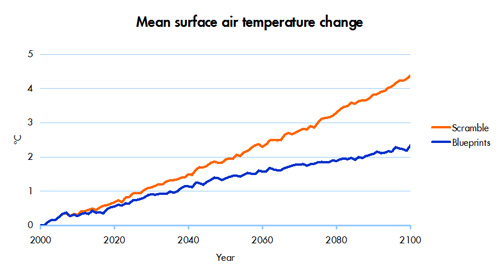
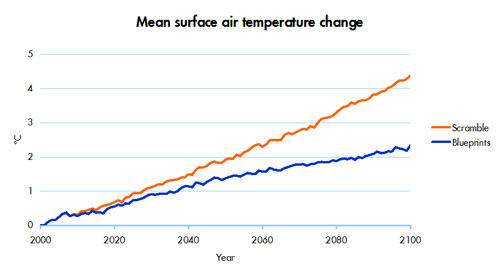
Conclusions aside, the paper notes that “No previous study has predicted the climate effects of energy system transitions”. I don’t think that this is the case in that the 2008 Shell Scenarios which incorporate a major energy transition were modeled by MIT  to show the climate impacts. I have shown the charts below several times in the past (including last week), but they clearly show that a substantive transition (Blueprints) can make a difference by the end of the century. What it also shows is that the transition will be very long and that we won’t really see the climate benefit until the second half of the century. Even then, the 2°C goal is missed in 2100, although the climate system is beginning to stabilize.

  • Carbon price
  • Climate Science
  • Energy technology

Should we be techno-optimists?

dchone March 9, 2012

One of the blogs I read from time to time is that of Paul Gilding, an independent writer on sustainability and former head of Greenpeace International. He spoke at TED last week with a talk called “The Earth is Full”. His blog post this week references the talk and argues why we shouldn’t rely on the “techno-optimist” point of view that all will be okay on the night.

 Driven by their optimism bias, people use the clearly huge opportunity of technology to reassure themselves we won’t face a crisis. They believe any serious limits in the system will be avoided because technology will intervene and we’ll adapt.

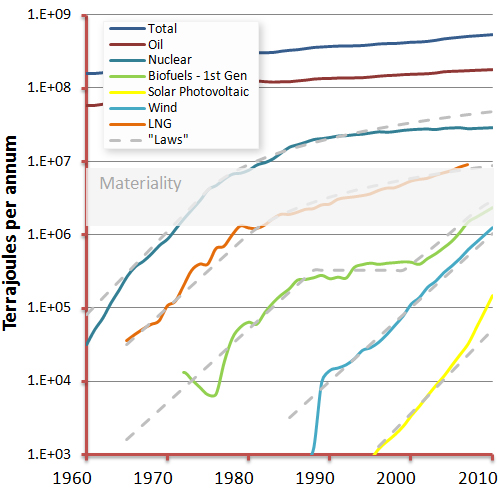
I discussed this a while back in an earlier post. Two colleagues in the Shell Scenario team published an article in Nature that showed clear historic trends for the deployment of new energy technologies.


 They derived two “laws” from this work, which are:

 Law 1

When technologies are new, they go through a few decades of exponential growth, which in the twentieth century was characterized by scale-up at a rate of one order of magnitude a decade (corresponding to 26% annual growth). Exponential growth proceeds until the energy source becomes ‘material’ — typically around 1% of world energy.

Law 2

After ‘materiality’, growth changes to linear as the technology settles at a market share. These deployment curves are remarkably similar across different technologies.

The “laws” show that it can take up to a generation (i.e. 25-30 years) for an energy technology to become material. Gilding also makes the point that we shouldn’t necessarily draw lessons from the spectacular deployment of technologies such as mobile phones and then assume that the energy industry can do likewise.

But can’t technology drive rapid change? Everyone at TED holds up their smart phones as a wonderful example of such fast, transformational change. This is a good and correct example, but it needs to be put in perspective. This is what I call a “toy technology” – something that makes our lives more convenient and more fun. These technologies are adding real value to our lives and driving change, but they are not transforming the foundations of our current economy.

Unfortunately the deployment of “toy technology” also follows the “laws”, although the time scales are shortened somewhat. Although the first hand-held mobile phone call was made around 1975 and Finland had a 20,000 person subscriber trial up and running by 1980 (i.e. first adopter), it wasn’t until 1995 that the technology became “material”, reaching 1-2% of the global population. Today the global market is approaching saturation (6 billion subscriptions) although now the transition from mobile phone to mobile smart device is underway. So even in the world of fast paced technological change, materiality still takes 15 or so years and full scale deployment another 15-20 years.

So should we be techno-optimists?

For the reasons I argued in my November post, “Can global emissions really be reduced”, it will only be a major technology shift that sees emissions fall dramatically. Ideally this should be introduced through a carbon price because that will pull it into the energy economy faster than would otherwise be the case. Carbon pricing was a principal feature of the Shell Blueprints scenario, which saw electric mobility, solar, wind and CCS all playing major roles in the period to 2050. Emissions do fall in that scenario and the level of CO2 in the atmosphere reaches a plateau, albeit above 450 ppm. 

We need to be optimistic about the role of technology, but also realistic about just how fast the transition can take place. Blueprints exceeded the “laws” in some instances yet still didn’t fully deliver on a 2°C ambition. However, natural gas was not as prevalent in that scenario as it now appears to be which should be a positive development, but on the other hand the Blueprints transition to a global carbon market was already well underway.

  • Carbon capture & storage
  • Carbon price
  • Emissions Trading

The green economy: blessing or curse?

dchone March 5, 2012

The above was the title of a panel debate hosted by the UK newspaper, The Daily Telegraph, late last week. There is a short write up in the Saturday edition of the newspaper. I was fortunate to participate in this, alongside Oliver Letwin MP, Minister of State (providing policy advice to the Prime Minister in the Cabinet Office) and Cabinet attendee. Other panel members were UCL Professor Paul Ekins, Jeremy Nicholson from the Energy Intensive Users Group and renewable energy venture capitalist Ben Goldsmith.

Photo Courtesy of The Daily Telegraph

Although Mr Letwin chose not to offer any opening remarks, his subsequent comments revealed some interesting thinking in the UK Government on energy and climate change. Three particular lines of discussion emerged during the debate;

  1. With the “Green Economy” often associated with wind-turbines and solar PV, there was much discussion on how the UK determines its future energy mix. Mr Letwin put forward the view that an entirely market determined outcome was not in the interests of Britain. There was the risk that such a direction could result in over dependency on a particular energy source, bringing with it issues such as reliability, future price exposure, capital cost and technology lock-in. He argued that although the market should play a major role in driving change, there was also a need for the government to ensure that the resulting energy mix was built on a variety of energy sources and technologies. These included renewables, nuclear and fossil fuels, the latter also supported by CCS. This in turn meant that there was a role for government to promote technologies in the early stages of development and that this would remain a feature of their energy policy. The government would also ensure that sufficient incentive was in place for the first stages of deployment of such technologies.
  2. Following on from (1) there was some discussion on the potential role for CCS in the UK energy system. Mr Letwin reaffirmed the need for the government to support a large scale demonstration of the technology and that the proposed government injection of £1 billion was both justified and modest given the scale of the low carbon energy option that it had the potential to deliver, particularly given the remaining fossil fuel production potential of the UK. He expressed the view that the key issue with CCS was not the need to determine its technical feasibility but rather to determine its cost feasibility. Mr Letwin’s enthusiasm for CCS extended into his closing remarks where he concluded that the UK would have one of the first large scale CCS facilities in the world and that the demonstration therein that natural gas was a viable zero-carbon fuel would be of huge benefit to the UK.
  3. Not surprisingly the subject of the UK carbon floor price emerged during the discussion. Mr Letwin linked the need for it to the points made in (1) above and defended its introduction given the current state of the EU-ETS and the very weak price signal it was now delivering. But he also made it clear that it would be better for all concerned if the ETS delivered the necessary price signal: his “fingers crossed” hand gesture when the proposed EU allowance set aside was mentioned was pretty clear body language. 

Overall, it was an interesting evening and well attended. I am not sure that we ever really answered the question, but we did at least get some useful insight into the thinking that supports the current energy policy direction of the UK.

  • Climate Science

How should climate change be taught?

dchone February 23, 2012

The external release of documents relating to the activities of the Heartland Institute has raised many questions, but an important issue that is now in the open again relates to the teaching of climate change in schools. How should this be handled and what should be taught? Is there justification in arguing that “both sides” of the issue should be covered? Are there “two sides” to this issue? If so, what exactly are the “two sides”, particularly in the context of a high school education?

My own experience with this issue is through the education of my son (now in his second last year of school in the UK). Climate change has seeped into a very wide variety of his subjects over the years, including chemistry, biology, geography and now economics. The message has been pretty consistent over time, i.e. “we are changing the composition of the atmosphere, that will have implications for future generations and here are some of the things that we might have to deal with.” This has resulted in a person with a pretty balanced view of the issue and some good insight into the economic thinking that supports carbon pricing within an economy. He is far from a climate zealot (not at all in fact) and is prepared to question the material he is presented with – which in turn leads to some interesting discussions between us.

But I remain unconvinced that the basic science has been taught with rigor, at least to the extent that there is a reasonable understanding of the atmospheric physics / chemistry at work. More focus on this aspect of the subject could do much to settle the issue of “both sides”. At least at this level there simply aren’t two sides. We know the earth behaves as a black body, we know that Plancks law applies to black bodies and even in high school it is possible to demonstrate that this doesn’t give us a correct answer for the calculation of the surface temperature of the planet (and I remember doing Planks Law in final year school physics myself). This then leads to an understanding that other processes are in play (trace gases in the atmosphere) and that we are now influencing those processes.

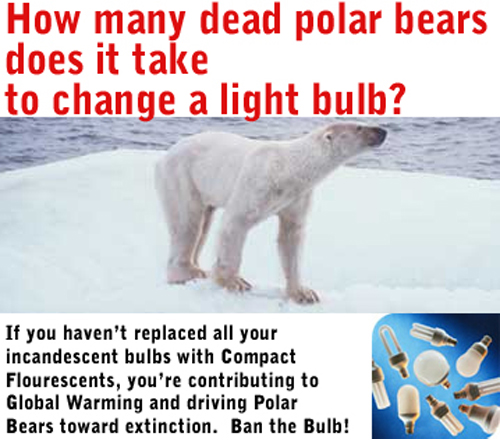
One of the difficulties with this subject is that it starts from a very small fact base of core physical principles and grows almost exponentially in both complexity and uncertainty. We then end up making very uncertain connections at the top, which not surprisingly raises the ire of some people. For example, there is plenty of imagery that links driving cars, flying in an aeroplane or even turning on a light with the threat of survival of polar bears (just to pick an example).


Then there is the link through many layers of climate science;

  • The release of CO2 into the atmosphere from the fossil fuel used to produce electricity (but not in France or Iceland of course);
  • The source of the fossil fuel and the CO2 released in its production and transport;
  • The wattage of the light bulb used and the time it is left on;
  • The change in radiative forcing as a result of additional CO2 in the atmosphere;
  • The sensitivity of the climate system to the additional forcing;
  • The impact that particulates released from the power station might have in changing the global radiative forcing;
  • The net temperature rise of the planet;
  • The impact the temperature rise has on Arctic ice in areas where the polar bear is most threatened;
  • The impact any ice reduction has on the longevity and reproduction cycle of polar bears in a particular area;

. . . . and so on.

Physics and chemistry today have delivered a high level of certainty regarding the behaviour of CO2 molecules in the atmosphere. But the fate of the polar bear is highly uncertain as are the precise causes of all the changes in its habitat. Yet, at least for younger students we tend to start with material that has high imbedded uncertainty and teach it as if it is fact, which of course it isn’t. This then leads to the call from some members of the community to present “both sides” of the issue, when in fact there aren’t any sides at all. The “both sides” call is then also interpreted by others as evidence that there is interpretation and uncertainty at the core of the issue, i.e. with the physics that underpins it, when in fact there is very little uncertainty. In a posting in July last year I recalled the speech given by Nobel Prize winning atmospheric chemist Mario Moilina (who unraveled the chemistry of CFCs and ozone) at an MIT event, where he started by saying “Since when was the Stefan Boltzman constant in dispute?” In fact it isn’t in dispute at all and we know with great precision how our planet radiates in the infra-red.

This issue isn’t just about school education, but also pertains to the education of the general public when it comes to establishing climate policy. It’s the same problem that occurs when a particular weather event is linked to CO2 emissions.

I am not a professional educator, but this line of reasoning seems to point to the need for the teaching of climate change issues at a much later point in the school curriculum and focusing more on the underlying science earlier on. We don’t teach maths by starting with chaos theory, calculus and complex numbers, rather we start with basic numerical techniques, then algebra, trigonometry and so on. This should perhaps also be true for climate change. The well understood processes that underpin the issue should be taught as a lead-in to the much broader discussion. Then at least the students can think about and debate the “two sides” for themselves.

  • Carbon price
  • Emissions Trading
  • Energy efficiency

The EU Energy Efficiency Target

dchone February 17, 2012

As I noted last week, there are intense negotiations underway in Brussels and Strasbourg as the EU Parliament heads towards a key committee vote on the Energy Efficiency Directive at the end of this month. All this has come about because of concerns that Europe will not meet the third leg of its well known 20-20-20 by 2020 target, i.e.;

  • A reduction in EU greenhouse gas emissions of at least 20% below 1990 levels
  • 20% of EU energy consumption to come from renewable resources
  • A 20% reduction in primary energy use compared with projected levels, to be achieved by improving energy efficiency.

 Understanding what the energy efficiency target actually is and what it means turned out to be much harder than I imagined. The third bullet above, after some Google searching, led me to COM(2006)545 final, COMMUNICATION FROM THE COMMISSION, Action Plan for Energy Efficiency: Realizing the Potential, within which was to be found:

This Action Plan outlines a framework of policies and measures with a view to intensify the process of realizing the over 20% estimated savings potential in EU annual primary energy consumption by 2020 (compared to baseline – see COM(2005)265 final of 22.06 2005). 

The last part of the above which pointed to a further communication was a footnote within the text. This next document (Green Paper) proved to be relatively easy to find (although the EU Commission link to it no longer functioned, but it was in EUR-Lex), but the baseline information was in an Annex, with the key assumption on GDP in a footnote within the Annex. In any case, the Annex provided the following information:

From the early 1970s until 2002, energy consumption in EU-25 rose by almost 40% – or 1% per year – while GDP doubled, growing at an average rate of 2.4% per year. Energy intensity, the ratio of GDP to energy consumption, therefore decreased by a third. However, since 2000, the improvement in energy intensity has been less substantial, reaching only 1% over two years. This Community average does not reflect the considerable differences between Member States caused by the differing economic structures (e.g. more or less energy intensive industry), the national currency exchange rate compared to the Euro and the level of energy efficiency that, by and large, is obviously much better in the EU-15.

If the current trend continues, gross energy demand could increase by 10% by 2020. Growth in electricity demand could also reach 1.5% per year. Today’s consumption in the EU could reach 1900 Mtoe within 15 years (2020), compared with 1725 Mtoe in 2005 (These predictions are made under the assumption of an average growth of GDP as foreseen to be 2.4% per year). . . . . .

. . . . . This Green Paper on energy efficiency envisages to launch the debate on how the EU could achieve a reduction of the energy consumption of the EU by 20 % compared to the projections for 2020 on a cost effective basis. With today’s most advanced technology, it is certainly possible to save around 20% of the energy consumption of the Member States of the EU Total consumption is currently around 1 725 Mtoe. Estimations indicate that, if current trends continue, consumption will reach 1 900 Mtoe in 2020. The objective is thus to arrive, thanks to energy savings of 20% at the consumption level of 1990, i.e.1520 Mtoe.

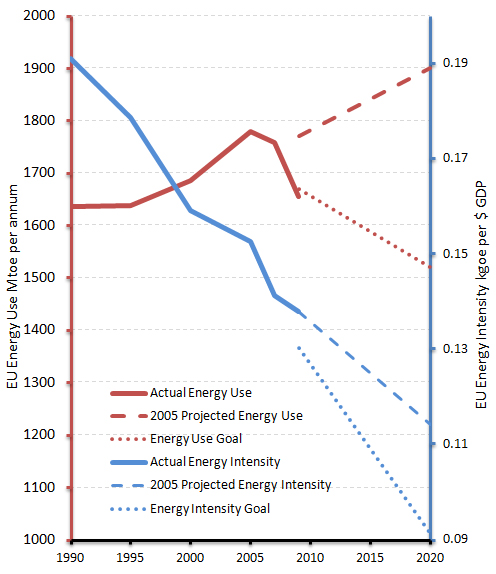
The 2020 goal is to limit energy consumption in Europe to 1520 Mtoe, but this is based entirely on projecting the early 2000s energy/GDP relationship out to 2020, assuming a continuous economic growth of 2.4% p.a. and then subtracting 20% from the final energy number. Measuring progress to date and comparing it with the original projection and the desired outcome reveals a very mixed picture.

Actual energy use in 2009 (latest IEA data) is well below the Green Paper projection and even just below the proposed pathway to 2020, but energy intensity (kgoe/$ GDP) is falling well short of the 2020 goal pathway. The issue of course is that the original growth projection of 2.4% p.a. bears little resemblance to reality. The EU has gone through a major recession, some parts of the EU remain in recession or worse and even the better performing economies are showing only minimal growth. There is also the possibility that this situation continues for some time.

This means that the EU really had four 2020 targets set in 2008, not three; 20% reduction in GHGs, 20% renewable energy use, 33% economic growth (2008-2020) and energy intensity of 0.09 kgoe/$ GDP. All this has been thrown off track by the lack of growth. The structural improvement in efficiency normally achieved as an economy grows and invests in new or replacement infrastructure has gone, the carbon price has collapsed due to a growing surplus of allowances (linked to both the lack of growth and the mandated investment in renewable energy) and while the EU is apparently on target for its renewable goal, there is pressure in these tight fiscal times to cut subsidies (with a drop in investment presumably following). Arguably, the target structure was only feasible under this one growth scenario.

But the Commission is trying to reboot the system through the proposed Energy Efficiency Directive. This calls for an even lower energy use by 2020 of some 1474 Mtoe p.a., which is presumably in line with a revised growth projection (assuming 0.09 ktoe/$ remains the goal then this appears to be <1% p.a. over the period 2009-2020). The draft Directive now also includes a proposed amendment to set aside allowances in the ETS, restoring confidence in that system as well.

The 2008 Energy & Climate Package would appear to be an over-constrained target framework, lacking in the flexibility needed as the economy twists and turns in unexpected ways over the duration of the time window (15 years). It argues for a more back to basics approach for deployment which simply imposes a carbon price on the economy through the cap-and-trade system. This then guides the way forward, providing the driver for renewable energy investment, greenhouse gas reductions and energy efficiency improvement (due to the cost penalty imposed on fossil fuel derived energy).

The Commission will almost certainly persist with the current framework through to 2020 and may yet have to administer other fixes, but post 2020 should be a new story. With the design of the next phase of the European energy journey looming, a back-to-basics carbon market approach is all that is really needed for the main deployment effort rquired in the economy.


  • Carbon price
  • Emissions Trading
  • Europe

A set-aside for the EU ETS

dchone February 9, 2012

Interest in the EU Emissions Trading System (ETS) is high at the moment in the European Parliament. MEPs are being asked to support a key amendment to the proposed Energy Efficiency Directive which will see the removal (set aside) of a substantial number of allowances from the Phase III auctions. Such an action would bolster the EU carbon price. Not surprisingly, the upcoming ITRE Committee (Industry, Research and Energy) vote has polarised business groups. I have written about the need for such action in the past, but thought it would be useful to outline the case once again.

A Baseline Correction for the EU ETS

The EU Emissions Trading System (ETS) is the flagship instrument within the EU energy and climate policy framework, and is designed to deliver emission reductions at lowest cost to the economy and provide the necessary price signal for the development of low-emission energy technologies. But the EU ETS is now faced with issues of real environmental improvement and international credibility.

Compliance with the EU’s 2020 target, of a reduction of greenhouse gases to 20% below 1990 levels, is almost a given as a result of a growing surplus of allowances in the system. This hasn’t come from real changes in the EU energy mix driven by the carbon price, but from a combination of industrial downturn and compliance with an increasing number of overlapping energy and environmental policies at both EU and member state level.

The market that develops as a result of an ETS is unlike other commodity markets, in that it is an artificial construct with a fixed supply of allowances determined by the desired emissions cap. Supply cannot naturally adjust when major changes to the system take place, such as in the current economic circumstances.

The underlying purpose of an ETS is not simply to meet an arbitrary target, but to impose a certain level of ambition on the covered sectors to catalyze the transition to a low-emission economy. If those sectors undergo a macro-level change, so too should the ETS to ensure that this level of ambition is maintained. Otherwise, there is no incentive for any underlying environmental improvement, because demand reduction hits the system. A similar argument could also be made for the case of a macro change that significantly increases demand, where the economic penalty on the system would otherwise become burdensome. This is also no different to the baseline changes that companies make when measuring emissions against a voluntary target, as would be dictated by, for example, the Greenhouse Gas Protocol.

Supply-side measures to enable such a baseline change are now required in the EU ETS. The current allowance surplus (now around 1.4 billion allowances) needs to be removed from the system to restore the ambition level, or scarcity, originally intended. A set-aside of allowances from the auctions in Phase III (2013–20) is the only short-term option available. There exists an opportunity through the discussions on the proposed Energy Efficiency Directive to do this, thereby restoring value to the system. The original system design rewarded action in Phase II (2008-12), on the expectation of scarcity in Phase III; this needs to be reintroduced.

With limited experience in operating trading schemes, it was difficult to foresee that predicting emissions would be so challenging. Most systems have therefore not been designed with sufficient supply-side measures to ensure the required robustness. This is a key learning point and should feed into EU policy formation as design discussions for Phase IV get underway in the coming years.

However, this would be a one-off measure. A longer term fix to the system is necessary. There is a body of literature that argues in favour of combining certain features of both price-based and quantity-based instruments, to create so-called hybrid policies. A recent example[1] concluded that trading schemes with price-like features, such as an reserve price below which allowances are not auctioned, should be considered to support carbon prices. An auction reserve price could be established for Phase IV of the EU ETS, thereby giving a long-term carbon price signal and providing companies some certainty over the return on investment in abatement technologies. Furthermore, an EU ETS auction reserve price would remove the need for EU member states to act unilaterally in this direction, such as recently done by the UK with its introduction of a carbon price floor.

Some may argue that a period of financial uncertainty is not the time to act, with some businesses struggling and unemployment rising. However, sectors exposed to international competition are given a transition period through the allocation of free allowances up to 2020 and are aware of Europe’s requirement to move towards a competitive low-carbon economy. Taking this opportunity to adapt to such an economy is vital for the future success of EU manufacturing as other regions and jurisdictions start to see the value in this new business opportunity. As recognised by the International Energy Agency, the EU ETS is the most cost-effective way for EU companies to meet climate change targets while remaining competitive, which then ensures energy costs and goods remain affordable for consumers.

Since the EU ETS is a leading symbol of the effort to tackle global climate change and reach Europe’s environmental targets, it is critical that the European institutions take decisive action now, with a baseline correction by setting aside and cancelling allowances from the Phase III auctions, and the introduction of an auction reserve price from Phase IV. These two measures would enable the EU to achieve the dual energy mix and emission goals that it has, but importantly still relying on the energy markets as the force for change.


[1]  Fankhauser, Samuel and Hepburn, Cameron and Park, Jisung (2010). Combining multiple climate policy instruments: how not to do it. Climate Change Economics 1 (33), pp. 209-225. ISSN 2010-0078


  • Carbon price
  • Climate Science
  • UNFCCC

Science, risk management or just politics?

dchone February 3, 2012

An opinion piece that appeared in the Wall Street Journal (Europe) on Tuesday (a few days earlier in the USA) presented the views of sixteen scientists on the issue of climate change under the heading “No Need to Panic About Global Warming“. Unfortunately there isn’t much in the way of science discussed, but there is some discussion on the response to the issue. Following the “no panic” theme of the heading, they argue that;

“There is no compelling scientific argument for drastic action to “decarbonize” the world’s economy. Even if one accepts the inflated climate forecasts of the IPCC, aggressive greenhouse-gas control policies are not justified economically.”

Although there are those that call for a complete transformation of the energy economy in just a few years (not really possible anyway), the current reality is that many governments around the world are taking a step by step response to the issue, developing policy approaches, implementing them in a measured way and learning from the experience. There is no panic, no drastic action and no aggressive control, just practical risk management through careful policy design.

Look at just one example. Over the last twelve months a very prudent approach has been implemented in Australia, with the gradual introduction of a carbon price across the economy. Initially it is a fixed price but in three years will transition to a market responsive price, although even that will have a collar.

Further to this, the sixteen scientists argue that the only reason action is being taken at all is so that it;

“. . . . offers an excuse for governments to raise taxes, taxpayer-funded subsidies for businesses that understand how to work the political system, and a lure for big donations to charitable foundations promising to save the planet.”

Again, the reality is very different. Continuing with the above example, Australia has used the money flowing from the carbon price mechanism to reduce taxes and ensure that trade exposed industries are kept whole, rather than being competitively disadvantaged. In the EU where climate policy has been well established for nearly a decade, member state governments have collected very little in additional revenue. Under the EU Emissions Trading System allowances have been grandfathered in the early years with only minimal auctioning. Although this will change from 2013 onwards, there has been no unseemly rush for revenue. Rather, significant sums of money have been channeled into renewable energy development, CCS and energy technology R&D.

Charitable foundations have also played an important role in supporting think-tanks and policy forums, not with the view of “saving the planet”, but with a clear and transparent agenda aimed at climate change policy development, design and implementation. Many such organizations have participated in and even led the development of policy instruments such as cap-and-trade, low carbon fuel standards and renewable energy targets.

Apart from the EU and Australia, a modest carbon pricing policy is in place in New Zealand, California, many US North East States, Alberta and British Colombia, with discussions and consultation underway in South Africa, South Korea, China and numerous other countries and states (click here for a map).

Meanwhile the scientists and economists at MIT, one of the USA’s premier universities frames the issue in terms of risk and uncertainty, rather than absolutes. Their Greenhouse Gamble wheels were developed by the Joint Program on the Science and Policy of Global Change to better convey uncertainty in climate change prediction. Their roulette-style spinning wheels depict the estimated probability, or likelihood, of potential temperature change (global average surface temperature) over the next 100 years, with policy implementation as the principle variable between the two. The policy framework necessary to move between the two is more substantive than that which we see today, but the path forward being taken by many nations is at least aligned with the required direction. This state of affairs is likely to persist for much of this decade, but is nevertheless still a critical capacity building phase for the future. Certainly if all nations moved forward with the types of efforts described above, the risk profile of the second wheel becomes achievable.


There is a closing argument that calls for doing nothing at all and focusing on economic growth for the benefit of all. The letter states;

“. . . . and it is likely that more CO2 and the modest warming that may come with it will be an overall benefit to the planet.”

According to MIT, doing nothing gives us around 1-2% chance of modest warming, i.e. less than 2°C, and something in the region of 30% chance of 5-6°C warming. Betting on this feels more like politics at play than any rational approach to risk management.

  • Carbon capture & storage
  • Carbon price
  • Emissions Trading

A surprising call from the investment community

dchone January 20, 2012

A recent Reuters article reported from a UN session on climate risk and energy solutions:

 UNITED NATIONS, Jan 12 (Reuters) – Institutional investors with a collective $26 trillion under management opened a new front on Thursday in the fight against climate change, urging the private sector to mobilize, follow the money and find new technologies to cut greenhouse gas emissions. Putting a price on climate-warming carbon emissions, which has been instituted in parts of Europe and elsewhere with limited success, would be “nice to have” but not essential, said Kevin Parker, global head of Deutsche Asset Management.       

“It’s not going to be long before an investor looking to roll out a new energy plant has to take solar and wind and other forms of renewables very seriously,” Parker said in an interview outside a session at U.N. headquarters on climate risk and energy solutions.  “It’s coming down to following the bouncing ball of money, because it’s money that talks.”       

Inside the session, which drew more than 400 participants from banking, insurance, government, labor and institutional investing, the United Nations’ Roland Rich warned the group against “putting all our eggs in the government basket.”

“The carbon-burning economy is tomorrow’s Rust Belt,” Rich said. “Your job, it seems to me, is to invest in the Microsofts and Googles of the green economy.”           

The article continued with reports of other speakers making similar calls. It may be the case that this reflects a significant level of frustration in the investment community, driven by weak carbon prices, inaction in several major economies and uncertainty with policy implementation where action is underway. Nevertheless, to argue that an issue such as climate change can be addressed without government action is a worrying development.

It has taken a good 15+ years to build the case for a carbon price in the energy system and while there is concern as to the current state of carbon markets, particularly in the EU, it is not the time to now argue that we can do without them.  The most effective emerging technology for dealing with CO2 emissions is carbon capture and storage (CCS) and arguably (at least by me) we will not see a reduction in global emissions until it starts deploying on a large scale. We won’t even see a reduction in the rate of growth of emissions until coal use reaches a plateau and begins to decline. Recent statistics hardly give confidence that such a point in time is even remotely close. 

Neither of these will happen without the presence of a carbon price, given the current demand for energy. Coal remains abundant, reliable and cheap for large scale power generation and while solar energy certainly falls on the planet in abundance, converting it to 24/7 electricity on a large scale (either directly or via wind) is neither reliable (from a 24/7 perspective) or cheap. Even as natural gas production increases globally, without a carbon price it will struggle to back out coal to the extent that it stays in the ground (rather it will tend to displace it to other markets). CCS of course is completely dependent on carbon pricing and early CCS demonstration in the EU is already suffering because of the low carbon price in the EU ETS.

There is no question that money talks and it is also true that a step change down in the cost of wind and solar has taken place in recent years, but the rate of investment in conventional energy infrastructure still far exceeds that of renewable energy and nuclear. In its recent World Energy Outlook, the International Energy Agency (IEA) warned that emissions lock-in at a level above that which is equivalent to a 2°C temperature rise this century is imminent.

Despite the repeated warnings, emissions continue to rise rapidly with no sign of a turndown. We really do need a carbon price in the energy system! It almost feels trite to have to say this is 2012, but apparently it is still necessary to do so.

Posts pagination

Previous 1 … 36 37 38 … 54 Next
Shell Climate Change
Contact / Proudly powered by WordPress Theme: Booklet.
 

Loading Comments...