Skip to content
  • Home
  • About David
  • Twitter
  • Facebook
  • LinkedIn

David Hone

Climate Change Advisor for Shell

Hello and welcome to my blog. There's lots said about why climate change now confronts us, and what it means, but the real issue is what to do about it. Plenty is said about that too, but there's not enough discussion on the practical aspects of implementation. Focusing on energy, that's what my blog sets out to achieve.

More about me

RSS Feeds

RSS feed RSS - Posts

  • How RSS feeds work
  • My blog rules

Follow

  • View Shell’s profile on Facebook
  • View davidshellblog’s profile on Twitter
  • View davidhone’s profile on LinkedIn

My new Amazon book

Putting the Genie Back


Recent Posts

  • Temperature implications for a troubled world
  • A landmark announcement from China
  • Can a 90% reduction in greenhouse gas emissions be achieved by 2040 in the EU?
  • Different planes or new fuels?
  • Like it or not, carbon management is the future
  • Five years on from COVID-19 – a scenario perspective

I am also interested in...

  • Global Climate Change
  • Putting the Genie Back
  • RealClimate
  • Shell

Archives

  • Emissions Trading
  • Carbon capture & storage
  • Carbon price
  • Climate Science
  • UNFCCC
  • Low carbon economy
  • Policy
  • Net zero emissions
  • Renewables
  • Twitter
  • Facebook
  • LinkedIn

Shell Climate Change

David Hone – Chief Climate Change Advisor for Shell

  • Home
  • About David
  • Climate Science
  • IPCC

A year of weather extremes?

dchone January 13, 2012

Through 2010 and 2011 in particular, weather extremes seemed to dominate the headlines. Extreme drought, rainfall, flood and wind all played a role in making the period one of the most expensive in terms of damage to infrastructure. In some locations there was also significant loss of life. It was also a time that saw the subject of extreme weather events rise up the climate change agenda, with numerous academic papers, blogs, seminars and campaigns focused on the issue.

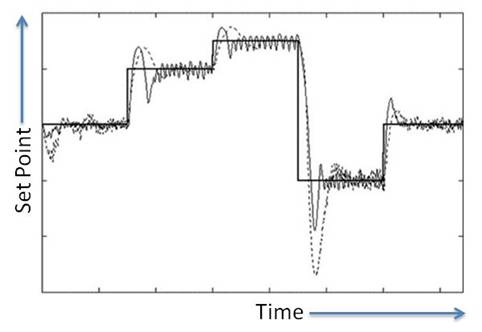
Certainly as the atmosphere moves from one steady state to (presumably) another and one which is warmer and therefore has more energy, weather volatility should increase, at least during the period of transition. This is true in any control system where there is a change in set point (not exactly what is happening in the world, but analogous). The picture below is fairly typical, with large swings in response as the system adjusts to the change.

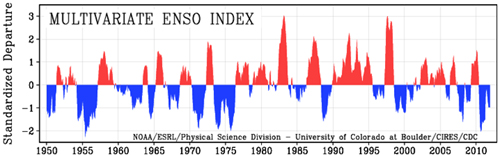
So we might well expect to see an increase in extreme weather events and many are now pointing to recent events as evidence. The problem here is that there have always been extreme events and there have also been previous periods of bunched extreme events. This may be driven by climate cycles, such as the El Nino Southern Oscillation (ENSO). A period that shows many similarities to the last two years is 1974-75 when there was a very strong La Nina event, such as the one we are currently experiencing.


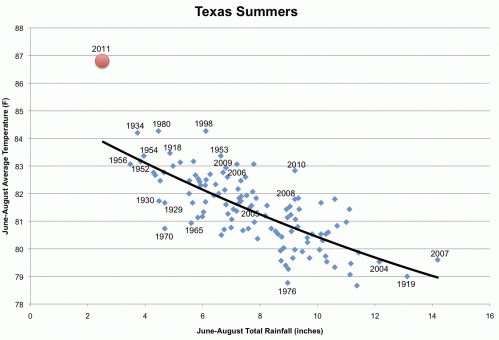
In the timelines above the near back-to-back El Nino events of the 1970s and 2010s are shown in blue (also see them in the chart above the timeline in blue) and various extreme events are shown in red. Much similarity exits, although the severe droughts that have been experienced in the southern US states didn’t show up at all in the 1970s. In fact the Texas drought has been shown as exceptional by any standards.

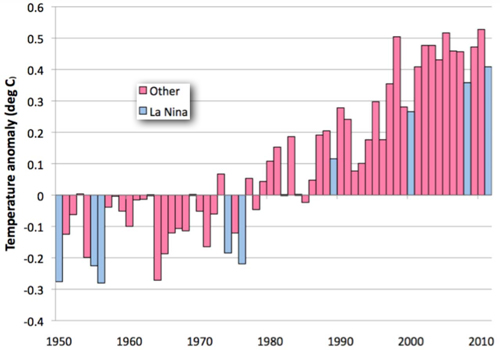
With so much focus on extreme events and a further focus by many on an apparent plateau seen in global temperatures in recent years, are we perhaps missing some clearer signals buried in the data? One such signal, which got very little media coverage, was published by the WMO at the very end of 2011 and shows last year to be the hottest ever, for a La Nina year (which are typically cooler). In fact every La Nina year over the past 40 years has been warmer than the previous one.

Over six decades and taking just the La Nina years (chart above) there has been a temperature movement of 0.7 deg.C, or 0.12 deg.C per decade. This is somewhat less than the climate sensitivity indicated by the IPCC, but equally it may only be indicative of what is probably the bottom edge of the span of temperature change. It is nevertheless an important trend to understand and follow. Extreme weather events also deserve considerable attention, but there needs to be some increased diligence when it comes to immediately associating them all with climate change.

  • California
  • Canada
  • Carbon tax

Two steps forward, one back

dchone January 4, 2012

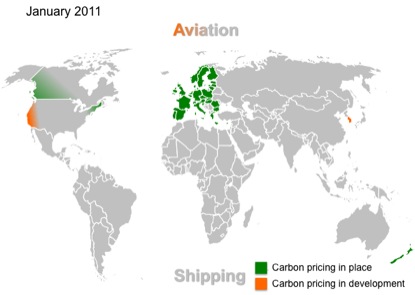
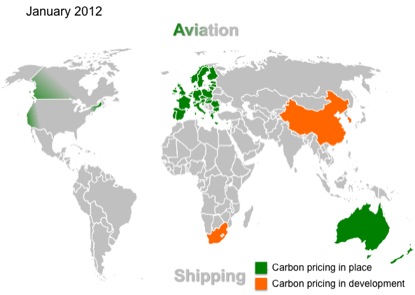
2011 turned out to be a busy year for the development of carbon pricing. Long the cornerstone of EU climate policy, the approach continues to find favour with governments focused on the issue of managing emissions, rather than those trying to manage the shape of the entire energy mix. Since the EU system was introduced in 2005, carbon pricing has appeared in Alberta and British Columbia in Canada, in the North Eastern US states and remains under consideration in South Korea. Several other governments have raised the possibility of a carbon pricing system of some sort.

At the outset of the year there appeared to be little prospect for much movement forward, with some worrying signs that a retreat was possible. Proposition 23 may have been defeated in California, but other legal challenges had surfaced and the new Australian government was not expected to raise an issue that had only a few months earlier led to the fall of the Prime Minister.

But by year end Australia had a carbon price mechanism in place, South Africa had announced its intention to implement a carbon tax, China was apparently moving forward with a variety of pricing mechanisms and California was finalizing the details of its cap-and-trade system. In addition the inclusion of aviation in the EU-ETS had withstood numerous legal challenges and looked likely to go ahead in 2012.

While this is a positive set of developments, it can’t counter the fact that there was a major step backward during the year as well. The price weakness in the EU-ETS at the end of the year and the related difficulties facing the Clean Development Mechanism (CDM) are worrying developments. Although COP 17 in Durban saw a lifeline of sorts thrown to the Kyoto Protocol (and therefore the CDM) and a key committee of the European Parliament voted in favour of a mechanism to bolster the ETS price, both these mechanisms remain in the balance.

2011 also saw a number of US States pull out of the Western Climate Initiative and New Jersey pull out of RGGI.

2012 could well be a pivotal year for a market-based approach to managing emissions.But with the prospect of new negotiations for an international agreement, the possibility of giving new life to carbon pricing is also with us.


  • Durban
  • UNFCCC

A Tweet to change the world

dchone December 22, 2011

Anyone who followed COP 17 in Durban would have noticed that the UNFCCC and its Executive Secretary, Christiana Figueres, are active Tweeters. But one Tweet in particular opens up a key issue facing the UNFCCC – what exactly is its remit? The Tweet in question came during COP17 and said:

Global business plan has to have 3 bottom lines: adaptation, mitigation and eradication of poverty. Only way to develop that is sustainable.

This comes close to formalizing a trend that has been an undercurrent of the UNFCCC process for some years now, i.e. dealing with the issue of access to energy (and therefore poverty). There is no doubt that this is a critical global issue and in many instances is a key part of the poverty trap that numerous communities and even nations find themselves in. Access to affordable water, food, shelter and energy are the drivers of development and well-being, with energy often being the lynchpin component. The issue is also linked to the UNFCCC via the adaptation challenge.

The question at hand is not whether access to energy and poverty  should be priorities to act on, but how (or even whether) they should be part of the UNFCCC process. As an issue, poverty seems to have grown under the UNFCCC as mitigation has become increasingly challenging and developing country emissions have grown. In the latter case, the need to use energy and therefore emit CO2 has come with rapid development, which in itself is the most effective way to shift populations out of poverty.

But does all this mean that the eradication of poverty should become a core pillar of the UNFCCC, which seems to be what is happening?

There is little direct justification for such a step in the Convention itself. The words “eradication of poverty” are mentioned, but not as a goal. Rather, for certain countries, poverty acts more as a valid exemption to the requirement for mitigation action. The two instances are:

Affirming that responses to climate change should be coordinated with social and economic development in an integrated manner with a view to avoiding adverse impacts on the latter, taking into full account the legitimate priority needs of developing countries for the achievement of sustained economic growth and the eradication of poverty,

The extent to which developing country Parties will effectively implement their commitments under the Convention will depend on the effective implementation by developed country Parties of their commitments under the Convention related to financial resources and transfer of technology and will take fully into account that economic and social development and poverty eradication are the first and overriding priorities of the developing country Parties.

Just as a reminder, the objective of the Convention is stated as follows:

The ultimate objective of this Convention and any related legal instruments that the Conference of the Parties may adopt is to achieve, in accordance with the relevant provisions of the Convention, stabilization of greenhouse gas concentrations in the atmosphere at a level that would prevent dangerous anthropogenic interference with the climate system. Such a level should be achieved within a time-frame sufficient to allow ecosystems to adapt naturally to climate change, to ensure that food production is not threatened and to enable economic development to proceed in a sustainable manner.

Based on the above, it could be argued that the eradication of poverty is a necessary precursor to action on climate change. After all, with so many nations claiming “exemption status”, mitigation action is and might remain insufficient to make real progress on lowering global emissions. But given that global energy emissions now stand at some 30 billion tonnes per annum and are rising rapidly, waiting for the eradication of poverty is a questionable strategy.

Given the above “ultimate objective”, a blank sheet of paper and the world in its current state, what should the starting point for action be? Should it be the eradication of poverty?

Harsh though it may sound, the answer is likely to be no. Dealing with poverty should be a global priority, but it probably shouldn’t be so intertwined with the need to reduce emissions and stabilize the concentration of CO2 in the atmosphere. From another perspective, the two issues could be argued as being largely unrelated. Africa is the poorest continent, yet if it undertook rapid development over the next 40 years with no mitigation action at all and emissions grew at 5% p.a. (well above current rates and comparable to China over the past 40 years), its cumulative emissions over that time would amount to only a tenth of the remaining atmospheric stock for CO2 that equates to a 2°C temperature rise. Meanwhile, the cumulative emissions for everyone else would have more than exceeded the stock limit remaining. In other words, the difficulties faced by Africa could be dealt with using current energy sources and the impact on the mitigation challenge would be minimal. Of course it would be better if Africa grew on a low emissions pathway, but if that remains the global focus we might win the battle and lose the war.

Crafting effective action by those who can both afford it and are relatively high emitters is no easy task, as successive COPs have demonstrated. But introducing “eradication of poverty” as a mainstream theme is unlikely to make the process any easier and quite possibly it could become a major distraction from the real task at hand – stabilization of greenhouse gas concentrations in the atmosphere at a level that would prevent dangerous anthropogenic interference with the climate system. By introducing poverty eradication into the core mix of UNFCCC, there is also the risk that much needed funding for emission reduction and adaptation projects is diluted. Clear lines of financial support for mitigation and adaptation under the UNFCCC and poverty eradication through other bespoke channels also helps ensure that funding is truly additional rather than being double counted.

Both challenges are extremely important and the world must address them simultaneously – but putting poverty as a core UNFCCC pillar potentially reduces the effectiveness of the one global body specifically designed to focus on climate change.

  • Carbon capture & storage
  • Durban
  • Greenhouse gases

Durban – Success, failure or . . . . . ?

dchone December 14, 2011

After two busy weeks, the Durban COP was extended by a full day and then went well into a second, with long nights of negotiation along the way. Eventually a deal emerged which has polarized both the media and blogsphere between being the salvation of mankind or the quick route to runaway warming. In reality it is neither, but if that is the case then where are we?

First the good news. After years of discussion, stalling and negotiation the Clean Development Mechanism (CDM) is now able to accept Carbon Capture and Storage (CCS) projects. This important technology now has the opportunity for global use under a clear set of rules that all countries have sanctioned. Of course there remains the ongoing issue of the low price of CERs, largely driven by the weakness of the EU-ETS, but at least the CDM will continue to exist thanks to a Durban agreement on the continuation of the Kyoto Protocol, albeit with a limited set of players. If nothing else, the “CCS in CDM” agreement puts CCS properly on the radar and hopefully paves the way for implementation through other means, such as via the Green Climate Fund. 

In addition to the move on CCS, the Green Climate Fund and Technology Mechanism both made useful progress. In comparison to expectations going into Durban, the COP could be regarded as something of a success. But these are small steps to take for a two week conference which attracts some 10,000 people (including observers). Of course the real objective is to make a major step forward and agree a way for all parties to begin rapidly reducing emissions.

What then of the agreement in Durban to negotiate a new protocol (or another legal instrument or a legal outcome) by 2015 at the latest, for implementation by 2020? From the perspective of large scale mitigation action involving all the major emitters, this is good news, but given the reality of the rate of increase in the level of CO2 in the atmosphere, the story is really very different.

In a 2009 posting, I discussed the issue of a 2°C objective on the basis of CO2 behaving like a stock pollutant in the atmosphere (Allen et al, Nature, April 2009). For a 50% chance of limiting the global temperature rise to 2°C, the stock of CO2 should not rise above 1 trillion tonnes of carbon (or 3.667 trillion tonnes of CO2). This provides a useful way of assessing the impact of the “Durban Platform for Enhanced Action”. Consider four cases;

  1. The “do nothing” base case which sees emissions continue to rise at the rate of 2% per annum (global emissions increased by 2.5% p.a. over the period 2000 to 2009 – IEA) and accumulate in the atmosphere. This sees the trillionth tonne emitted in 2044 with continued rapid accumulation in the decades following.
  2. A dramatic (but of course hypothetical) deal in Durban which sees global emissions peak immediately and begin to fall at 1.7% p.a., the same rate of decline as currently built into the EU ETS. In this case the trillionth tonne is emitted just after 2100, but emissions are very low by this time and still falling, so the 2°C limit is effectively met.
  3. Business as usual continues until 2020, but the “Durban Platform” acts aggressively on global emissions post-2020, with emissions peaking in that year and then falling. To achieve the same outcome as Case 2 the annual rate of decline must now be 3% p.a.
  4. Business as usual continues until 2020, with the “Durban Platform” resulting in a global plateau in emissions from 2020 to 2030, then falling after that. Now the rate of decline must be over 4.5% p.a. to achieve the same outcome as Case 2. 

While the agreement to start negotiating again with a view towards implementation of a global plan from 2015/2020 must be seen as a positive development, the time lag now built into the process must equally be a cause for concern. There is nothing easy about emissions and the future, but starting the job today is an essential requirement for meeting the 2°C goal – this was also the clear message from the IEA (International Energy Agency) going into COP 17. A theoretical global decline of 1.7% p.a. is at least still within the bounds of technical (but clearly not political)plausibility, although only just, but arguably a reduction rate of 3% or 4.5% is beyond an achievable outcome. Even the financial crisis only managed to deliver a 1.4% reduction from 2008 to 2009 before emissions bounced back in 2010. A 3% p.a. decline from 2020 requires more than a billion tonnes per annum of reduction – or the startup of at least 130 very large CCS facilities that year and then each year after that. A 4.5% p.a. decline is considerably more difficult to achieve.

The above cases 3 and 4 which both represent a robust deal coming from the “Durban Platform” are also very optimistic given the track record of the UNFCCC negotiations and perhaps of greater concern, the track record of national implementation of agreements made.

Nevertheless, Durban may well be seen as a landmark COP and it may just mark the point at which attitudes change, but the shape of the outcome also makes the challenge ahead that much greater.

  • Green growth
  • UNFCCC

A “Catch 22” to be delivered from Durban?

dchone December 6, 2011

One of the key potential deliverables from Durban is an operational Green Climate Fund (GCF). This is one of the important components of the pledge to channel up to $100 billion per annum by 2020 to developing countries for mitigation and adaptation projects. But whether the final decision is made here or at a future UNFCCC session, the current proposals may represent an investment Catch 22 that results in little or no direct use of the fund by the private sector. At a roundtable I attended in Durban over the weekend, GCF national negotiators discussed aspects of the proposed fund with the private sector. The fund does have a means for direct private sector access, which is good news, but therein lies the Catch 22. The issue that was discussed at the roundtable was the question of incentive for the private sector to actually use this instrument.

5.3.2 Private Sector
41. The Fund will have a private sector facility that enables it to directly and indirectly finance private sector mitigation and adaptation activities at the national, regional and international levels.

There are two aspects to the fund which are important in this regard. The first which was mentioned by one of the roundtable participants was that the project must be additional. This means it is a project that wouldn’t have occurred anyway, in other words it is dependent on access to the GCF for it to happen. For climate mitigation projects this implies that the project actually requires a price on carbon emissions, such as in a project under the Clean Development Mechanism (CDM) of the Kyoto Protocol. A second issue is that, at least in the case of direct private sector access, the GCF is unlikely to operate as a grant instrument but more probably as a source of loans for the project, perhaps underwriting performance aspects such as country risk. This was also discussed at the roundtable.

The problem here is that a project in a developing country which claims additionality effectively needs a grant of the carbon price. This is how the CDM works. Although there is no “grant” in the traditional sense, the fact that the CERs are awarded / granted to the project and can be monetized in a carbon market such as the EU-ETS in effect grants money to the project, albeit after the project has commenced operation rather than before. But if a grant to the private sector is unlikely, then only non-additional projects will be put forward, which in turn aren’t eligible to use the GCF.

Wikipedia defines a Catch 22 as follows:

A logical paradox arising from a situation in which an individual needs something that can only be acquired with an action that will lead him to that very situation he is already in; therefore, the acquisition of this thing becomes logically impossible.

The paradox here comes about if I have the opportunity to pursue an emissions mitigation project in a developing country. The only approach left standing which offers any scale is the GCF (CDM is rapidly being marginalized), but as it may not function as a grant mechanism for the private sector, I can’t actually monetize the carbon emissions to underpin the project economics. If I attempt the project in a way that doesn’t need carbon price monetization then it won’t be additional, in which case it isn’t applicable under the GCF, so I am left without any course of action to take forward even though the GCF has been set up with a private sector facility for me to use. It means that a CCS project, for example, would never be done under the GCF, at least not as a pure private sector project. This isn’t the complete end of the story. A private entity may be able to work in partnership with government to access the GCF in grant form.

This may not be quite a pure Catch 22, but it’s pretty close, at least based on the conversations heard over the weekend. There is still much water to pass under the bridge before the GCF is finalized, so hopefully these early bugs will be ironed out as time passes.

  • Carbon capture & storage
  • South Africa
  • UNFCCC

What could COP 17 in Durban achieve?

dchone December 1, 2011

As delegates start negotiations in Durban, the major issues of the Kyoto Protocol and a “Roadmap to 2020” are dominating the news wires. The big picture story is very important, but in the meantime nations need to use this meeting to make real progress in a number of smaller but important areas. Despite the rhetoric, an alternative global framework is slowly emerging from the process, albeit one that won’t immediately deliver the sharp reductions that we know are needed, but nevertheless one that has the prospect of engaging the business community and catalyzing significant project activity in many countries. In particular, the developing country emission reduction pledges which emerged from Copenhagen and Cancun in response to the agreed 2°C global ambition are being progressively distilled into a series of Nationally Appropriate Mitigation Actions (NAMAs), or bottom-up national/sector policies and commitments.

There still remain very substantial gaps to fill. Recently, through its Vision 2050 project, the World Business Council for Sustainable Development (WBCSD) called again for the development of “a carbon price and a network of linked emissions trading frameworks . . . “ in combination with technology development policies as the principal systematic and lowest cost approaches to reducing emissions. Although such a comprehensive approach remains distant, the issues of technology and financing are being dealt with to some extent through the development of the UNFCCC Technology Mechanism and the Green Climate Fund. These mechanisms, in combination with the development of NAMA programmes in key countries can make a real difference, but a number of essential steps should be taken in Durban to fully activate this process;

  1.  Full business involvement is critical to getting the large scale investment needed. As business we need to better understand and even contribute to the development of proposals through an open consultation process and stakeholder meetings. Then, as countries begin defining and implementing NAMAs, partnerships with business should be established through which proposals can be developed and therefore attract the necessary investment.
  2. The Green Climate Fund needs to begin operating, with a particular focus on large scale emission reduction opportunities in power generation and transport in emerging economies. It’s also important that the fund is available to a broad range of emission reduction technologies.
  3. Delegates must recognize the long term importance of a carbon market and therefore ensure that the Clean Development Mechanism (CDM), the one existing mechanism able to project a carbon price into the entire developing world, has a clear way forward independent of a global agreement on targets. The opportunity to confirm the acceptability of Carbon Capture and Storage projects under this mechanism should not be lost.
  4. Finally, the COP should seek to establish a means by which the Technology Mechanism can support and fund the creation of local and regional technology platforms tied to NAMA delivery.

These are modest steps, somewhat esoteric in nature for the layman, but essential for real progress. We recognize that the meeting in Durban can only deliver so much, but the above is not outside the grasp of a single meeting.  A recent Shell document that I have worked on gives more detail on what is needed from Durban.

To download the document, click here -> Structural Approaches (Durban).

  • Carbon capture & storage
  • Emissions Trading
  • Energy efficiency

Can global emissions really be reduced?

dchone November 24, 2011

With delegates, energy / environment  Ministers, business representatives and NGO leaders arriving in Durban for COP 17, attention again turns to the pressing issue of actually reducing global emissions. The latest UNFCCC conference comes against the backdrop of two grim statistics of recent weeks – the record year on year (2009 to 2010) jump in global emissions just announced by the US Carbon Dioxide Information Analysis Center (CDIAC) and the prospect of an early “lock-in” of a minimum 2°C temperature rise this century, as indicated by the International Energy Agency in mid November.

As society grapples with these issues, the merit of various technologies and emission reduction approaches arises. Some advocate for a rapid switch to renewable energy, others favour nuclear and most argue that unless the efficiency of energy use is robustly tackled then there cannot be a solution. But a closer look at the current state of the global energy system reveals a very different reality.

As developing economy growth has accelerated in recent years energy prices have risen, albeit with rapid increases in both renewable energy deployment and fossil fuel production. Since 2000 the world has added 0.3 billion tonnes oil equivalent (btoe) per annum of non-fossil (zero carbon) energy, but nearly eight times this amount of fossil energy production (BP Statistical Review of World Energy). Even the global financial crisis has caused but a ripple in this trend. Demand is huge and growing. 

Arguably, we are in a time  where underlying global energy demand exceeds supply. This isn’t to say they are out of balance as that is not possible, but it says that if there were more energy then global economic growth would be even faster. This condition could well persist for a long time given population growth and the rapid expansion of several major economies – with more to follow.

A direct implication of this thinking is that the production of all fossil fuel energy is infra-marginal, i.e. there is nothing at the margin and that even the most expensive to produce barrel or tonne on the planet is profitable at current price levels. Rather, energy prices are increasingly being set by marginal and currently expensive local alternatives such as bio, wind and solar.  The further implication of this is that as developed countries install non-fossil energy supply or reduce their energy use through efficiency measures, the fossil energy that is backed out is simply moved elsewhere and there is no drop in global demand and no drop in global emissions – at all. This condition may also persist for a long time. In addition, in the case of rapidly developing economies such as China, renewable energy deployment is not backing out other fuels, rather it is supplementing a constrained fuel pool and allowing faster economic growth.

This then poses an enormous challenge for global efforts to reduce emissions. The current approach, which increasingly focuses on a “clean / renewable energy” solution, will not deliver a global reduction – at least not for a long time. Nationally there may be significant wins (e.g. the last 20 years has seen the UK reduce emissions through rapid uptake of natural gas), but on a global basis we are simply shuffling the fossil energy supply from one place to another (“Rearranging the deckchairs on the Titanic” comes to mind here). 

This then points to one solution in particular, the application of carbon capture and storage (CCS). With no reduction in fossil fuel use, carbon dioxide levels in the atmosphere will continue to rise  unless emissions are returned to their source. This argues for policy development to be tilted towards CCS technology with the goal of full  demonstration and commercialization in the short to medium term.

CCS is efficiently incentivized through a carbon price, although this is only emerging on a fragmented basis. But even national implementation which results in local rather than global CCS deployment can still be considered of global benefit as at least some emissions are captured and stored. As a carbon price becomes more global it does eventually force fossil fuels to the margin. This will then drive a  reduction in consumption as alternative energy sources come into the mix at lower and lower prices, but CCS remains a critical technology for this century at least.

For the UNFCCC process, this means an eventual complete about-face on CCS. Today it represents a glaring gap in the Clean Development Mechanism with CCS projects not even sanctioned for consideration. This at least is up for change in Durban. But longer term, following the thoughts outlined above, CCS should become the only viable offset mechanism for trade between nations given that it represents a tonne of CO2 sequestered. Permanent sequestration through forestry might also be considered. Anything else, no matter how laudable the project, may not actually represent a real reduction in global emissions.

On to Durban!!

  • Electricity
  • Low carbon economy
  • Natural gas

Success slipping away?

dchone November 17, 2011

Earlier this year I looked at the prospects for the USA meeting its 2020 declaration to reduce greenhouse gas emissions by 17% by 2020, relative to a 2005 baseline. Success at least looked feasible, driven by three significant factors:

  1. The reduction in emissions as a result of the financial crisis;
  2. The surge in natural gas production which at least has the potential to back out coal in the power sector, thereby delivering a reduction in power generation emissions;
  3. The new and much more stringent CAFE standards which are now in place.

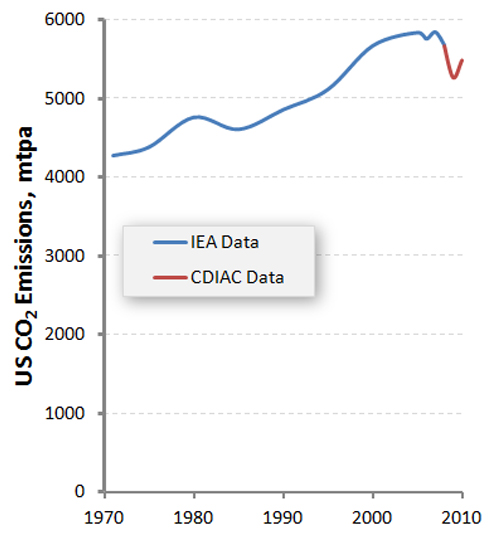
As illustrated in the chart below, a key element of the appraisal is the degree to which emissions bounce back after the recession, i.e. as production ramps up in response to new factory orders and so on. This is because of the scale of the fall in emissions as a result of the recession itself – some 500+ million tpa. 

Very recently the US Carbon Dioxide Information Analysis Center (CDIAC) released new estimates for global and national emissions for the years 2008, 2009 and 2010 – i.e. the key years in terms of the drop in emissions and first signs of recovery. The global trend is a concern given the significant jump of over 2 billion tonnes in CO2 emissions from 2009 to 2010 which more than offsets the 2008 to 2009 fall and puts global emissions at a record level.

The US figure is a real good news / bad news story. The rise from 2009 to 2010 was over 200 million tpa, which on the one hand indicates some recovery in the economy, but on the other puts significant pressure on a successful outcome  in 2020. The same projection but with the Industrial Recovery bar revised to 218 mtpa shows the target being missed by some margin.


A second critical element of this pathway is the rate at which natural gas backs out coal in the power generation sector – or coal generation is reduced as environmetal standards become tougher to meet, with natural gas filling the gap. The data for 2008-2010 isn’t conclusive, but it is showing some signs of a smaller recovery for coal than the national energy total and a loss of share in power generation to natural gas. 

Assuming about constant output from fossil generation through to 2020 (i.e. incremental power is picked up by new renewable capacity), then the necessary reduction scenario is only achieved if coal output drops by some 500,000 GWHrs and natural gas rises by a similar amount. More data is needed, but there is at least some indication that this trend may be underway, particularly now that petroleum based power generation has been driven to very low levels.

  • Australia
  • Carbon tax
  • Emissions Trading

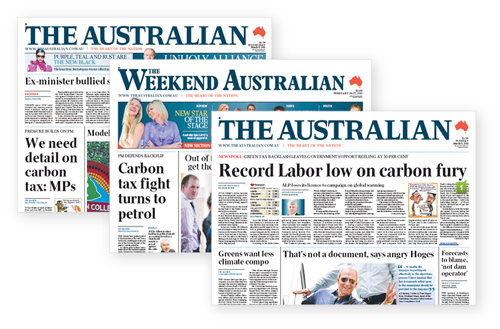
A carbon price for Australia – finally!

dchone November 9, 2011

Depending on your take on events the toll has been as high as two Prime Ministers and one Leader of the Opposition, but Australia now has a carbon pricing mechanism operating in the economy (I say “now” in that even though it doesn’t formally start until July, the price exposure for companies was there the instant the law was officially passed). There does remain some uncertainty given the “blood oath” made by the current Opposition Leader to repeal the law, but at least for now the business playing field in Australia has changed.

The mechanism starts next July and is structured such that it transitions to an emissions trading system a few years later. This means that from the outset the approach is allowance based, with the government selling allowances at AU$23 per tonne of CO2 and then the same allowances being returned to government for emissions compliance. Somewhere around 2015 this will change in that the number of allowances available for distribution will be capped and banking of allowances, together with an opportunity to use offsets, will be allowed.

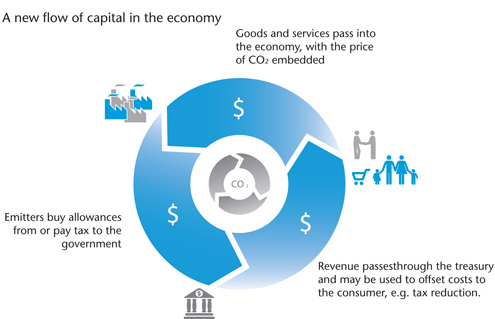
Australia has followed a near text-book approach to implementation as it has decided to recycle the funds collected directly back to consumers affected by the carbon price in the form of tax changes, with a bias towards those on lower incomes. Trade exposed industries will also see a direct recycle back, thus minimising the change in their international competitive positioning. The approach adopted by the government follows the cycle discussed in the WBCSD publication Carbon Pricing released earlier this year.

 The goal of a carbon price is to create a change in the economy such that the market begins to differentiate between goods and services on the basis of their carbon footprint.

In its generic realization, the carbon price, initially experienced by the emitter or fuel provider (e.g. by paying a tax, purchasing allowances from the government or implementing a required project), is passed through to the consumers of the product. The result is a change in the relative cost of most goods and services based on their carbon footprint, and the emergence of a new cost ranking within the economy. This will influence the purchasing decisions of consumers.

Products with a high carbon footprint will be less competitive, either forcing their removal from the market, or driving manufacturers to invest in projects to lower the footprint. Any revenue raised by the government from carbon pricing, will be typically directed to the treasury as part of the overall national budget process. It should be used efficiently; for example, to offset any net change in costs to the consumer by reducing taxes.

A transparent pass-through of operating costs to the consumer is an important feature of any market. It allows the manufacturer to adjust the sales price to maintain profitability, as new costs enter a process, or existing costs change. An increase in the sales price could only occur to the extent that the market allows the change to take place, due to competition from manufacturers with a different cost structure that may limit the potential for cost pass-through. This gives rise to one of the principal challenges of introducing carbon pricing into an economy.

Carbon pricing is being introduced piecemeal throughout the world. Some manufacturers incur the cost of carbon, while others do not, although they may be competing in the same market. A manufacturer incurring the cost of carbon is penalized, as the market price is set by a lower cost provider without the carbon price. This can result in “carbon leakage”, where a higher cost manufacturer struggles to compete, and market share is gained by a producer not subject to the carbon price. Consequently, the environmental integrity of the approach can be undermined and economic distortions introduced. A global carbon price is therefore important in order to gain a level playing field. Another challenge arises in heavily regulated markets where the producer may not be able to raise prices, and therefore cannot recover the carbon cost.

The design of a carbon pricing policy must recognize these issues.

Back in February when all this started, an observer might have thought that the economic roof had caved in.

But despite the difficult politics that have surrounded the proposal (now law), the government should be applauded for persisting. Regearing the economy and creating a different set of winners (and losers) somewhere down the road is not an easy task, but it has to be done.A command and control policy set which might appear as an alternative is both more expensive for consumers and far less flexible for business.

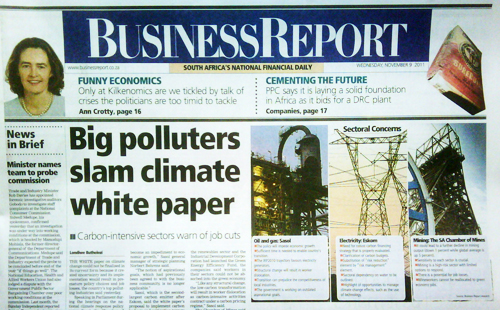
I happen to be in South Africa this week and a similar set of proposals is under discussion, although more likely implemented as a straight carbon tax. Australia and South Africa are similar in many respects – both are heavily dependent on coal and both are major resource based economies. South Africa will need to be even more thoughtful than Australia regarding recycle back into the economy, given the different income distribution in this country and the pressing need of access to electricity for all the population, but the principles which guide them should be the same. There is also the additional complication of having a state run monopoly providing electricity to the country, but even that is starting to change as the government looks at the introduction of independent renewable energy suppliers. As was the case in Australia, the battle lines are being drawn, at least according to the Cape Times today.

That part of the global economy exposed to a direct carbon price remains small, but it is rising and Australia is an important step, as will be South Africa. So far this isn’t enough to change the terms of the global energy mix, but it is having regional impacts. A similar move in China and / or the USA would change all that though.

  • Aviation
  • Energy efficiency
  • Transport

Where to now for aviation?

dchone October 31, 2011

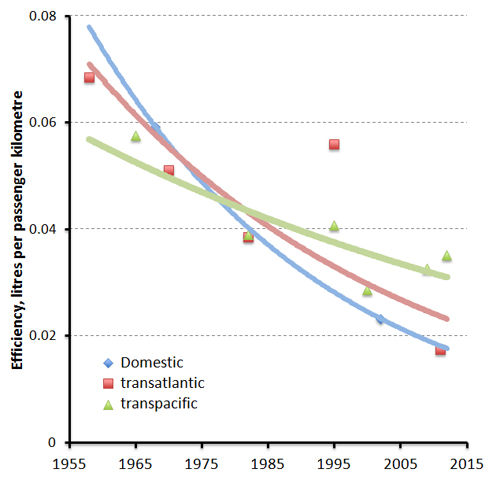
Last week’s first commercial flight of the Boeing 787 Dreamliner potentially marks the beginning of a new era for the aviation industry. Its composite construction and 20% better fuel efficiency (than the 767) continues a long term trend of improvement by Boeing. But the numbers behind this essential global industry are daunting, albeit with impressive strides forward such as the 787.

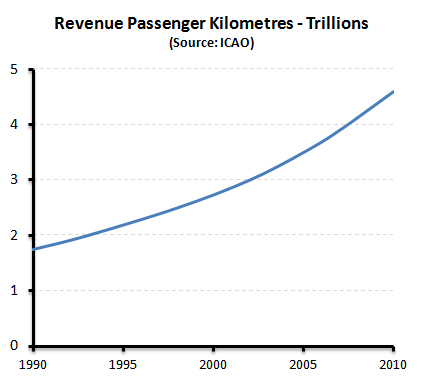
Revenue Passenger Kilometres (RPK) have more than doubled since 1990 and the Boeing Current Market Outlook for the period 2011 to 2030 has RPK growth rates surging ahead in many parts of the world at well over 5% p.a. such that by 2030 RPK in the Asia Pacific area alone is nearly 4 trillion. Globally, 2030 traffic is forecast to be about triple that of today.

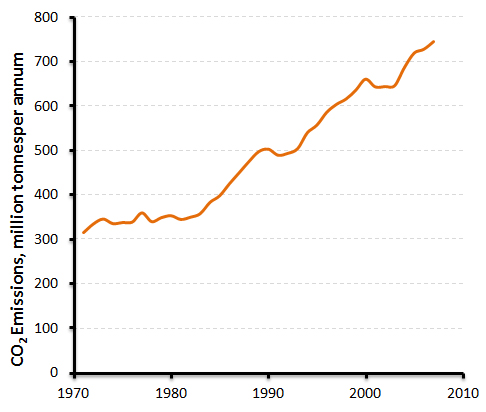
Total CO2 emissions (Source: IEA) have risen as well, but since 1990 the growth has been “only” 50%, compared with the more than doubling of activity. This points to the impressive jumps in fuel efficiency, with the Dreamliner delivering yet again.

The chart above gives an indication of the improvements achieved by plane type. I wasn’t able to locate actual efficiency figures, so the chart has been derived from the fuel capacity, passenger carrying capacity and range of various aircraft plotted against the year of release for the aircraft in question. Clearly the trend has been strongly down, starting with the Boeing 707 in the 1950s. But how much further can this impressive trend extend? Airlines are also pressing hard to increase efficiency of their legacy fleets by taking steps such as reducing weight, incentivizing passengers to do the same with their baggage, optimizing schedules and pushing air traffic control and airports to improve landing, takeoff and taxiing procedures.

But if air traffic is to triple in just 20 years, efficiency will have to jump by even more than it has to date to deliver any sort of sustainable service. Increasing Kerosene (Jet A1) demand will not only put pressure on crude oil demand, but will also pressure the yield of kerosene from the barrel. This will require refiners to become more inventive in the processing of crude oil and could well point to even higher energy demand by refineries to make more transport fuel from the barrels of crude available. It may also point to an even faster turnover of the fleet as airlines scramble to upgrade to the next generation of fuel efficient aircraft – planes such as the 787 Dreamliner, A380 and upcoming A350 series from Airbus.

Many airlines are now starting to experiment with biofuels and new production processes such as Fischer-Tropsch based Gas-to-Liquids with its high kerosene yields will add to the aviation fuel pool. But revolutionary step change airframes that might make up a future Boeing 800 or Airbus 400 series are unlikely to impact this 20 year picture, they just won’t be here in time or in sufficient numbers to make a difference (the Dreamliner was first mooted in the late 1990s). The2030 die is now largely cast with what we have and know about.

The challenge of an absolute reduction in CO2 emissions from aviation is also an unlikely prospect given the above figures. Yet by 2030 global emissions need to have peaked and be showing real falls. Although aviation may well continue to show impressive efficiency improvements and could have introduced biofuels into the mix by 2030, sheer demand will probably mean a rise in emissions. This then puts more pressure on other sectors to reduce, such as power generation and road transport.

Posts pagination

Previous 1 … 37 38 39 … 54 Next
Shell Climate Change
Contact / Proudly powered by WordPress Theme: Booklet.
 

Loading Comments...