Skip to content
  • Home
  • About David
  • Twitter
  • Facebook
  • LinkedIn

David Hone

Climate Change Advisor for Shell

Hello and welcome to my blog. There's lots said about why climate change now confronts us, and what it means, but the real issue is what to do about it. Plenty is said about that too, but there's not enough discussion on the practical aspects of implementation. Focusing on energy, that's what my blog sets out to achieve.

More about me

RSS Feeds

RSS feed RSS - Posts

  • How RSS feeds work
  • My blog rules

Follow

  • View Shell’s profile on Facebook
  • View davidshellblog’s profile on Twitter
  • View davidhone’s profile on LinkedIn

My new Amazon book

Putting the Genie Back


Recent Posts

  • Temperature implications for a troubled world
  • A landmark announcement from China
  • Can a 90% reduction in greenhouse gas emissions be achieved by 2040 in the EU?
  • Different planes or new fuels?
  • Like it or not, carbon management is the future
  • Five years on from COVID-19 – a scenario perspective

I am also interested in...

  • Global Climate Change
  • Putting the Genie Back
  • RealClimate
  • Shell

Archives

  • Emissions Trading
  • Carbon capture & storage
  • Carbon price
  • Climate Science
  • UNFCCC
  • Low carbon economy
  • Policy
  • Net zero emissions
  • Renewables
  • Twitter
  • Facebook
  • LinkedIn

Shell Climate Change

David Hone – Chief Climate Change Advisor for Shell

  • Home
  • About David
  • Events
  • Green growth
  • Low carbon economy

Green growth or green confusion?

dchone October 14, 2011

I have just been at the inaugural Global Green Growth Forum (3GF) in Copenhagen. This was a high level event, opened by the Crown Prince of Denmark and the new Danish Prime Minister, then following the initial panel discussion there was an introductory keynote by United Nations Secretary General Ban Ki-Moon – in person. The venue was also around the corner from the Copenhagen Tesla dealership!! 

So the event got off to a flying start, but what then? One of the issues for me is that it wasn’t entirely clear what the conference was actually about. Green growth has become one of those new catch phrases that means many things, depending in large part on the listener. Perhaps the best articulation came in a coffee break discussion – “green growth” is the recognition of the type of growth in energy production and the provision of key goods and services that will be required over the coming decades as some three billion people move from a relatively low income status to middle class.

In fact this income shift is well underway and is placing stresses on a number of systems. Rising CO2 in the atmosphere is perhaps the early warning, but little has been done to mitigate that problem. Now there is concern about water, food, energy supply and general resource availability. Unlike the CO2 issue, there is little clarity as to what we might do about these issues. Faced with rising CO2 emissions, economists, the business community and much of civil society have been clear on the course of action to pursue – to put a price on carbon. We know how to do this, we know the timeframe within which it must be done and we have a reasonably clear notion of where it will lead (CCS, renewable energy etc.), but even this seems beyond our collective capacity to act. Instead, we are arguing about science, an otherwise solid bedrock of society.

At its root, the green growth agenda feels like a growing worry that the market structure we have created over the last two centuries isn’t sufficiently robust to take us forward and that somehow market fundamentals like supply, demand and ultimately price won’t work. It’s not exactly a surprise that we might be thinking this today, after all the financial markets have hardly done us any favours over the last two to three years. But does that mean markets in general will let us down? In the 1970s similar worries surfaced – then it was overpopulation, food supply and energy as the primary concerns. It was also a time of deep recession (1974), oil price shocks(1973) and a prevalence of floods (Australia 1974) and famine (Ethiopia 1973-74). But economies grew, the energy system adapted, amazing new technologies surfaced and food supply issues soon faded.

So back to the conference in Copenhagen and two days of leading figures talking about all things green. It was certainly interesting, but I don’t think it got very far. Leadership was identified as a key component, but there was no articulation as to where that leadership should take us. In fact, when one key panelist was answering a question on the agenda for Rio+20 he said that the agenda was currently lacking because there was no leadership. There was also a spattering of business bashing (e.g. “it is the fault of Japanese business that Japan won’t accept a second Kyoto commitment”) and even the assertion that government had sent a clear signal to business that it was serious about addressing climate change because of the agreement on the 2 °C target.

It looks like the green growth agenda is here to stay, even though we may just decide to take our chances with the market system that we have. But we shouldn’t do nothing. The CO2 issue represents a market failure, the Stern Report  made this clear in 2006. Arguably, deforestation is another. There are ways to address these failures within the existing market system, the application of a carbon price as discussed above is one. The development of REDD has the necessary ingredients to tackle deforestation.

A green growth agenda that can propose, clearly define and implement a limited number of such approaches is what we need. Hopefully the meeting in Copenhagen was a forerunner to this, rather than just a taste of more and more discussion forums.
  • Carbon capture & storage
  • Emissions Trading
  • Energy efficiency

A Tale of Two Earths – The Future of the EU-ETS

dchone October 7, 2011

The script of former Vice President Al Gore’s recent Climate Reality global web event started with the words, “Somewhere there may be an Earth where . . . . . . isn’t happening“ and went on to fill the blank with a series of climate events currently underway, then concluded, “But not here, not this Earth, we have to deal with reality.”

Reality was also an issue at two separate events that I attended this week in Europe, an IEA/IETA/EPRI Emissions Trading seminar in Paris and the annual Platts European Emissions Markets Conference in Brussels. I was also a keynote speaker at the latter. At the Brussels event the EU Commission spoke about the development of the EU Emissions Trading System, the progress towards Phase III and even noted that the current low carbon price in the EU was a suitable reaction to the recession and that the system had responded as necessary. In the Paris event, which was under the Chatham House Rule, we heard a similar story and a description of the expanding discussions between the EU and other governments with regards linkage of emissions trading systems. One might have come away from these thinking there is an Earth where rapid progress is being made in building carbon markets and using them to quickly and effectively reduce emissions on a global basis.

There may be an Earth which is doing this, but very unfortunately it isn’t this one. It should be, it needs to be, but we have to deal with reality.

The Brussels conference also heard from Mark Lewis of Deutsche Bank, who laid out a somewhat grim supply-demand picture for the ETS. Deutsche Bank estimate that the system is 400 million European Allowances (EUAs) long in Phase II, but with an additional potential for 800 million CERs (units from the UNFCCC Clean Development Mechanism) to enter the system, giving a total EUA equivalent length of 1.2 billion allowances going into Phase III (or the equivalent of 20 big coal fired power plants running continuously for the whole of Phase III). In addition, 200 million EUAs from the CCS support mechanism will be auctioned in the near future and 2012 will also see the early auction of some of the 2013 Phase III allowances. On the upside they do see that the system has the capacity to absorb all this over the coming years, to the extent that by 2020 there is a short position of 400 million allowances (i.e. reductions that will have to be found). They see this being largely absorbed by fuel switching (coal to natural gas), with existing gas turbine generation capacity allowing this to happen relatively easily. As such, they forecast a price of some €25 by 2015, with a cost of carry taking it to €28 by 2020. But there are a number of caveats to this, the two key ones being;

  • The assumption that neither the EU Energy Efficiency Target (the focus of the upcoming Energy Efficiency Directive) or the even higher profile Renewable Energy Target will be met. Of course if renewable energy supply surges as it has done in recent years thanks to the efforts in Spain (equivalent to 800 million allowances), the 400 million allowance short position will quickly evaporate.
  • The assumption that the aviation emissions trading proposal will go into full operation, with both incoming and outgoing flights covered by an expanded ETS. Their analysis reckons aviation to be some 400 million allowances short through to 2020, so if this important add-on to the ETS doesn’t happen or is significantly delayed, then the whole ETS is flat through to 2020. Although there is no final ruling by the European Court of Justice, this week the Advocate General did express the view in favour of ETS implementation in response to the court challenges from a number of international airlines.

In addition, despite the gathering storm clouds, Deutsche Bank have not factored in the possibility of a second major economic downturn.

So the reality is that although the ETS carbon price has potential upside, it could well remain very weak for a number of years on the back of a long supply-demand position. This is problematic. Although the allowance based system will always ensure that emissions are reduced to the level of the cap, if this happens with a carbon price in single figures, the system will not deliver on its further critical underlying objectives, which are:

  • Long term incentive to drive technology development, in particular carbon capture and storage (CCS) and renewable energy.
  • Early trigger to begin the major task of decarbonising the power sector with a particular need to guide investment into the 2020s.
  • Assisting developing countries in beginning the task of emissions reduction
  • Demonstrating the effectiveness of carbon pricing through an ETS with the goal of encouraging similar systems elsewhere.
  • Supporting the carbon market approach agreed under the Kyoto Protocol.

The combination of reduced emissions as a result of the recession in the EU and the impact of a plethora of Member State and Community wide supplementary policies operating in the ETS space has led to this overhang of allowances.

Over a number of recent blog postings I have set out the case for the removal of allowances in the ETS. At the Platts conference I spoke about the same thing using the linked presentation below. There is no challenge here to the ETS as such, it is a fully functioning, well designed emissions trading system, but it has been hit from all sides by a series of events.

The time to correct this is now. That is the new reality the EU Parliament and Commission must face up to.

Click here to see the presentation.


  • Emissions Trading
  • Energy efficiency
  • Europe

Sustainability in Brazil

dchone September 30, 2011

Over the last few days I have been at Sustentavel 2011 in Rio de Janeiro, the largest event in South America which focuses on sustainable development. There is a great deal of energy for this subject in Brazil, but perhaps even more so this year as Rio de Janeiro prepares itself for Rio+20. Many of the sessions I attended made mention of Rio+20 and sought to articulate what it meant for Brazil and the world, but more importantly what such a global event should seek to achieve.

Not surprisingly climate change figured in much of the discussion. In many instances there was a desire to broaden this into a discussion on water, food and energy and in the case of the latter to focus almost entirely on energy efficiency. The water-food-energy nexus is an important subject and much work remains to really understand it, especially because climate change worsens the stresses. My concern with the climate change discussion at Sustentavel was around the issue of energy efficiency. Not only is it important to remember that it’s only a component part of the CO2 issue, but in certain instances it can exacerbate the problem when not properly managed. As I pointed out in a post last year on Jevons Paradox, there is ample evidence to show that improved energy efficiency can lead to even greater consumption – and potentially higher emissions.

I was part of a panel on “The Green Race”, with the remit to the panelists to draw on lessons from the past that can guide us in the future. Personally I am very skeptical about “The Green Race” – rather I think of it more of an energy race where all the stops are being pulled out, i.e. maximize the potential of everything. I think this is more of what is going on in China today than a greening of the economy. There is no doubt that China is erecting a record number of wind turbines, but it continues to build coal fired power stations at a record rate as well.

In my presentation (see below for link) I argued that the lesson we are now learning is that over exuberance in policy development has a price to pay. The example I used is the EU-ETS, where we have seen the carbon price dulled and (most probably) costs driven up by a series of national and EU wide polices operating in the same space as the ETS. Examples include the Renewable Energy Directive, the UK Carbon Reduction Commitment and the upcoming Energy Efficiency Directive. Going forward, other countries looking at implementing carbon price policies need to learn from this and resist the temptation to over legislate. My key conclusions were:

  • Reducing emissions needs to remain a clear and unambiguous objective.
  • Carbon price mechanisms are effective and can deliver the necessary reductions.
  • Layering of additional policies can add to the cost and weaken the carbon price signal.
  • A clear long term policy framework is required.
  • Complimentary policies can enable new technologies (e.g. CCS) and ready them for deployment.
  • Constantly changing the framework undermines its purpose.

David Hone at Sustentavel 2011 (to view the presentation)


  • Climate Science
  • Greenhouse gases

The Climate Reality Project – an inconvenient next step?

dchone September 22, 2011

Last week I went to the London showing of Vice President Al Gore’s Climate Reality Project – it was one of 24 consecutive presentations held around the world on the 15th of September. There was a lot to look forward to in attending this, particularly to see how Mr Gore would respond to the troubling attacks on the science currently seen in some political debates and the continued challenge to carbon pricing policy in countries like Australia. Some have argued that we are at a crossroads in climate policy, with richer nations seemingly deciding that they will wing it and let the physics play out over the coming century (for a thoughtful piece on this click here).

 From a personal perspective and for context, I found An Inconvenient Truth to be a remarkable film and I was very pleased to be able to attend an Al Gore training session myself – and one that he personally delivered for a day in Cambridge, England. I have even used some of the material in my own presentations, which of course was the quid pro quo for attending the training. But it is good material and although I differ with Mr Gore on the way he interpreted some of the paleoclimate record, his overall message was solid.

This time though, I was disappointed and I am even more disappointed that this was the case. The core section of the presentation focused on extreme weather events and pretty much blamed them all on the long term change in the climate that is seemingly underway. By chance that same afternoon, I had listened in to an MIT web cast on exactly the same subject – extreme weather events. For me the contrast between the two was a concern. Although both presentations explained the observable shifts taking place in the global hydrological cycle and both showed the disturbing trend in measurements such as atmospheric humidity, Mr Gore then went straight from that to the remarkable cascade of disasters that have unfolded over the past 12 months. MIT did not, nor would their presenter be drawn on it even when pressed on the subject by one of the listeners. Rather, MIT focused on the rising global temperature and humidity and declining ice coverage and showed real measurements which illustrated how warmer ocean surface temperatures might lead to more intense hurricane activity.

Included within the Climate Reality slideshow were the Pakistan floods, the Australian floods and bush fires, the US floods from North Dakota to Nashville and down the Mississippi / Missouri River system, mud slides in Colombia and the Texas drought. These have been (and continue to be) awful events and they are illustrative of some of the possible impacts of a warmer, moister atmosphere, but they are not necessarily caused by this. In fact, 1974 also suffered a string of such disasters and both it and 2010/11 had another thing in common, an intense La Nina (1973-1975) in the Pacific. Record Australian, Brazilian, Colombian and Bangladeshi floods all featured in 1974, together with a super-outbreak of tornadoes in the United States. Somalia suffered an intense drought in that period as did the central USSR.

I don’t want to undermine the efforts of Mr Gore, but only point out that he is going to have to do better to communicate his important message. In this era of soundbites and media savvy politicians it will be all too easy to take shots at this new work. The much longer but more rigorous MIT approach is where we should be, despite the huge challenge of successfully communicating uncertainty and atmospheric chemistry to a global audience. Let’s not forget that a much more complex atmospheric chemistry issue (CFCs and the ozone layer) was communicated in the 1980’s.

In the last section of the presentation Mr Gore poured scorn on those who have challenged the science. This included special interest lobby groups (oil companies among them) and a number of well known political figures. I can’t agree with the statements made by some leading politicians who dispute the work of the scientific community, but direct attack isn’t the answer here, despite the huge temptation to do so. Nor is it the reality that all industry lobby groups are seeking to undermine the science. While some groups have been less than helpful and others have just displayed ignorance, many, many business groups have positively contributed to the development of a way forward. In the US, USCAP did a remarkable job in helping craft and then supporting the Waxman-Markey bill. Globally, some 150 companies (many of which are Fortune 500) belong to the International Emissions Trading Association (IETA) and actively press for cap-and-trade approaches at national and regional level. Similar work is done in the WBCSD, the UK and EU Corporate Leaders Groups on Climate Change, the European Round Table of Industrialists, just to name a few. Sure, the businesses in these groups might fight their corner and will have no qualms about challenging issues such as allowance allocation in trading systems, but that is in the nature of reaching agreement.

The Climate Reality Project is an important next step, but at the moment it feels like a somewhat inconvenient one. The challenge back is the right thing to do, but the debate needs to be moved to a higher level, out of the trenches that currently seem to be occupied by many. This is an issue that will be around for the next 100 years and possibly much longer. We will all be too exhausted to even think about a true response if the current level of rancor is simply maintained.

  • Carbon capture & storage
  • Natural gas
  • United Kingdom

Natural gas, CO2 emissions and climate change

dchone September 19, 2011

As global natural gas production has risen and shale gas in the US impacts on the energy outlook for that country in particular, there has been increasing discussion about the impact of natural gas on climate change. Several scientific papers have recently been released questioning the carbon dioxide benefits of natural gas over coal in power production.

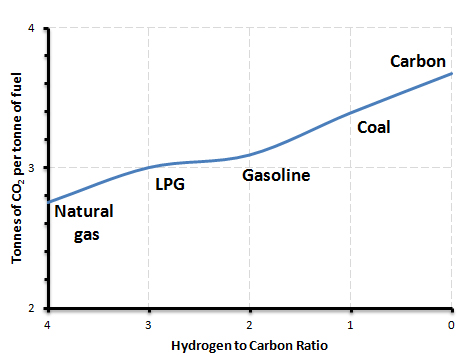
Perhaps the best place to start on this tough subject is to look at the basic chemistry, which at least grounds the discussion in some fact. Combusting natural gas or coal to produce thermal energy (for conversion to electricity) results in differing amounts of carbon dioxide emissions. This is because of the hydrogen to carbon ratio of the two which sets both the amount of energy released and the production of CO2. 

Looking at the chart above, this means that a tonne of methane (natural gas) releases 2.75 tonnes of CO2 (calculated via the ratio of molecular weights) when combusted. Combining the release of CO2 with the release of energy gives the CO2 released per unit of thermal energy produced. Natural Resources Canada publishes CO2 emission factors as follows:

Coal                    0.093 kg CO2/MJ

Coke                   0.108 kg CO2/MJ

Natural gas    0.056 kg CO2/MJ

Natural gas emissions are shown as being about 40% below those of coal and 50% below those of coke simply on an energy basis (note that this is a simple combustion calculation and does not reflect factors such as the often found lower efficiency of older coal units in many countries, e.g. the IEA reports that the global average CO2 emissions for electricity/heat generated from coal is 904 gms CO2/kWhr, vs. 386 gms CO2/kWhr for gas).

So substituting natural gas for coke / coal in an economy can lead to emissions reduction from the power sector. This has been seen in the UK (Source: BP Statistical review of World Energy) where natural gas use has grown substantially over the last 30 years. Total UK fossil energy use has been stable over that period, whereas emissions have fallen by 20%. 

As I illustrated recently for the USA, this means natural gas offers an economy an energy pathway forward which can both underpin growth and deliver emission reductions. Importantly, gas is affordable, particularly given its low sulphur and particulate emissions, so it doesn’t require heavy handed policy intervention such as high feed in tariffs. In the case of the USA, such an outcome may be delivered anyway because of the retirement of older coal plants as they face new air, waste and water regulations, coupled with the powerful economic pressure of an abundant, indigenous and cleaner energy supply source. But such a pathway is not always guaranteed and could be delivered with increased certainty by having a carbon price operating in the economy. 

Some observers are concerned that such a change simply locks in a new, albeit lower, emissions pathway and sets up the economy for problems later on when very deep emission reductions are required (although in many countries gas infrastructure already exists). But such a pathway forward should not necessarily be dismissed, as it can have positive implications for the global negotiations, particularly when the USA is involved. With the current focus on the economy, short to medium term emission reduction targets are proving to be a significant impediment to action in a number of countries. This in term destabilizes the global discussion on climate change. A national route forward at modest cost can potentially contribute positively to the broader discussion.

This isn’t the end of the story though. There has been recent focus on the methane emissions related to natural gas production and delivery to market. For example, a study by Cornell University argued that emissions from shale gas production meant that use of this fuel in the energy system may be little better than coal (although a number of questions have now been raised as to the accuracy of this study). However, a more recent analysis by Carnegie Mellon found that the life cycle GHG emissions of Marcellus shale natural gas are estimated to be 63–75 g CO2e/MJ of gas produced with an average of 68 g CO2e/MJ and that Marcellus shale natural gas GHG emissions are comparable to those of imported liquefied natural gas. Therefore, gas still delivers an advantage over coal and as such, shale gas can also be the driver of national reductions such as those seen with gas in the UK.

Finally there is the issue of the longer term – can natural gas alone solve the climate change issue? The short answer here is “no” – it contributes to a solution but further discussion is necessary. This issue was highlighted recently by a paper from Tom Wigley, currently at Adelaide University in Australia (by coincidence my alma mater). Wigley argued that natural gas production could be associated with high leakage rates of methane which would offset any combustion emissions advantage. He also argued that coal combustion also results in at least some sulphur emissions which in turn, by acting as a coolant in the stratosphere, offset part of the warming associated with the CO2 emissions from the coal. There is some validity in this argument, but other considerations should come into play:

  • The atmospheric methane issue is one that is posing some interesting questions. Two recent papers in Nature discuss the issue in response to the fact that the previously increasing atmospheric methane concentration has inexplicably stalled over the past three decades. This may be due to a fall in fossil-fuel emissions or to farming practices that are curtailing microbial sources. Certainly the fossil fuel industry has done a great deal to reduce methane venting, a common practice up to the 1990s. Today, even remote natural gas has much greater commercial value thanks to the development of a global market, which in turn makes venting and leakage just poor business practice. The leakage rates assumed by Wigley range up to 10%, which in practice would be a considerable commercial penalty for a project.
  • Carbon dioxide is a stock pollutant, which means that the cumulative amount emitted over time matters. By contrast, sulphur drops out of the atmosphere very quickly (weeks to months). Should coal use decline in the future or sulphur emission standards become even stricter or at least more widespread, the climate protection currently offered will decline. At that point, the benefit of a lower stock of atmospheric CO2 as a result of earlier use of natural gas would be advantageous. The stock pollutant argument also means that the earlier coal is backed out of the power generation system the better. Such a move would also deliver local air quality benefits in many places.

Eventually though the issue does come back to the stock of CO2 in the atmosphere. In 2009 I discussed a paper on this issue published by Nature. Assuming an atmospheric carrying capacity of one trillion tonnes of carbon, equating to 2 deg.C, a business as usual pathway would see this limit exceeded in 2044. Even if there is massive global replacement of coal with natural gas over the next 30 years, we still wouldn’t get far into the 2050s before this limit was breached. So natural gas may gain us some valuable years, but before long it will also need decarbonisation options. This then points to the future need for carbon capture and storage (CCS) and of course a big push on renewable energy and nuclear power. All of these technologies also have issues related to cost, public acceptance, technical capacity and suitability for grid management.

So it really comes down to a question of balancing emissions targets, cost and meeting the  continually increasing demand for energy. In the short to medium term, natural gas potentially does all of these. Emissions targets can be met at modest ( or possibly zero) cost and energy demand is satisfied. As natural gas use increases in deference to coal there is the benefit of a lower stock of carbon in the atmosphere. Finally, as we face up to a world of really deep emission cuts, natural gas with CCS offers a further low emission energy source which can compete with nuclear and renewable sources.


  • Australia
  • Climate Science
  • Emissions Trading

Ten questions on climate change from Australia

dchone September 9, 2011

Over recent weeks one of the major Australian newspapers (The Melbourne Age) has asked readers to submit questions on climate change and at the same time opened a poll so that all readers could vote on the questions they most wanted to see answered. The newspaper pledged to investigate and attempt to answer the top ten questions. The poll closed last weekend and the questions are now in. As promised, The Age has started to answer them. Without getting too lengthy and also drawing on many previous postings (so excuse the links), here are some thoughts from me on the ten questions (with abbreviated questions as headings – but click here to see the full questions: 

1. Can Australia make a difference by taking action?

While it is true that Australian emissions are small on a global scale and that therefore even reducing them to zero wouldn’t be sufficient to affect levels of CO2 in the atmosphere, this isn’t a reason not to take action. Climate change is a collective issue, a tragedy of the commons, which requires collective action to solve. No one country, region or industrial sector can solve this unilaterally. Even if the big three, China, the USA and the major EU economies acted alone (with China reaching a plateau in the short term and then reducing by 50% by 2050 and the US and EU reducing by 80% by 2050), global emissions would plateau at best assuming that the rest of the world emissions grew by no more than 1.5% per annum over the next 40 years (in fact they have been growing at well over 2% p.a. over recent decades). So this issue needs a response from all nations, including Australia.


Will Australia inspire other nations? This isn’t the primary motivation of acting and in any case many nations around the world are beginning to move on this issue and take action. The responses still vary widely, but they are underway. For example, Canada is developing legislation to stop the further construction of coal fired power stations, unless carbon capture and storage is utilised. China is now very close to introducing a carbon price into some parts of its economy and California is starting up a cap-and-trade system. The list is long and growing, even though the sum total of global efforts fall short of the necessary level of ambition.

2. What about agricultural emissions?

There is no doubt that agricultural emissions are important. As such, they featured in some detail in a recent study released by WWF and Ecofys which looks at the feasibility of a near zero emissions world by 2050. Although the primary focus of the report is energy, there is much said about agriculture because of the growing interaction with the energy system. For example, see page 62 of the report for a series of recommendations that relate to food and agriculture.

3. Isn’t it true that the magnitude of future warming is not “settled science”, but in fact highly uncertain?

Climate change is all about uncertainty, but a great deal of work has been done in this field. The MIT Joint Program on the Science and Policy of Global Change focuses considerable effort on communicating the risk and uncertainty (The Greenhouse Gamble) related to climate change. But importantly it also demonstrates that a policy led approach to managing emissions can shift the risk and offer benefits over the long term.

4. Shouldn’t we just go nuclear?

At least for the time being, there is no single solution to this issue. We will need a broad range of solutions. Even in France where nuclear has grown to dominate (~80%) the electricity sector over the last 40 years, emissions have only fallen by 14% (from 435 MT to 374 MT from 1971 to 2008 according to the IEA).

5. Are climate skeptics funded by industrial concerns so as to maintain the status quo?

The origins of climate skepticism and the driving force behind it is examined in great detail by Naomi Oreskes and Erik Conway in their book “Merchants of Doubt”. This is an excellent read and turns up some surprising answers, linking those who question and challenge the issue of climate change with the same people and groups who challenged tobacco as a cause of cancer, acid rain and the destruction of forests, chlorofluorocarbons and the thinning of the ozone layer and so on.  

6. Why is there so little investigative journalism into the science and its flaws.

This is because the science isn’t flawed. Yes, there remains uncertainty, but new research is refining and improving our knowledge of the Earth’s climate system and how it is expected to respond to increasing levels of CO2. I discussed the science in some detail in a recent post.

7. Renewables are viable now, so why do we need coal and uranium for baseload power?

A number of renewable technologies offer a great deal of potential and some are being widely deployed, such as onshore wind. But there are limits to the rate at which these new technologies can be fully developed and deployed. As such, we will need a broad range of energy technologies for a long time to come. My colleagues in the Shell scenarios team wrote about these limits in an article published in Nature late in 2009 and I discussed it in a posting at that time.

8. Is it possible to have a fruitful debate on the science given existing belief structures?

As mentioned above, I discussed the science at some length in a recent posting. But we do seem to live in a world today that is becoming detached from science, despite our increasing dependency and love of technology. I wrote a post on this last year. Perhaps belief structures are getting in the way, an issue which is also discussed by Naomi Oreskes in the book mentioned above.

9. How do the Liberal Party’s policies compare with other centre-right policies around the world?

I don’t think there is such a strong link between political leaning and climate policy, despite the rhetoric on this subject. Policy approaches vary widely around the world as do the governments that set them. For example, in the EU where there are 27 Member States with governments covering a broad range of the political spectrum, including many centre-right governments, there is a comprehensive climate change policy framework now in place which includes emissions trading, long term targets and tough energy efficiency goals. This policy framework goes beyond any of the party proposals under consideration in Australia today, but equally it has been in development for nearly ten years. It started out very modestly. In North America where there has been little progress on climate legislation at the federal level, many US States and Canadian Provinces, again covering a broad range of the political spectrum, have implemented far reaching emissions management policies. In the United States it was the Republican Party (centre-right) which introduced cap-and-trade (emissions trading) to the world when they decided to use that policy instrument to manage sulphur emissions from power stations in the 1980s.

10. Why should we believe the science when there is no observed relationship between climate and atmospheric CO2?

There is really no question of a relationship between climate and atmospheric CO2. This was shown over 100 years ago and explains very clearly and without challenge why the surface of the planet is temperate where a simple heat / radiation balance calculation shows that it should be frozen. The issue is therefore how much more change will occur as we double or triple the level of CO2 in the atmosphere.

  • Emissions Trading
  • Europe
  • United Kingdom

The Times and the EU ETS

dchone September 1, 2011

Last Saturday (August 27, 2011) The Times featured the EU Emissions Trading System (EU ETS) on its front page.  Carbon markets are becomingly increasingly important and should appear in the mainstream media, but it’s also important that the media provide accurate context to fully explain often complex issues to the public.  This particular story suggested that the EU ETS was being manipulated by power companies, enabling them to pass on to their consumers the full cost of carbon on the allowances that they are granted for free:

Flawed green scheme

costs households £120

“. . . . an investigation by The Times has found. Energy companies such as Scottish Power, EDF Energy and Centrica, the owner of British Gas, have pocketed about £9 billion in free windfall profits by manipulating a carbon trading scheme.”

As with many other policy instruments, the EU ETS has changed over time and has become stronger and more effective.  The issue of allowances is complicated but the simple fact is that concerns regarding the free allocation of allowances were corrected by the European Parliament way back in 2009 for the upcoming Phase III of the ETS which starts in 2013.

Let’s examine the history of the scheme. The European Commission and Parliament decided, during the ETS design and legislative process (2001-2003), that allowances should be granted for free to most participants in the first two phases of the trading system (2005-2012 inclusive). This was done to ensure the softest of starts for the EU economy, particularly for industries that exported outside the EU, or competed with imports, and therefore couldn’t pass on carbon costs to their customers. What was less recognized at the time, although anticipated by a number of observers, was that in some electricity markets, particularly the deregulated UK market, the carbon price that traded at the margin would be the one that set the electricity price, thereby granting those holding free allowances infra-marginal rent.

It may be the case that the electricity companies didn’t have to pass on the cost of their ‘free’ allowance allocation to their consumers, but it should be stressed that pricing at the margin isn’t manipulation, rather it is exactly how markets should function. For the most part, they do work this way. The price of many goods and services is set by the marginal supplier, with those able to produce the same goods or services at lower cost profiting from this. 

With the benefit of hindsight, what was wrong about Phases I and II of the ETS was to create such a circumstance artificially, but as noted above, this rent opportunity ends with 100% auctioning of allowances to the power companies in Phase III onwards.

The only reason this construct persisted for a number of years is because the Commission has maintained a hands-off approach to the ETS in order to assure the market of stability and give confidence to those investing in it. It rightly took the view that the market would be much worse off if government was constantly changing the rules by which it operated. Within a known window of change the free allocation to electricity producers was ended, but could only be enacted from the start of the next operating phase, which is January 1st 2013. Auctioning for this period will begin in a few months time, in 2012.

The Times article also makes a link between free allocations, the overall performance of the market and the modest CO2 reductions achieved during Phases I and II. However, there is hardly any relationship between the reductions achieved by the system and the mechanism for distribution of allowances. The overall reduction is set by the number of allowances distributed. This then establishes the price at which allowances trade and it is this opportunity cost which guides project investors. Most experts noted that in Phase I of the ETS there was considerable over-allocation, as the Commission had limited data upon which to base the likely demand for allowances. As a result the system traded near zero for some months before Phase II got going. Phase I had no mechanism to correct for this over allocation as banking into the future was not allowed in this “learning by doing” period.

Actual CO2 reductions in Phase II continue, but the recession linked to the global financial crisis has taken some steam out of the market, as has been the case in so many sectors. Most observers now agree that a Phase II surplus is accumulating and that this will be banked forward by market participants. This has led to the call for a set-aside of allowances within Phase III which will ensure a robust CO2 price.

But none of this is related to the free allocation approach taken in Phases I and II.

The EU ETS has not been perfect, but it is a learning process that continues, evolves and improves. Other jurisdictions considering the use of emissions trading have learned a great deal from it. For example, the north-eastern US Regional Greenhouse Gas Initiative (RGGI) noted the issues with electricity producers and implemented full auctioning from the outset.  We need to recognise that the European Union broke new ground with the ETS, that early teething problems have been resolved and the system is improving.

We know from both the economic theory and practical implementation (US sulphur trading system) that emissions trading / cap-and-trade is the most flexible and lowest cost approach to reducing emissions against a fixed future target. But the system constantly bares its soul for all to see through operational transparency, which in turn makes it an easy target for criticism. The alternative is to have government demand CO2 reductions, specify the power generation mix and order up wind turbines or nuclear reactors with much less price transparency and almost certainly higher cost to the consumer. In this period of fiscal uncertainty, the carbon market approach must be the preferred option.

But such good news, setting out a reasonable, measured and effective way of moving towards a lower carbon European economy, doesn’t usually sell newspapers!

  • Energy efficiency
  • Transport
  • UNFCCC

CAFE Standards and USA CO2 emissions

dchone August 26, 2011

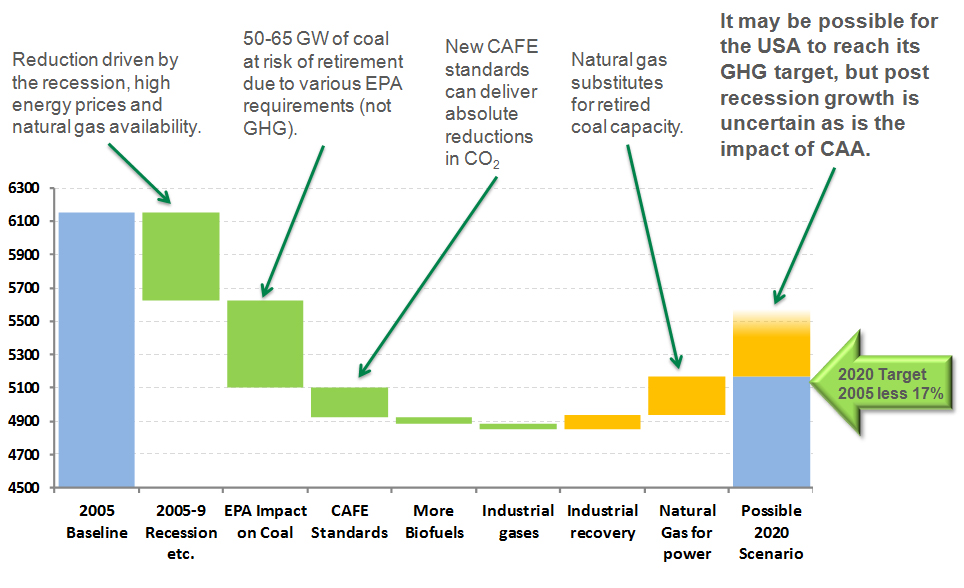
Given that the US Administration has lodged a commitment with the UNFCCC to reduce US emissions by 17% by 2020 (relative to 2005), the question remains as to how this might be accomplished. Clearly there is no overall national plan or legislative approach, which therefore means the Administration is largely relying on a range of existing serendipitious (from a CO2 perspective) policies, state action such as in California and possibly some good fortune (e.g. the dash to gas now taking place as shale gas production increases) to achieve the goal. In a recent post prompted by the remarks of the US Ambassador to Australia that it was “absolutely realistic” to believe the US would meet its target, I estimated that it was theoretically possible for this to be true, based primarily on natural gas backing out coal in the power generation sector and revised CAFE standards reducing consumer gasoline demand. 

Since then the Administration has reached agreement with the vehicle manufacturers on even tougher CAFE standards, as announced at the end of July.

 JULY 29th 2011, WASHINGTON, DC – President Obama today announced a historic agreement with thirteen major automakers to pursue the next phase in the Administration’s national vehicle program, increasing fuel economy to 54.5 miles per gallon for cars and light-duty trucks by Model Year 2025. The President was joined by Ford, GM, Chrysler, BMW, Honda, Hyundai, Jaguar/Land Rover, Kia, Mazda, Mitsubishi, Nissan, Toyota and Volvo – which together account for over 90% of all vehicles sold in the United States – as well as the United Auto Workers (UAW), and the State of California, who were integral to developing this agreement.

This therefore seemed like a good opportunity to do a bit more analysis of the third green bar on the diagram above which represents the potential drop in CO2 emissions in the transport sector. The focus below will only be  on cars and light trucks (i.e. largely households and small businesses), but of course further opportunity also exists with the recently announced proposal for trucks.

August 9th, 2011 Bloomberg – U.S. truck makers will improve tractor-trailer fuel economy by about 20 percent by 2018, saving $50 billion in fuel costs over five years and decreasing carbon- dioxide emissions, President Barack Obama said. The administration’s plan – the first attempt to regulate the efficiency of heavy-duty trucks, including city buses and garbage trucks — will save 530 million barrels of oil, according to a statement from the White House today.

Our model assumes the rigid application of the new CAFE standards through to 2025, but based on the EPA “Window Sticker” numbers which more closely reflect what a given vehicle might actually achieve when in service. For example, instead of using the CAFE standard for cars in 2025 which ranges between 46 and 61 mpg, we used 38.5 mpg and similarly for light trucks (30 mpg vs. CAFE range of 30-50 mpg). We have also assumed a total fleet growth over the period 2010 to 2025 from some 250 million to nearly 300 million vehicles, but have kept miles driven per vehicle a constant at just over 11,500 per annum. The model scraps at the oldest (and least efficient) end of the fleet and starts from 1990 where we assumed a homogenous fleet. The model does not currently include biofuels or the impact of electrification, so this is purely the impact of CAFE on a standalone basis.

Starting in 2009 with total fleet CO2 emissions at 100, the model shows that by 2020 emissions have fallen to 85, and then 75 by 2025. Our calculated fleet emissions for 2009 are 1.21 billion tonnes CO2 (vs. IEA 1.45 billion tonnes for all road transport, including trucks and buses, in 2008), so this change represents a reduction by 2020 of 180 million tonnes of CO2 per annum against a US total GHG emissions of some six billion tonnes per annum in 2005.

This matches well with the original assumptions in the chart above. As noted in the original post, this is an important contribution to US emission reduction efforts between now and 2020.

Thanks to my colleague Alex Ratcliffe for developing the supporting spreadsheet.

  • Carbon capture & storage
  • Low carbon economy
  • Policy

Six topics for the candidates

dchone August 18, 2011

As the US heads into the process of electing its next President, many subjects and issues will be debated. While climate change may not be the defining issue of the moment in the USA, given the long term importance of the subject it would be useful to understand how the various candidates for office might seek to shape the energy and climate policy landscape through this decade. The climate issue will almost certainly come back to confront a President in office through to 2017 and is probably inescapable for a  candidate with ambition to serve through to 2021.

Six areas of discussion and debate that could be on the agenda over the coming year would ensure both a better understanding of the subject and the range of potential policy directions that might be pursued by the next President;

Carbon pricing:

Many economists have said that the most effective way of beginning the long and complex task of managing carbon dioxide emissions is to put a price on the right to emit CO2 from power stations, industrial sources and transport. Although carbon pricing exists in some ares under regional and state based systems, a consistent national approach has yet to be developed.

Energy options:

Over the past decade the US has developed a major biofuels industry, become a leader in wind power deployment and significantly increased natural gas production. More recently new vehicle CAFE standards have been agreed. All of these offer real opportunity for significant emissions reduction, but need to be part of a broader energy policy framework that includes emissions management as an objective. The United States has already indicated its intention through the UNFCCC to reduce its greenhouse gas emissions by 17% by 2020 relative to 2005 and these options, if managed within the context of this goal, offer the possibility of success.

International positioning:

As a major current emitter and the largest cumulative historical emitter, it is important that the United States (with the EU, Canada, Australia, China, Japan and others) lead on the global task of managing CO2 emissions. But going it alone (or in a small club) isn’t a sustainable outcome. The USA will need to work with partners such as the EU and China to encourage and ultimately ensure global participation in the task of emissions reduction.

Technology policy:

Technology will play a long term role in the management of emissions. This will include scaled up use of technologies that the US already has experience with such as wind, biofuels and nuclear, together with new energy technologies such as solar and carbon dioxide capture and storage. New policies will be required to promote the development, demonstration and deployment of these and other technologies and to grow the technical skill base required to support this endeavor.

Looking beyond 2020:

With the 2020 energy picture now taking shape, longer term objectives need to be considered to ensure investment decisions made over the coming decade are compatible with the desired direction for 2030 and beyond. For example, should the USA have a recognized policy goal to reduce carbon dioxide emissions very substantially (this means something like an 80% reduction) over the first half of this century?

Adaptation:

Extreme  weather events of recent years and current heat and drought extremes have at least demonstrated that a considerable response effort would be required should  climate trends result in an increased frequency and / or intensity of such events. Sea level change may also pose a challenge for some areas as we head towards the middle of the century. Although the USA has a considerable response capacity, there is merit in beginning to fashion a more robust policy approach to physical climate change.

  • Emissions Trading
  • Europe

Further thoughts on an EU ETS set-aside

dchone August 11, 2011

After a post-recession recovery to some €17, EU-debt driven jitters have hit the EU ETS and in recent days it has fallen close to €10 per tone of CO2. Some market watchers have praised this as indicative of a system which is responsive to the underlying condition of the economy as a whole, but the reality for investors and energy companies trying to develop low emission projects and strategies is a much more challenging business environment. Does this mean that the ETS is reacting as it should or failing to do it’s job?

There is no doubt that the ETS will deliver on its part of the EU 2020 goal to reduce emissions by 20% across the economy as a whole, so in that sense we should consider it to be a success. But arguably the system has a more important goal, namely the delivery of a power sector heading towards zero emissions – a fundamental part of an economy intent in reducing emissions by at least 80%. This means that the ETS should be driving fuel switching, encouraging the development of CCS and supporting the resurgent nuclear industry. At the moment it is struggling to do any of these things.

A few weeks back I put forward a case for setting aside allowances in Phase III of the ETS as a means of supporting the price. The first airing of this idea at the EU Council of Ministers wasn’t a great success, but it has appeared again within the recently proposed Directive on Energy Efficiency, although this time specifically linked with the impact of that particular Directive:

“. . . . . including recalibrating the emissions trading system by setting aside a corresponding number of allowances from the part to be auctioned during the period 2013 to 2020, should a corresponding political decision be taken.”

So it would appear that the notion of recalibration is alive, although its implementation in practice remains somewhat distant. In thinking further about the case for correction, it is worth looking back to a document which started much of the thinking about measurement and reporting on emission reduction pledges, the WRI / WBCSD Greenhouse Gas Protocol.

The Protocol has now been used by companies for over ten years as a guide for measuring and reporting on corporate emissions. It sets out the rules for the scope of a measured system and guides the user on correcting the baseline when changes occur. This latter practice ensures that emission reductions are real and constitute actual environmental improvement rather than simply being a result of a change in structure of the company reporting its emissions.

The issue of real environmental improvement now faces the EU ETS. The 2020 target now looks as if it will be met largely because of the result of a macro economic shock to the system. The recession has had the effect of changing the shape and structure of the covered sector, to the extent that compliance with the target is now almost a given. As noted above, reductions from major projects and real change will be limited.

This is where the GHG Protocol comes in. If the Protocol was the complete guide to managing this system, it would potentially call for a change in the original baseline emissions as a result of the changes seen in Europe over recent years. The only way of implementing such a change in the ETS is to withdraw or set aside some of the allowances in the system.

The challenge remains to provide a clear quantification of this, a task much more complex for the ETS than a company correction to its baseline. Current estimates argue for something over one billion allowances being removed from Phase III, although in the case of the ETS any actual set aside number will be as much a political agreement as anything else.

A correction will support the carbon price and more importantly give confidence to investors that the Commission is prepared to stand behind the market it has created, ensuring that it is the investment driver for emissions reduction in Europe and not just an annual compliance mechanism.

Posts pagination

Previous 1 … 38 39 40 … 54 Next
Shell Climate Change
Contact / Proudly powered by WordPress Theme: Booklet.
 

Loading Comments...